Perception and Readiness of Pre-service Teachers on Mobile Learning
Ahmad Sobri Shuib¹, and Muhammad Nidzam Yaakob²
¹Head, Department of Research and Innovation in Teacher Professionalism, Institute of Teacher Education, Darul Aman Campus, Malaysia, [email protected]²Academic lecturer, Ministry of Education Malaysia, Malaysia, [email protected]
Abstract
Developments in mobile technology have changed the way people learn. Learning is not confined in the classroom alone; it could also occur beyond the boundaries of the classroom and can happen anytime and anywhere. The current generation of students has greater access to knowledge through their mobile devices. Thus, innovation on pedagogy must change along with the changes in technology. The ability of mobile learning to deliver knowledge should be fully utilized by teacher educators when implementing teaching and learning in the classroom. The purpose of this study was to identify the perceptions and willingness of pre service teachers on the use of equipment and mobile technology in learning. Preliminary data obtained in this study provide useful information for the implementation of teaching and learning at the Institute of Teacher Education Campus management. The sample in this study was a randomly selected group of 120 pre-service teachers studying Bachelor of Teaching at the Institute of Teacher Education, Darul Aman Campus. Data were analyzed using descriptive analysis using SPSS 19. The study found that pre- service teachers have a positive attitude towards the use of mobile technology in learning. The findings of this study provide teacher educators with useful information when it comes to diversifying their teaching by integrating mobile devices in teaching and learning at the institute.
Keywords: mobile learning, pre service teacher, teacher education.
Introduction
From toddlers to seniors, an increasing number of people are now connected and digitally communicating with each other in ways that would have been impossible to imagine only a few years ago. Students today are exposed to smartphones -- an advanced technology that is more powerful than the classroom computer. They are experiencing technology that shapes the way they interact with information and other people from around the world. They experience at school and reflect their experiences outside of school.
The Concept of Mobile Learning
In early researches, the concept of mobile learning was strongly linked to the device (Sharples, et.al., 2002) and the potential for enabling lifelong learning (Sharples, 2000). However, it soon became clear that the device and focus should be on the mobility of the learner. This led to considering mobile learning from the learner’s perspective, and to the definition that: “Any sort of learning that happens when the learner is not at a fixed, predetermined location, or learning that happens when the learner takes advantage of learning opportunities offered by mobile technologies” (O’Malley et al., 2003).
Current studies (Sharples, 2005; Taylor, et. al., 2006) are exploring the notion of learning in the mobile age to develop a theory of mobile learning that builds on Engeström’s conceptualization of the Activity Theory and Laurillard’s (2002) Conversational framework. The focus of their work is on mobile learning as a form of communication in its context. Current perspectives on mobile learning generally fall into the following four broad categories (Winters, 2006):1) Techno-centric is the mobile learning that is viewed as ‘learning using a mobile device, such as a PDA, mobile phone, iPod, Play Station Portable, etc.; 2) Relationship to e-learning is a perspective that characterises mobile learning as an extension of e-learning. These definitions are often used all-inclusive and do not help in characterising the unique nature of mobile learning; 3) Augmenting formal education. In the mobile learning literature, formal education is often characterised as face-to-face teaching, or more specifically, as a stereotypical lecture. However, it is not at all clear that this perspective is wholly correct. Forms of distance education (for example, distance correspondence) have existed for over 100 years, leading to questions regarding the place of mobile learning in relation to all forms of “traditional” learning, not only the classroom; 4) Learner-centred. A strong linage of research into conceptualising mobile learning is race able by reviewing the combined works of Sharples, Taylor, O’Malley and their colleagues.
Koole’s FRAME Mobile Learning Framework (2009)
The mobile learning model which makes the most sense is Koole’s Model for Framing Mobile Learning (2009). The model is called FRAME: that means ‘Framework for the Rational Analysis of Mobile Education’.
Figure 1
Koole’s Model for Framing Mobile Learning (2009)
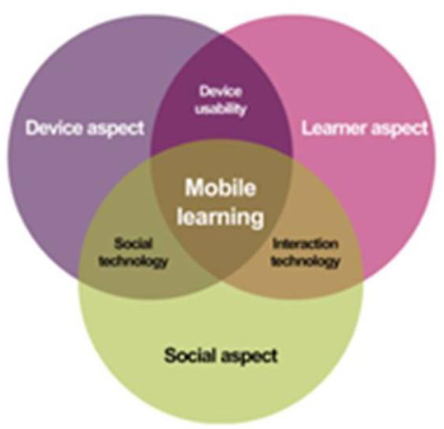
Reprinted from “A Model for Framing Mobile Learning” by M. Koole, 2009, Mobile Learning: Transforming the Delivery of Education and Training, Vol. 1, pp. 25-47. Copyright (2009) by Edmonton, Alberta: AU Press
The Framework for the Rational Analysis of Mobile Education (FRAME), is a model that describes mobile learning as a process resulting from the convergence of mobile technologies, human learning capacities, and social interaction. It addresses contemporary pedagogical issues of information overload, knowledge navigation, and collaboration in learning. This model is useful for guiding the development of future mobile devices, the development of learning materials, and the design of teaching and learning strategies for mobile education (Kool, 2009)
Literature Review
Perception Survey of Mobile Learning
A study by Pollara & Kee Broussard (2011) on 54 studies relating to this perception of mobile learning found that 17 studies are producing positive perceptions on mobile learning. Yaneli Cruz, Saïd Assar & Imed Boughzala (2012) performed a study on 14 teachers about their perceptions on mobile learning. The study found that the participants provided a deep understanding of mobile learning opportunities such as availability, interactive environment, and improved communication embedded in everyday activities. The participants are also aware that the current teaching practices, including accessing relevant information, sorting materials, encouraging reflection, and creating interactive activities with timely feedback, have changed in the mobile environment. A number of universities in Australia are training teachers on using mobile devices particularly ipads as aid in professional learning, especially math. This study found that student teachers showed a positive attitude towards the use of mobile devices to assist learning.
Studies Related to Implementation of Mobile Learning in Malaysia
Over the past 10 years, research in mobile learning has evolved from a small research based on interest to achieve significant research in schools, institutions of higher education, the workplace, and so on around the world. In countries such as South Korea wherein there’s strong internet infrastructure, the use of mobile devices such as smartphones and tablets is common. This makes learning with mobile devices in schools possible. In Korea, mobile learning is still at a nascent stage but has a bright future (Young-Kyun Baek Dong-Uk &Chang, 2005). The scenario is almost the same as in Malaysia, because Malaysia’s infrastructure for Internet is quite good and stable, and the use of mobile devices is also widespread among Malaysians, from secondary school students through to pensioners, farmers, and even fishermen. Thus, the development of mobile learning in Malaysia is not impossible.
Among the earliest studies in the field of mobile learning in Malaysia is the study of the evaluation of the implementation of mobile learning programs to students standard 5 (11 years age) at an elementary school in Kuala Lumpur (Saedah Siraj and Norlida Elias, 2005). The purpose of the study was to investigate whether the implementation of mobile learning program achieved the aspirations set on it and also to assess the strengths and weaknesses of the program. The respondents were supplied with a laptop and wireless environment. Based on Stake’s Countenance Evaluation Models (SCEM), the study interviewed students during, before, and after the implementation of usability evaluation. The study found that the implementation of mobile learning have been set to achieve it. The study also found that the mobile learning program has many strengths as well as some weaknesses.
The Open Universiti Malaysia (OUM) is among the earliest universities to implement mobile learning through their learning system. OUM has implemented a pilot project on mobile learning via short messaging service (SMS) to the students of distance education from their bachelor’s degree for six consecutive semesters in May 2009 to January 2011.Tina Lim, Mansor Fadzil, and Norziati Mansor (2011) in their study of the implementation of mobile learning initiative at OUM found that students appreciate the text and felt that the SMS has helped them to stay focused on their studies. SMS was also found to be useful in providing important information related to the course. Moreover, in general, students agreed that the SMS system allows them to learn at anytime and anywhere, and helps them manage their studies better. Each semester, more than 95% of the involved students expressed their desire for mobile learning via SMS be extended to other courses as well.
Md Yusof, Nurzawani (2007) developed a prototype application for mobile learning through learning of science subjects from two secondary schools. The analysis of the use of mobile learning prototype application indicated that the application was received by the students as a means of supporting them in learning science subjects. Students say that learning through mobile applications is exciting and that it gives them a learning experience in a new environment where they can learn science through a Personal Digital Assistant (PDA).
Studies Related to Implementation of Mobile Learning in Other Countries
Durdyyev (2012) developed a software for teaching mathematics through smart phones using Android OS. The successful development of the application has received a positive response from the respondents and they were very satisfied with the system. Developments in mobile technology now also change the pattern of learning (Naismith, Lonsdale, Vavoula, & Sharples, 2004). Learning is not only focused in the classroom, it can also occur anywhere and anytime using mobile devices and is supported by mobile technology.
Research has shown the very effectiveness of mobile learning in teaching and learning. A study by Saran, Cagility, and Seferoglu (2008) found that mobile learning has increased the English skills of students through the use of multimedia. The motivation of the students to learn English has increased since they can use their free time to learn English. The study also found that the use of SMS and MMS is effective in enhancing student vocabulary. Mobile learning was also found to be effective for teaching and learning for activities outside of the classroom that involve collection of field data such as bird observation activities (Chen, Kao, & Shen, 2003) and study visits (deCrom & de Jager, 2005).
Although mobile learning was proved to be a significant success when used for teaching to students who are not able to read and write (Collet & Stead, 2002; Traxler, 2002), mobile learning is still in its early stages in either Europe or Malaysia. Although there are many studies in Europe and in Asia, these only focused on the digital functions of a mobile device (Pownell & Bailey, 2001; Savill– Smith & Kent, 2003; Vahey & Crawford, 2002) and were performed by giant telecommunication companies such as Ericsson, Apple, Intel, and Sun for the purpose of trade and commercial competition. In addition, there are also studies that focus on the effectiveness of a tool in providing learning activities such as mini quiz (Montanaro, 2012 ) as well as courses and online training for professionals (Burke et al., 2005). There are also researchers who focus their study on the use of devices such as handheld computers only (M–Learning Project, 2005; MOBIlearn Project, 2005, Chen, Kao, & Shen, 2003; Becta Report, 2005). However, studies of mobile learning in the field of teacher education are rather lacking. Hence, this study is important in serving as initial data for the implementation of mobile learning initiatives in teacher education institutes in Malaysia. This study is also significant in terms of seeing up to what extent the potential of mobile learning can flourish in teacher education in Malaysia. The findings could also help the Ministry of Education to improve the technology infrastructure in educational institutions as well as to provide more teachers with many mobile devices and implement specialized training for teachers.
Research Objective
The objective of this study was to identify the perceptions and willingness of pre-service teachers on the use of equipment and mobile technology in learning.
Research Question
- What is the pre-service teachers’ readiness to use mobile devices for learning?
- What is the pre-service teachers’ perception to use mobile devices for learning?
Research Methodology
Sample
The sample in this study was a group of 120 pre-service teachers studies Bachelor of Teaching at the Institute of Teacher Education Campus Darul Aman. They were randomly selected. They are prospective elementary school teachers. The actual population of the students Bachelor of Teaching semester 8 is about 150 people (of which 30 of them had been taken as a pilot study sample). Thus, the study sample represents 86% of the total population of students taking up Bachelor of Teaching at Teacher of Education, Darul Aman Campus.
Instruments
Questionnaires were used to collect data as the study was designed in the form of reviews. Questionnaires fulfil the objective of seeing the overall pattern of readiness and perceptions of the respondents on the variables, as stated in the study objectives. The instrument in this study is an adaptation and modification of the study by Rashidah Bt Rahamat, Parilah M. Shah, Rosseni Din & Juhaida Bt Bt Abdul Aziz (2011). In this study, the questionnaire consists of two parts. Part A contains sample demographic information while section B contains 20 items regarding preparedness and perceptions of learning mobile learning. The instrument consists of a five-point Likert-scale. The respondents should choose the most appropriate answer from the choices.
The Pilot Study, Validity, and Reliability
To measure the liability of the items used in the questionnaire, 30 students (who were not involved in this study) have been selected in the pilot study. According to McDermoott and Sarrela (1996), the sufficient number of respondents to be used in the pilot study is usually not less than 20 people. Analysis of the reliability of the survey instrument showed a Cronbach Alpha value of 0.86. Values above 0.80 have high reliability (Mohd Najib Abdul Ghafar, 1999). To ensure the validity of the questionnaire constructed, experienced lecturers were referred to give response to the questionnaire content. In addition, some students were asked to assess the suitability of the item with the objectives of the study.
Findings
Data analysis was based on demographics and research question.
Analysis of Sample Demographic
This report analyses the gender and race of the respondents. Frequency counts (in percentage) were used to analyze the demographic background of the respondents. Analysis of the background data of the study are shown in Tables 1 to 3.
Table 1 shows that the number of female respondents (69.2%, n= 83) is larger than that of the male respondents (30.8%, n=37). This is in line with student enrolment in semester 8 where the number of enrolled female students is larger than that of the enrolled male students.
Table 1
Distribution of Sample by Gender
| Gender | Frequency | & |
|---|---|---|
| Male | 37 | 30.8% |
| Female | 83 | 69.2 |
| Total | 120 | 100 |
Table 2 shows the distribution of the sample in terms of race. Malays (83.3%, n=110) has the highest number, followed by the Chinese (14.4%, n= 19), Indians (0.82%, n=1), and other races (1.5%, n=2).
Table 2
Distribution of Sample by Race
| Race | Frequency | % |
|---|---|---|
| Malays | 96 | 80 |
| Chinese | 21 | 17.5 |
| Indians | 1 | 0.8 |
| Other | 4 | 1.7 |
| Total | 120 | 100 |
Table 3 shows the distribution of the sample according to their major courses. Most of the respondents is majoring in Special Education (Learning) with a frequency count of 27.5% (n =33), while the fewest is majoring in Physical Education and Health (9.2%n=11.)
Table 3
Distribution of Sample by the Major Courses
| Major Course | Frequency | % |
|---|---|---|
| SE (Remedial Education) | 30 | 25 |
| SE (Learning Disabilities) | 33 | 27.5 |
| Science | 14 | 11.7 |
| Mathemathic | 16 | 13.3 |
| Physical Education | 11 | 9.2 |
| Islamic Study | 16 | 13.3 |
| TOTAL | 120 | 100% |
Table 4 shows the phone models used by the respondents. In descending order, the cellphone brands widely used by the respondents are: Samsung 39.2% (n =47); Nokia 20% (n = 24) and Sony 18.3% (n =22).
Table 4
Model Held Cell Phones
| Handphone Model | Frequency | % | N |
|---|---|---|---|
| Nokia | 24 | 20 | 120 |
| Sony | 22 | 18.3 | 120 |
| Samsung | 47 | 39.2 | 120 |
| Motorola | 0 | 0 | 120 |
| CSL | 2 | 1.7 | 120 |
| Blackberry | 1 | 0.8 | 120 |
| iPhones | 7 | 5.8 | 120 |
| LG | 1 | 0.8 | 120 |
| Sharp | 0 | 0 | 120 |
| Panasonic | 0 | 0 | 120 |
| China Model | 0 | 0 | 120 |
| Siemen | 0 | 0 | 120 |
| Others Model | 16 | 13.3 | 120 |
Table 5 shows that the most common activity performed by the respondents through their mobile devices is to send SMS 99.2% (n = 119). This is followed by making calls 90.8% (n = 109), sending MMS 79.2% (n = 95), and taking pictures 66.7% (n = 80).
Table 5
Activities Common Using Mobile Devices
| Activities | Frequency | % | 120 |
|---|---|---|---|
| Make a call | 109 | 90.8 | 120 |
| Sent SMS | 119 | 99.2 | 120 |
| Sent MMS | 95 | 79.2 | 120 |
| Login social network | 61 | 50.8 | 120 |
| Take a picture | 80 | 66.7 | 120 |
| Record sound/voice | 38 | 31.7 | 120 |
| Browse internet | 70 | 58.3 | 120 |
| Sent e-Mel | 16 | 13.3 | 120 |
| Read e-Mel | 29 | 24.2 | 120 |
| Other activities | 10 | 8.3 | 120 |
This section seeks to answer research question 1: What is the pre service teachers’ readiness to use mobile devices for learning?
Table 6 shows the willingness of the students to use mobile devices for learning. The respondents showed a high response rate (mean = 4.1, SD=07) on using mobile devices for learning.
Table 6
Availability Using Mobile Devices to Learning
| No. | Subject | Mean | SD |
|---|---|---|---|
| 1. | Ready to learn at anytime and anywhere using mobile devices (e.g. cell phones, smart phones, Tablet PCs, iPad, iPod, etc.) | 3.9 | 0.9 |
| 2. | Ready to do enrichment activities while waiting for the bus/parents/friends | 3.6 | 1.0 |
| 3. | Ready to use my phone as a learning tool | 3.9 | 0.9 |
| 4. | Ready to use other mobile devices (e.g. cell phones, smart phones, Tablet PCs, iPad, iPod, etc) as a learning tool | 4.1 | 0.7 |
| 5. | Ready to use learning packages for science education (EDU paper) if it was designed in portable media | 3.9 | 0.8 |
| 6. | Ready to keep course materials such as slides, lecture notes, practice questions, quizzes in the mobile phone because it would benefit my learning process | 3.9 | 0.9 |
| 7. | Preparing my personal time in installing software that allows learning resource materials (e.g. slides, lecture notes, practice questions and quizzes) which can be used in mobile phones | 3.7 | 0.9 |
| 8. | Ready to buy a new mobile device because it will improve the performance of my learning at the Institute of Teacher Education | 3.6 | 0.8 |
This section seeks to answer the second research question: What is the perception of pre service teachers on using mobile devices for learning?
As shown in Table 7, the highest mean is the willingness of students with smart phones to access the internet to find information (Mean = 4.4; SD = 0.7). The other items that have a high mean is, using smartphones to download educational materials (Mean = 4.1; SD = 0.8) and using smartphones to check social sites (Mean = 4.2; SD = 0.8).
Table 7
Perception on Using a Smart Phone to Learn
| No. | Subject | Mean | SD |
|---|---|---|---|
| 1 | Using smart phones to download entertainment materials such as songs, movies, videos and games | 3.8 | 1.0 |
| 2 | Using smart phones to download educational materials such as dictionaries and mobile educational games | 4.1 | 0.8 |
| 3 | Using smartphones to browse the internet in looking for information | 4.4 | 0.7 |
| 4 | Using smartphones to log in to social networking sites like Facebook, Twitter, Yahoo Messenger, Friendster, and so on | 4.2 | 0.8 |
As shown in Table 8, the highest mean is the willingness of the students to have a laptop to access the internet in finding information (Mean=4.7; SD=0.5). Other items that have a high mean is using a laptop to download educational materials (Mean =4.5; SD=0.7) and using a laptop to login at social sites (Mean =4.5; SD=0.6).
Table 8
Perception on Using Laptops for Learning
| No. | Subject | Mean | SD |
|---|---|---|---|
| 1 | Using laptop computers to download entertainment materials such as songs, movies, videos, and games | 4.2 | 1.0 |
| 2 | Using laptops to download educational materials such as a portable dictionary and educational games | 4.5 | 0.7 |
| 3 | Using a laptop to surf the internet to find information | 4.7 | 0.5 |
| 4 | Using a laptop to login at social networking sites like Facebook, Twitter, Yahoo Messenger, Friendster, and so on | 4.5 | 0.6 |
As shown in Table 9, the highest mean is the willingness of the students to use tablet computers in accessing the Internet to find information (Mean =4.5; SD=0.7). Other items that have high mean is using tablet computers to login at social networking sites (Mean =4.3; SD=0.7) and using tablet computers to download educational materials (Mean = 4.2; SD=0.7).
Table 9
Perceptions on Using Tablet Computers to Learning
| No. | Subject | Mean | SD |
|---|---|---|---|
| 1 | Using tablet computers to download entertainment materials such as songs, movies, videos, and games | 3.9 | 0.9 |
| 2 | Using tablet computers to download educational materials such as dictionaries and mobile educational games | 4.2 | 0.7 |
| 3 | Using the tablet computers in browsing the internet to find information needed | 4.5 | 0.7 |
| 4 | Using a tablet computer to log in to social networking sites such as Facebook, Twitter, Yahoo Messenger, Friendster, and so on | 4.3 | 0.7 |
Discussion and Implications of the Study
The results showed that all of the respondents have their own mobile devices, especially cellphones. In fact, most of them have more than one mobile phone, and majority of the cellphones they own has to the ability to access the internet. This scenario is an important indication of the possibility of using mobile learning in teaching and learning. Malaysia has good infrastructure facilities, comparable to other developed Asian countries such as Korea and Japan. Extensive usage of Wi-Fi facilities either in schools, higher education institutions, or public places would allow easy access to the internet. This will enable students to perform a variety of activities with their mobile devices, particularly their mobile phones, tablet computers, and laptops.
This study clearly shows that students have a high level of readiness in using mobile devices for learning. This study has found that the majority of students are willing to use learning materials which can be downloaded on mobile devices. Portable learning materials such as mathematical softwares (Durdyyev, 2012), quizzes (Montanaro, 2012), or English treasury (Song & Fox, 2008) is very interesting and the students have agreed that these have a positive impact on teaching and learning.
The results showed that the level of preparedness of the students in the use of mobile devices for learning is above 80%. Students have a high level of readiness to learn anytime and anywhere as well as to perform a variety of learning activities such as when they are outside waiting for the bus, a friend, or at any leisure.
Overall, this study shows positive perceptions among students when it comes to mobile learning. They showed a positive response in using their mobile devices for learning in particular. The results showed that aside from using mobile devices for entertainment and social networking, the students also preferred to accommodate learning materials with mobile devices like cellphones, laptops or tablet computers. This is a good sign in the development of mobile learning in Malaysia.
Today’s learning materials for mobile learning is still lacking. Not many institutions are implementing mobile learning initiatives. If there is, the usage is rather limited. Among the institutions supporting the mobile learning initiative is the Open University Malaysia (OUM) or other institutions such as the Malaysian Smart School. OUM has been using mobile learning initiatives, particularly for management and very little learning-related activities. Similarly, there is also a smart school but more mobile initiatives such as presence management or get the marks of students.
For institutions to implement programs or curricula through mobile devices, Bora & Dhumane (2012) states that there are four criteria to be considered when mobile learning is to be included in main stream education:
- List of the courses that lean initiatives mobile learning in formal educational institutions prospectus. It is important to incorporate mobile learning into education and training.
- Cheaper charged tuition fees. Some countries charge tuition fees for enrolment in advanced courses and higher education.
- The course is assessed as the other courses. If mobile learning courses are not evaluated with the same methods and procedures as the other courses offered by the institution, they cannot be considered as part of mainstream education and training.
- The courses that have achieved accreditation. It is important to incorporate mobile learning into the mainstream. Like distance education and e-learning, accreditation of mobile learning is an indication that the sector has entered into the mainstream.
In Malaysian institutions such as the Royal Malaysian Police (RMP), Road Transport Department (RTD), and other educational institutions, mobile learning initiatives are being used in managing results or the results of the interviews and the like. The use of mobile learning in teacher education institutions are lacking.
Today’s generation of students is very enthusiastic with their mobile devices which can always surf the Internet at any time through wireless technology. But nowadays, cellphones are not allowed to be brought to school due to fears of having the process of teaching and learning be disrupted by these devices. However, a number recent studies show that mobile devices like cellphones can serve as useful and effective learning tools (Hyo-Jeong So, Vosloo & West, 2012). These devices open up the possibility of allowing teachers and students to interact in a two-way learning process.
The use of mobile learning is not official or in indirect method only. For example, students contact lecturers via sms or whatsApp or phone call to get information about learning, problem assignments, and so on. During lecturers in lecture halls, there are students who surf the internet to read related topics, download material from YouTube, find the meaning of specific terms, or find exercise questions. These conditions of mobile learning actually occur indirectly. Only that, the less there is at present, is the design of formal learning and specific learning materials at the Institute of Teacher Education is still lacking. The adoption of mobile learning is not widely used as a method in teaching and learning.
Conclusion
The implementation of mobile learning in education in Malaysia is not impossible. In fact, the implementation of a mobile learning initiative at the Institute of Teacher Education is something that should be given due attention by various parties. Mobile learning should be encouraged to take place in a classroom setting like how e-learning was received and given credit by the education system before.
Mobile devices have taken over the role of desktop computers and e-learning technologies. Through a mobile learning initiative, millions of dollars can be saved since less electricity, less special laboratory exercises, and less network cables are used.
Universities and colleges can use mobile learning initiatives on matters related to management. For example, they can use mobile learning as a means of communication with their students when making announcements such as schedule change, submission deadlines, registration procedures, and other administrative requirements.
Higher education institutions should move forward and develop training modules for smart phones, tablet PCs, iPad or iPod. Furthermore, a book on mobile learning needs to be written. In terms of technology, Internet access is a must for the implementation of mobile learning. To accommodate the over flow of data on educational websites, there is a need for high-speed wireless data transfer and it should beat a reasonable cost to the public.
References
Becta Report. (2005). Retrieved from http://www.becta.org.uk /research/reports/portableict.cfm
Bora, Shital P. & Dhumane, Pankaj B (2012). Mobile Learning: It’s Implication in Education and Training. Online International Interdisciplinary Research Journal, {Bi-Monthly}, ISSN2249- 9598, Volume II, Issue II, Mar-Apr 2012
Burke, M., Colter, S., Little, J., Riehl, J. (2005). Promote collaboration in field-based courses. Paper presented at 4th World Conference on Mobile Learning. Cape Town, South Africa.
Chen, Y. S., Kao, T. C., & Shen, J. P. (2003). A mobile learning system for scaffolding bird watching learning. Journal of Computer Assisted Learning, 19(3), 347-359.
de Crom, E. P., & de Jager, A. (2005). The “ME”-Learning experience: PDA technology and e-learning in ecotourism at the Tshwane University of Technology (TUT). Paper presented at 4th World Conference on Mobile Learning. Cape Town, South Africa.
Goda, G., Kogure, Y., Shimoyama, Y., Kimura, M., & Obari, H. (2008). Survey research on mobile phone market for mobile-learning in Japan. Paper presented at Fifth IEEE International Conference on Wireless, Mobile, and Ubiquitous Technology in Education (pp.194-195). Beijing, China.
Hyo-Jeong So, Vosloo & West (2012). Turning on Mobile Learning in Asia. UNESCO Report, Place de Fontenoy, Paris, SP. France.
Keegan, D. (2005). The incorporation of mobile learning into mainstream education and training. Paper presented at the 4th World Conference on Mobile Learning. Cape Town, South Africa.
Matthew Kearney & Damian Maher (2012). Mobile learning in maths teacher education: Driving pre-service teachers’ professional development. Retrieved from: http://acec2012.acce.edu. au/sites/acec2012.acce.edu.au/files/proposal/216/ACECpaperFINAL.pdf
Mc Dermoott, R.J. & Sarrela, P.D. (1996), Health Education Evaluation and Measurement: A Practitioner’s Perspective. 2nd Edition, New Jersey: Prentice Hall Englewood, h. 147-148.
Md Yusof, Nurzawani (2007). Mobile learning application for secondary students in science subject : A prototype for support and movement / Mobile learning application for secondary students in science subject: A prototype for support and movement / Nurzawani Md Yusof. Unpublished thesis, Universiti Teknologi MARA (UiTM). http://eprints.ptar.uitm.edu.my/1972/
M-learning project. (2005). Retrieved from http://www.m-Learning.org/
MOBIlearn project. (2005). Retrieved from http://www.mobilearn.org/
Montanaro, A. (2012). Implementing Mini Quizzes to Increase Student Learning for a Class Via a Mobile Learning Application. Master of Science Project, University of North Carolina Wilmington. Unpublished
Durdyyev, M (2012). Mobile Math learning application for children (Fun Math). Universiti Teknologi PETRONAS. Retrieved from http://utpedia.utp.edu.my/3875. (Unpublished)
Koole, M. (2009a). Chapter 2: A Model for Framing Mobile Learning. In M. Ally (Ed.), Mobile Learning: Transforming the Delivery of Education and Training (Vol. 1, pp. 25-47). Edmonton, Alberta: AU Press
Naismith, L., Lonsdale, P., Vavoula, G., & Sharples, M. (2004). NESTA Futurelab Report 11: Literature review in mobile technologies and learning. Bristol, UK: NESTA Futurelab. Retrieved from http://www.futurelab.org.uk.resources/documents/lit_reviews/Mobile_Review.pdf
Pollara, P. & Kee Broussard, K. (2011). Student Perceptions of Mobile Learning: A Review of Current Research. In Proceedings of Society for Information Technology.
Pownell, D., & Bailey, G. D. (2001). How to use rubric for implementing handheld computers: A tool for educational leader. Retrieved from http://educatorspalm.org.
Rashidah Bt. Rahamat, Parilah M. Shah, Rosseni Bt Din & Juhaida Bt Abd Aziz (2011). Students’ Readiness and Perceptions Towards Using Mobile Technologies for Learning the English Language Literature Component. The English Teacher Vol. XL: 69-84.
Saran, M., Cagiltay, K., Seferoglu, G. (2008). Use of mobile phones in language learning: Developing effective instructional materials. Paper presented at 5th IEEE International Conference on Wireless, Mobile, and Ubiquitous Technology in Education (pp.39-44). Beijing, China. doi. ieeecomputersociety.org/10.11.09/WMUTE.2008.49
Savill-Smith, C., & Kent, P. (2003). The use of palmtop computers for learning: A review of the literature. London, UK: Learning and Skill Development Agency.
Song, Y. & Fox, R. (2008). Using PDA for undergraduate student incidental vocabulary testing. ReCALL, 20, pp 290-314 doi:10.1017/S0958344008000438
Tina Lim, Mansor Fadzil, and Norziati Mansor (2011). Mobile Learning via SMS at Open University Malaysia: Equitable, Effective, and Sustainable. Mobile Learning via SMS-OUM. The International Review of Research in Open and Distance Education Learning, Vol 12, No 2 (Feb 2011). Open University Malaysia, Malaysia
Winters, N. (2006). What is mobile learning? In M. Sharples (Eds.), Big Issues in Mobile Learning (pp. 4- 8). Report of a workshop by the Kaleidoscope Network of Excellence, Mobile Learning Initiative. University Ofn Nottingham.
Yaneli Cruz, Saïd Assar, and Imed Boughzala, “Exploring Teacher’s Perception and Potential Use of Mobile Learning in a Business School” (July 29, 2012). AMCIS 2012 Proceedings. Retrieved from http://aisel.aisnet.org/amcis2012/proceedings/ISEducation/26
Young-Kyun Baek & Dong-Uk Cheong (2005). Present and Future for Mobile Learning in Korea. Proceeding of the IEEE International Workshop on Wireless and Mobile Technologies in Education (WMTE ’05).
International Journal on Open and Distance e-Learning, Vol. 1 No.1&2, December 2015 Issue