A Meta-Interpretation of Collaborative Learning Activities in an R&D Management Online Degree Program
Primo G. Garcia1, Jaine Cadoc-Reyes2 and Ellaisa Ruth B. Veluz3
1[email protected], 2[email protected], 3[email protected]Faculty of Management and Development Studies
University of the Philippines Open University
Abstract
Collaborative learning has been a commonly used instructional strategy in management education. To further understand the teaching and learning issues in adopting collaborative learning inOpen and Distance e-Learning (ODeL), this study adopted meta-interpretation to identify the themes that constitute learners’ views and experiences in the collaborative learning activities in two courses offered in the Diploma in Research & Development Management at UP Open University as reported in the literature, and from these, teaching and learning implications on collaborative learning in management in the ODeL environment were derived. The study also recommends some approaches to designing and delivering online collaborative learning in these contexts.
Keywords: Collaborative learning, WebQuest, Research and Development Management, meta-interpretation
Introduction
One of the professional management programs being offered at the University of the Philippines Open University (UPOU) is the Diploma in Research and Development Management (DR&DM). The DR&DM program is directed to provide and equip students with adequate skills and knowledge in planning Research & Development (R&D) programs, develop and promote technologies for utilization, and manage human and organizational relations in R&D systems. Moreover, it aims to enable students to formulate and implement R&D strategies and programs, apply new perspectives on R&D and on technology development; evaluation; promotion; and commercialization, conceptualize and implement commercialization and technology utilization schemes, and apply newly acquired skills in managing human and organizational relations in R&D systems.
The main goal of the program is to nurture professional managers and leaders in the field of R&D. Some DR&DM teachers have incorporated collaborative work in their courses, on the assumption that management itself is a relational practice (Gilbert, 2013, p. 26). A commonly used instructional approach in management education (Kimber, 2007), collaborative learning is found to be useful in enhancing and training professional managers since it is said to promote problem-solving, team building, verbal and numerical skills, social skills, and self-esteem, among others (Johnson, Johnson, and Smith, 2006; Kuh, Kinzie, Buckley, Bridges, and Hayek, 2007; Kimber, 2007).
Dillenbourg, Baker, Blaye, and O’Malley (1996), as cited by McInnerney and Roberts (2004), defined collaborative learning as “mutual engagement of participants in a coordinated effort to solve the problem.” McInnerney and Roberts (2004) defined online collaborative learning as a situation where “students learn primarily by communicating among themselves via the Internet”, and online cooperative learning, on the other hand, is a situation where “students are allocated to, and learn in, small groups and communicate within those groups via the Internet”. While there have been numerous studies on collaborative learning in management education in residential settings (Johnson, Johnson, and Smith, 2006), the empirical work on online collaborative learning in management programs has remained relatively scant. This study hopes to contribute to filling in this gap by examining the experiences of the learners in two collaborative learning activities conducted in two separate courses in the DR&DM program–R&DM220 (Organizational Structure, Relations, and Processes in R&D Systems) and R&DM251 (Technology Evaluation).
This paper aims to explore the recurring themes that constitute learners’ views and experiences in the case study entitled “Alligator Story” undertaken in R&DM220 and WebQuest undertaken in R&DM251, as reported in the literature . From these themes, the study shall also derive teaching and learning implications on collaborative learning in management in the ODeL environment. By unpacking the recurrent themes on the learners’ experiences, the study can provide some insights on the role of collaborative learning in management education, in general, and R&D management, in particular.
Review of Related Studies
Collaborative Learning1
The terms “collaborative learning” and “cooperative learning” are often used interchangeably even though they pertain to different ideas. According to Bernard, Rubalcava, and St. Pierre (2000), collaborative learning differs from cooperative learning as the latter usually refers to a situation where a task is divided and distributed among group members and each member contributes to constructing one final product. On the other hand, collaborative learning refers to a situation where mutual discussion, active processing of information, analytical and critical thinking, and synthesis of the whole process is present (Bernard, Rubalcava, and St. Pierre, 2000 ).
Group diversity has an adverse positive effect on the learning process of the students as they are exposed to the different perspectives, knowledge, and experiences of their co-learners (Gokhale, 1995). On a similar note, Vygotsky (1978), believes that students perform exceptionally well when working in the collaborative learning medium rather than when working on their own.
Furthermore, it has been demonstrated in Gokhale’s (1995) study on the relationship of collaborative learning and critical thinking that collaborative learning “provided students with opportunities to analyze, synthesize, and evaluate ideas cooperatively.” Moreover, it was investigated that collaborative learning enhances critical thinking through “discussion”, “clarification of ideas”, and “evaluation of others’ ideas”.
Collaborative Learning in ODeL
Previous studies have reported the effectiveness of collaborative learning activities in an online environment. According to Bates (2015), online collaborative learning enhances learners’ critical thinking, analytical thinking, synthesis, and evaluation skills through knowledge construction resulting from intellectual discourse among students.
Stacey (1999) reviewed several literature focusing on online collaborative learning and found evidence that the interactive nature of collaborative learning has the ability to “change the nature of distance education from an autonomous, isolated experience to a potentially social constructivist environment”. Moreover, her study highlighted the following attributes of knowledge construction through collaborative learning: clarification of ideas via group communication, obtaining feedback to a learner’s ideas from other group members, sharing diverse perspectives of group members, group sharing of resources, ideas, and expert advice, seeking group solutions for problems, power of group discussion mediated by communications media, practicing the new language of the knowledge community in small groups, learning a safe setting for risk, providing socio-affective collaborative support, providing technical support collaboratively, planning to continue group beyond the course, using group responsibility as an individual motivator, changing roles with changing needs, using conferences to manage group activities, and effects on student outcomes.
A study conducted by Thompson and Ku (2006) highlighted graduate students’ experiences and attitudes in online collaborative learning in an instructional design course. The research findings of the study showed the major challenges faced by the students, as well as ways on how they overcame these challenges, the relationship of the degree of collaboration and quality of their projects, and their attitudes towards collaborative learning. Thompson and Ku (2006) concluded that groups who had a positive approach in group work were more collaborative, which resulted in a better quality of their group projects.
Methods
To gain an understanding of the learners’ views and experiences in the two learning activities, the study adopted a meta-interpretive approach, which focuses on the interpretive synthesis of qualitative research (Weed, 2005). As opposed to meta-analysis, which is aligned with positivist epistemology, meta-interpretation is framed within a qualitative epistemology. Meta- interpretation uses interpretations of other authors as raw data for synthesis. This approach is appropriate to this study given that it aims to synthesize the learner experiences as constructed in two research papers, both of which were largely qualitative in nature.
In analyzing the learners’ views and experiences of collaborative learning, texts in the two papers were initially coded either using the same categories provided in the original paper, concepts derived from literature, or categories identified by the authors. Based on these codes, the themes pertaining to students’ constructions of collaborative learning were identified. Typical of qualitative nature, the interpretive process was iterative (Taylor and Bogdan 1998).
Once the themes were derived, it appeared to the authors that they can be further categorized into thematic points. Using this as an interpretive device, the authors classified the themes into central theme and sub- themes. Implications of the themes on the use of collaborative learning in ODeL were then discussed.
Scope and Limitation
This study does not aim to compare the two collaborative learning activities which were delivered in two different courses. This study is focused on finding the recurrent themes in students’ learning views and experiences in collaborative learning as reported in the two papers.
Given the limited sample size, the external generalizability of the conclusions derived from the study may be limited. As such, the authors opted for “user generalizability” (Merriam, 1998) by presenting the context of the study (i.e., nature of the collaborative learning activities, description of courses in which they took place, and the learners who performed them) so that the readers who are familiar with the same context can decide for themselves the generalizability of the study’s conclusions to their own situations.
Collaborative Learning Activities in Focus
In this section, the two learning collaborative learning activities, including how they were implemented, will be described.
Learning Activity Design
1. “Alligator Story: An Exercise on Values”
One of the two collaborative learning strategies studied in this paper is the mini-case study titled “Alligator Story: An Exercise on Values” (see Appendix A) which was part of the requirements of the course R&DM220 (Organizational Structures, Relations, and Processes in R&D Systems). R&DM220 is a 6-unit course under the DR&DM post-baccalaureate program. It focuses on “human and organizational relations, processes, and behavior (including implications and applications of organization theory to the practice of research and development management), organizational designs in appropriate research environments, and institution building concepts and principles as they are applied to research organizations” (“Diploma in Research & Development Management”, n.d.).
The “Alligator Story”, as part of the R&DM220 module on the “Culture of Research Organizations”, intends to provide students a better understanding of the interrelationship of values, subcultures, and organizational culture.
A total of 12 students enrolled in R&DM220 1st Semester A.Y. 2012-2013 served as participants of the study. Out of the total number of enrollees, seven were females and five were males. A majority were in their late 20s to late 30s and were mainly working in the field of research and development, product development, and quality systems. Furthermore, they were predominantly in the second semester of their first year in the DR&DM program.
Learning Tasks
For this activity, the class was first divided into three groups consisting of four to five members each. The students were then asked to read the “Alligator Story” individually and were tasked to rank the characters based on “how disgusting they are to them”. They were also told to indicate the reasons behind their rankings. The students worked individually for the first part of the activity. However, for the second part, they were asked to brainstorm the collective ranking of the characters and to incorporate and relate organizational culture to the fictive story. Please see Appendix A for the list of discussion questions required from the students.
The outputs from the group activity were evaluated by the faculty-in-charge (FIC), a term used for teachers in UPOU. In addition, there was also “peer assessment” where each member evaluated his/her teammates’ performance and contribution to the group activity. The FIC assessed the students based on the “quality of arguments presented, depth of discussion, and clarity of presentation”. On the other hand, the criteria for peer assessment are the student’s “effort to connect with group mates, quality of contribution in discussions, attitude in the discussions, and contribution to overall group performance”.
Strategies Implemented
Learning object. The medium used to facilitate discussion was a fictive story which was previously used by the FIC in a residential class. The students were no longer required to gather additional information to complete the learning activity.
Scaffolding. The students were given a step-by-step set of guidelines on how to accomplish the activity and when to submit the activity. To help the students in accomplishing the activity, the teacher suggested strategies on how they can organize their online meetings, what communication tools to use, what alternative ways of organizing virtual meetings to employ, and how to assign tasks to members. The students were also provided with guide questions to aid them in their group discussions (see Appendix A). Moreover, they were also informed about the benefits of collaborative learning to aid them in understanding the concept of working with peers in an online environment.
Timing. The collaborative learning activity was scheduled almost one month after the start of classes because it was assumed that around that time, the students had already adjusted to the online learning environment. It was also not advisable to hold the activity at the latter part of the semester as around that time, the students would already be preparing for their final examinations.
Time allotment. The groups were allotted two weeks to complete the learning activity.
Feedback. The FIC was available to entertain questions regarding the activity.
Assessment. The evaluation rendered for the activity was in the form of peer assessment and teacher’s assessment. In terms of grading, the teacher’s assessment carried more weight.
2. WebQuest in R&DM 251
The WebQuest learning activity was undertaken in the 3-unit course R&DM251 (Technology Evaluation) under the DR&DM post-baccalaureate program. R&DM251 tackles perspectives and frameworks in technology evaluation and mechanisms in institutionalizing technology evaluation systems. WebQuest is “an inquiry-oriented activity in which some or all of the information that learners interact with comes from resources on the internet, optionally supplemented with videoconferencing (Dodge, 1997).
The WebQuest activity was employed in the last unit (Unit IV: Institutionalizing Technology Evaluation) of the R&DM251 course to synthesize the students’ learnings from the whole course. In addition, it aimed to enhance collaborative research and learning which elicits the interdisciplinary background and expertise of the students.
The students of R&DM251, like those enrolled in R&DM220, were mostly in their late 20s to late 30s. Most of them were in their second year in the DR&DM program and are employed in technical, R&D, or business-related companies.
Learning Tasks
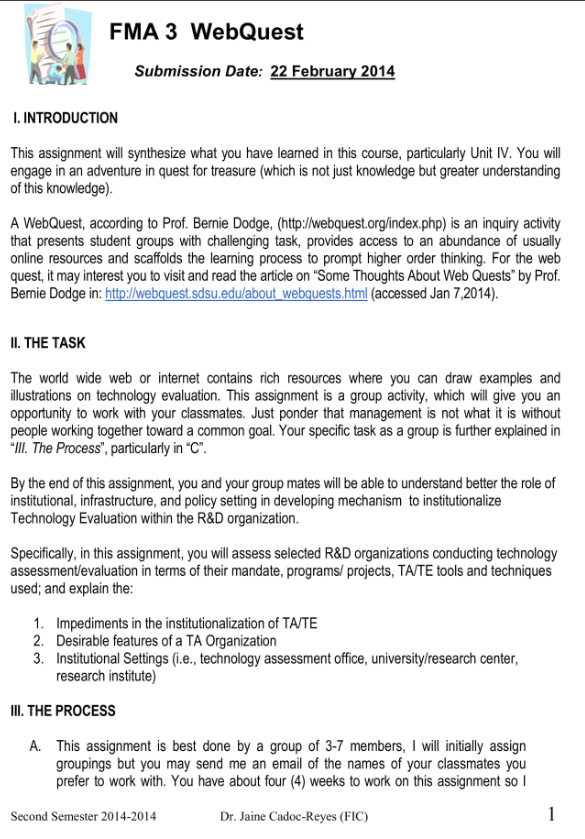
The WebQuest learning activity used as part of the requirements for the R&DM251 course on Technology Evaluation was adapted from Dodge’s model (Dodge, 1997). The modified WebQuest retained its structure as it was used for several semesters from 2007 until 2014.
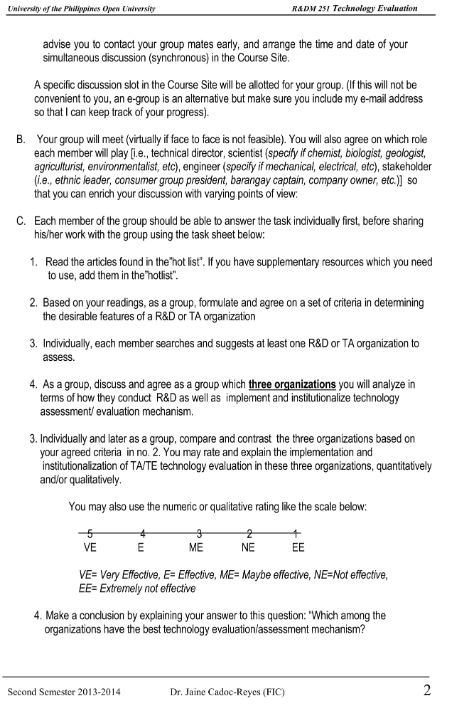
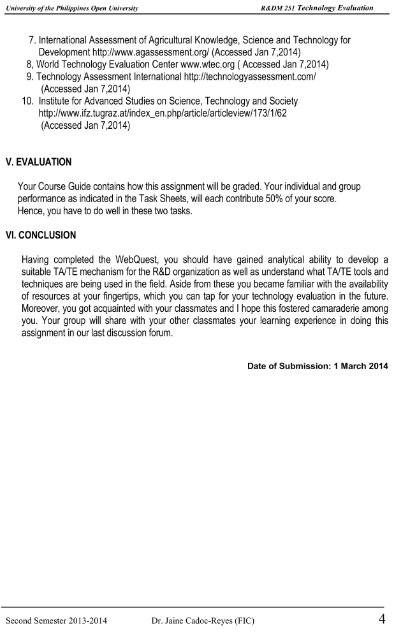
For this learning activity, (see Appendix B) the class was encouraged to work in groups with three to seven members each. The FIC initially assigned the groupings by combining individuals with different specializations and work background in a group. The class was encouraged to send an email with the names of their preferred groupmates to the FIC. The groups were then given one discussion slot in the course site. Then, they were asked to meet with their group mates, whether physically or virtually, to assign a role to each member. The roles they may choose from are the following: technical director, scientist, engineer, and stakeholder. This “role-playing” activity allowed the students to answer the questions through different perspectives. After assigning roles, they were asked to individually accomplish the task sheet before discussing it with their group mates.
The outputs from this activity were assessed using peer evaluation and the FIC’s student performance assessment.
Strategies Implemented
Learning object. The WebQuest activity undertaken in R&DM251 aimed to give the learners a greater understanding of the role of institutional, infrastructure, and policy setting in developing mechanisms to institutionalize.
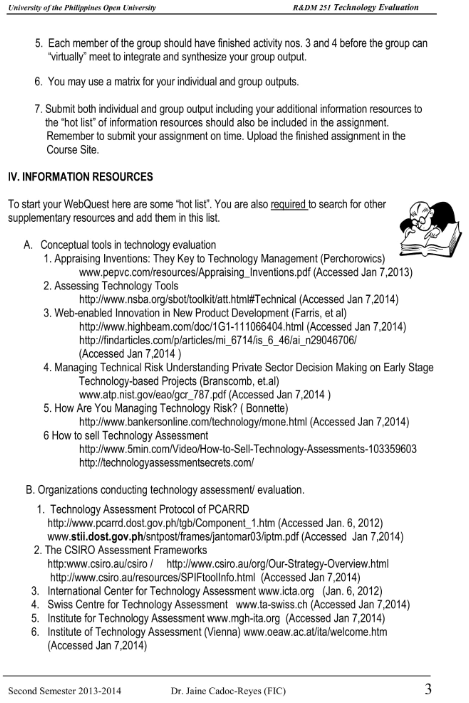
Scaffolding. To accomplish the activity, the students were given a task sheet which they need to answer individually before discussing it with their group. They were also asked to compare and contrast three R&D organizations based on how they conduct R&D, and how they implement and institutionalize technology assessment/evaluation mechanisms. To aid the students in their WebQuest, a “hot list” of information sources were given to them. This “hot list” consisted of resources on conceptual tools in technology evaluation and organizations conducting technology assessment/evaluation.
Timing. The WebQuest activity was held at the latter part of the course as it served as a synthesis for Unit IV: Institutionalizing Technology Evaluation.
Time allotment. The students were given four weeks to accomplish the learning activity.
Feedback. The FIC was also available to entertain questions regarding the activity.
Assessment. The students’ individual and group performances, as indicated in the task sheets, contributed to 50% of their score. In addition to the assessment done by the FIC, peer evaluation was also employed.
Results and Discussion
The analysis of the texts on the students’ views and experiences of the two learning activities yielded the following themes.
1. Collaborative Learning can deepen learning
Collaborative learning can enable learners to gain a deeper understanding of the lessons being taught. Through the learning activity, learners in R&DM 251 were said to have “gained…an in- depth understanding of the lessons from their interaction, sharing of experiences, and information exchange.” The activity in R&DM 220 was liked because it enabled the learner not only to discuss the topic at hand but also think about it at a “deeper level”, as gleaned from the statements reported:
“The story itself is a good starting point to initiate discussion on values. It makes you not only to think hard but also to feel deep at the same time.”
The exercise also allowed the students to “appreciate [their] differences and discover how organizational culture is made.”
“I also had the chance to re-examine my personal values and relate myself with the characters in the story.”
2. Collaborative Learning can broaden perspective
Collaborative learning can also lead to the broadening of the learners’ perspectives brought about by the opportunity to “learn better through interaction, information exchange, and experience sharing among group members” (R&DM 251). As one student in the said course who did the WebQuest activity said, “more inter-disciplinary, more heads are able to share their experiences and opinions with the group.”
One respondent in R&DM 220 enjoyed the chance to learn from his/her classmates and in the process expand one’s perspective:
“I liked how I have learned a lot from my group mates. Some of the perspectives that they have had never crossed my mind. Upon hearing their opinions did I only realise that those may be acceptable or possible as well.”
The idea of assigning roles in WebQuest also ensured that different perspectives are brought into the group activity. As a student in R&DM 251 said, role playing is a “good learning method and beneficial for additional group inputs, encouraging full group discussion and participation, and broadening perspectives of group members”. The fact that the group members come from different professional backgrounds mean that learners can learn from each other on how to address problems:
“…Since not everyone in the group is of the same field, it's good to know how each member of the group perceive things and what possible if not the best solution on the problem being tackled...it is also a good exercise on how members participated in group discussion for they tend to do that in their respective jobs.” (R&DM 251 student).
3. Collaborative Learning is Enjoyable
The learners find satisfaction in doing collaborative activities. One student in R&DM 220 said that he/she had “so much fun with the activity that there was no part or area about it that [he/she] did not like.” Learning activities have provided the students an opportunity to have personal contacts and get to know each other better, as explained by one respondent:
“I was able to get in touch with my online classmates by hearing their voices and seeing their faces during our group discussion via Skype.” (R&DM 220 student).
Despite having different schedules, a student in R&DM 251 had expressed his/her appreciation for collaborative learning since it has allowed him/her to “get to know more of [his/her] classmates.” This personal contact supposed brings more enjoyment to the learners by bringing into distance learning a more “at school environment,” as a student in R&DM 251 noted. The fact that they recommend the inclusion of videoconferencing in the class meant that they put value on synchronous, oral, interactions.
4. Collaborative Learning is Challenging
Collaborative learning can also pose several challenges to the learners. The time and geographical difference among the learners add another layer of complexity to the work. These students in R&DM 220 and R&DM 251 shared their views on this:
“Finding a common time for all to conduct the virtual meeting [is challenging]. We are working and [have] different time of availability.” (R&DM 220 student)
“The time and space difference between the learners already makes the conversational turns in online environment more challenging.” (R&DM 220 student)
“The group activity also “needs more time (from members) to interact with each other.” (R&DM 251 student)
“…As for us, when we do WebQuest, we require to communicate almost every day”. (R&DM 251 student)
Another challenge in collaborative learning is attributed to the behavior of some co-leaners" who do not respond promptly” (R&DM 220 student), “do not seem to take deadlines seriously” (R&DM 220 student), or do “not exert effort to check email updates regularly and the late submission of her contributions.” (R&DM 220 student).
Challenges also arise when some of the learners are said to be confused about their roles in the activity. As an R&DM 251 student said, “patience is also needed when some members do not understand their role well”, given that “it requires research to intensively get the perspective of the position being played.”
Some learners are also said to have poorly understood the guidelines on the activity. One R&DM 220 student said:
“For instance, it was said by the FIC that the final ranking should be posted in the Moodle site. The members of one particular team posted their individual rankings in the discussion forum.”
5. Teacher’s Absence Creating New Space for Collaborative Learning
Since the point of interaction in collaborative learning is between learners, the teacher is “relatively” absent in the learning environment, thus, opening up a new space where the learners are freer to interact among themselves. In R&DM 220, it has been reported that this “relative ‘absence’ of the teacher in this phase of the class enabled the students to deal with each other in a much more informal manner and allowed them to know each other on a more personal level. In the process, another space for interaction was also created -- one that extends beyond the ‘formal’ space of the ‘classroom’ that was created and managed by the teacher.” In collaborative learning, the teacher becomes more of a “co-learner” (R&DM 251) as opposed to just dispenser of knowledge.
6. Teacher’s Presence Facilitating Collaborative Learning
The role of the teacher as a facilitator of collaborative learning is also appreciated by learners. A student in R&DM 251 said that “…what really gave life in terms of encouraging learning in this course was the involvement and active participation of the [teacher]. A student in the same course liked when the teacher “actively participate(s) in/facilitate(s) the team's learning process, [provides] feedback in the form of stimulating inputs and challenging questions…which made me feel the personal touch of the teacher, and therefore enhanced everyone's learning....”
7. Flexibility in Collaborative Learning
Analysis of the learners’ recommendations on how to improve the collaborative learning activities tend to show that the learners prefer some leeway in terms of assessment, topics to choose from, resources to use, and with whom to do the activity with, as shown by the following statements:
“Addition of open-ended questions for peer assessment.” (R&DM 220 student)
“Provide more topics to choose from, if not, let the students suggest some topics that might be of interest to them.” (R&DM 251 student)
“…Students should be reminded not to limit themselves with the references in the Hot List” since students “have a tendency to be dependent on them rather than use it as a guide.” (R&DM 251 student)
“Students to do the same exercise with friends rather than classmates.” (R&DM 220 student).
8. Structure in Collaborative Learning
Learners appreciated the guidelines and resources provided by the teacher. For example, the “Hot List of information resources in the WebQuest was considered very useful by the respondents”, since they “provided up-to-date topics and examples as well as serving as a guide on tackling the subject.”
The importance of explicitly stating the learning objective of the activity has also been raised in R&DM 220, given that “at times, the learner can also misunderstand the purpose of the activity.”
The timing of when the collaborative learning activity is scheduled within the semester is also said to be crucial. One R&DM 251 student said that “group assignments should be done on early stages of the lessons since there will be less lessons to tackle or readings as well as no preparation for the exams.”
9. Collaboration is Learning
The act of doing a collaborative activity, which involves the learners interacting with one another and “working together as a group” to “collectively accomplish a common task in an online environment”, is said to be an opportunity “to learn more about the lesson” (R&DM 220 student). It is such an imperative in their learning process such that an R&DM 251 student recommended that “one compulsory assignment requiring group work should be given since this forces interaction among students even if with hectic schedule.”
The previous discussion indicates that the themes derived from the texts can be categorized under the following thematic points: purpose, learner experience, teacher’s role, and format. The thematic variations identified per thematic point are shown in Table 1.
Table 1. Thematic points and thematic variations derived from the texts
| Thematic Point | Thematic Variations (Subthemes) | Central theme | |
|---|---|---|---|
| Purpose | Collaborative Learning can deepen learning | Collaborative learning can broaden perspective | Collaboration is learning |
| Learner experience | Collaborative Learning is enjoyable | Collaborative Learning is challenging | |
| Teacher’s role | Teacher’s absence creating new space for Collaborative Learning | Teacher’s presence facilitating Collaborative Learning | |
| Format | Flexibility in Collaborative Learning | Structure in Collaborative Learning | |
Participants see collaboration essentially as an opportunity to learn from one's peers through the exchange of ideas. As Stacey (1999) argued, computer-mediated collaborative learning allowed for the social construction of knowledge through “sharing diverse perspectives of group members”. Not only did group work give learners the opportunity to share their perspectives and ideas but also enhanced individual and group engagement, which are crucial in the learning process.
The participants are said to see collaborative learning as enjoyable given that it promotes social interaction and team building among co-learners by providing “a network of social interaction that underlay the mutual respect and trust needed for a successful collaborative learning process” (Stacey, 1999). Having said this, collaborative learning is also challenging. This is especially true in the case of online learners who communicate with each other at a distance. Requiring synchronous communication, collaborative learning promotes learner motivation and co-creation of knowledge among peers. However, the same collective effort which learners find enjoyable, also brings with it certain challenges, including difficulties in communicating through technology, negative attitudes of some learners on collaboration, and technology, and lack of individual accountability (Thompson and Ku, 2006; An, Kim, and Kim, 2008). Furthermore, the same collective effort which learners find engaging also impinges on the flexibility of the course -- the ability to study at one's own pace. The urgency to depend on their co-learners for grades also imposes a limitation on some learners (MacDonald, 2003).
This brings in the role of the teacher. Given the relative complexity of organizing collective work online, teachers are seen by learners as providers of structure, source of clarity, and corrector of mistakes. As other studies have shown, teachers are essential in bridging this gap by providing feedback (whether individual or by group), giving guidelines and rules in doing the activity, and by encouraging questions. While learners look for this structure, they also need enough elbow room for them to work around the required collaborative learning activity (An, Kim, and Kim, 2008). This is especially true for adult learners as in the case of the participants in this study, hence, the expressed appreciation for the teacher's relative absence in the collaborative activity. In addition, the advent of new technologies which allows for more interactive and engaging interactions among learners, have actually lessened the need for the physical presence of the teacher in collaborative learning (Greiffenhagen, 2012).
The study has shown that collaborative learning, is itself, learning, which goes to show the target learners’ appreciation for its benefits. As one student indicated, the learners’ participation in group discussions is reflective of what they “tend to do that in their respective jobs,” which in turn, highlights the appropriateness of collaborative learning as an instructional strategy in the training of professional managers whose practice can be best described as relational. Implementing it in the ODeL environment, however, requires a delicate balancing act for the teacher between providing structure and flexibility. Based on these two cases, learners in online collaborative learning benefit from clear instructions, clarifying expectations, providing online resources to enable exploration, and using peer review as an opportunity for co-creation of knowledge but also as a mechanism for establishing accountabilities among learners in the group. Having said this, learners also appreciate if they are given flexibility in terms of what online resources to use, whom to do the collaborative learning activity with (i.e., colleagues instead of classmates), and how to assess their work.
While collaborative learning activities in a sense are essential to the learning experience of management students, it was also recognized that it can be challenging. Hence, there is a need to ensure that the amount of collaboration required does not negate the flexibility that ODeL affords to online students. One way to achieve this is to schedule the conduct of the learning activities in the early to middle part of the term when students are doing fewer course requirements. These findings can be applied not only in the two R&DM courses but also in similar courses and programs within and outside UPOU.
Conclusions
The study has shown that the DR&DM students’ experiences and views in both courses seem to show that the very act of collaboration is learning. Collaborative learning is said to open up opportunities for learners to deepen their understanding of the lessons while expanding their views of R&D management concepts, issues, and situations. While the affordances provided by collaborative learning makes it enjoyable to students, the complexity of doing it online makes it more challenging as well. The study also indicates that in designing and delivering collaborative learning activities, teachers need to provide enough structure to lessen confusion about the process of collaboration but also provide enough the flexibility to allow for exploration of ideas that learners find interesting or relevant to their professional lives.
Given the limited scope of the study, a study involving collaborative learning activities in other courses or programs can be conducted in the future. A quasi-experimental (cross-sectional) study to determine other effects of online collaboration on learning can also be pursued.
References
Abrami, P. C., & Bures, E. M. (1996). Computer-supported collaborative learning and distance education. American Journal of Distance Education, 10(2), 37-42. https://doi.org/10.1016/0360- 1315(90)90138-W.
America Distance Education Consortium. (2003). ADEC Guiding Principles for Distance Teaching and Learning. Retrieved August 2012 from http://www.adec.edu/admin/papers/distance- teaching_principles.html.
An, H., Kim, S., & Kim, B. (2008). Teacher Perspectives on Online Collaborative Learning: Factors Perceived as Facilitating and Impeding Successful Online Group Work. Contemporary Issues in Technology and Teacher Education, 8(1), 65-83.
Basic elements of cooperative team (n.d.). Retrieved August 2012 from http://clte.asu.edu/active/ baselemcooptms.pdf
Bates, A.W. (2015) Teaching in a Digital Age: Guidelines for Designing Teaching and Learning. Vancouver BC: Tony Bates Associates Ltd.
Bernard, R.M., dela Rubalcava, B.K. & St. Pierre, D. (2000). Collaborative online distance learning: Issues for future, practice, and research. Distance Education, 21(2), 260-77. https://doi. org/10.1080/0158791000210205.
Biehler, R. & Snowman, J. (1997). Psychology Applied to Teaching (pp 418-419). Retrieved August 2012 from http://college.cengage.com/education/pbl/tc/coop.html.
Brandon, D.P. & Hollingshead, A.B. (1999). Collaborative learning and computer supported groups. Communication Education, 48(2), 109-26. https://doi.org/10.1080/03634529909379159.
Brickell, G., & Herrington, J. (2006). Scaffolding learners in authentic, problem based elearning environments: The Geography Challenge. Australasian Journal of Educational Technology, 22(4), 531-547. doi: 10.14742/ajet.1284.
Brindley, J.E. & Walti, C., & Blaschke, L.M. (2009). Creating effective collaborative learning groups in an online environment. International Review of Research in Open and Distance Learning, 10(3). Retrieved from http://www.irrodl.org/ index.php/irrodl/article/view/675/1271.
Brown, A.L. and Palincsar, A.S. (1989). Guided, cooperative learning and individual knowledge acquisition. In L.B. Resnick (Ed.), Knowing, Learning, and Instruction (pp. 393-451), Hillsdale, NJ: Lawrence Erlbaum.
Capdeferro, N. & Romero, M. (2012). Are online learners frustrated with collaborative learning experiences? International Review of Research in Open and Distance Learning, 13(2). Retrieved June 10, 2012 from http://www.irrodl.org/index.php/ irrodl/article/view/1127/2129.
Carney, J.H., Joiner, J.F. & Tragou, H. (1997). Categorizing, Coding, and Manipulating Qualitative Data Using the WordPerfect/Word Processor. The Qualitative Report, 3(1). Retrieved September 1 2012 from http://www.nova.edu/ssss/QR/QR3- 1/carney.html.
Carr, W. and Kemmis, S. (1983). Becoming critical: knowing through action research. Victoria: Deakin University Press.
Chou, P. & Chen, H. (2008). Engagement in online collaborative learning: A case study using a web 2.0 tool. MERLOT Journal of Online Learning and Teaching, 4(4), 574- 582.
Cooperative Learning. (n.d.). Retrieved August 2012 from http://edtech.kennesaw.edu/intech/ cooperativelearning.htm.
Cooperative Learning Instruction Strategies. (n.d.) Retrieved August 2012 from http://www.teach- nology.com/currenttrends/cooperative_learning/.
Curtis, D. & Lawson, M. (2001). Exploring collaborative online learning. Journal of Asynchronous Learning Networks, 5(1), 21-34. Retrieved June 10, 2012 from http://wikieducator.org/ images/6/60/ALN_Collaborative_Learning.pdf.
Daradoumis T., Marquès, J.M., Guitert, M., Giménez, F., & Segret, R. (2000). Enabling Novel Methodologies to Promote Virtual Collaborative Study and Learning in Distance Education. Retrieved August 2012 from http://cv.uoc.es/~grc_000228_web/Papers/ICDE_paper.doc.
Dillenbourg, P., Baker, M., Baye, A. & O'Malley, C. (1996). The evolution of research on collaborative learning. In E. Spada & P. Reiman (Eds) Learning in Humans and Machine: Towards an interdisciplinary learning science. (Pp. 189-211). Oxford: Elsevier.
Diploma in Research & Development Management. (n.d.). Retrieved from http://fmds.upou.edu. ph/index.php/academics/postbacprog?id=48.
Dodge, B. (1997). Some thoughts about WebQuests. Retrieved November 3, 2017 from http:// webquest.org/sdsu/about_webquests.html.
Driscoll, M. (2005). Psychology of Learning. Boston: Pearson Education, Inc.
Economides, A. (2008). Culture-aware collaborative learning. Multicultural Education & Technology Journal, 2(4), 243-267. https://doi.org/10.1108/17504970810911052.
Gilbert, D.J. 2013. Collaborative Competence: Redefining Management Education Through Social Construction. Journal of Psychological Issues in Organisational Culture, 4(3): 26-43. doi: 10.1002/jpoc.21116.
Gokhale, A. A. (1995). Collaborative Learning Enhances Critical Thinking. Journal of Technology Education, 7(1). doi: 10.1007/978-1-4419-1428-6_910.
Green, K. (n). Basic Elements of Cooperative Learning. Retrieved August 2012 from http:// cooperativelearning.nuvvo.com/lesson/216-5-basic-elements-of-cooperative learning.
Greiffenhagen, C. (2012). Making rounds: The routine work of the teacher during collaborative learning with computers. International Journal of Computer-Supported Collaborative Learning, 7(2), 11-42. doi: 10.1007/s11412-011-9134-8.
Hathorn, L. G., & Ingram, A. L. (2002). Cooperation and collaboration using computer-mediated communication. Journal of Educational Computing Research, 26(3), 325- 347. https://doi. org/10.2190/7MKH-QVVN-G4CQ-XRDU.
Hayes, J., & Allinson, C. W. (1997). Learning styles and training and development in work settings: Lessons from educational research. Educational Psychology, 17(1-2), 185-193. doi: 10.1080/0144341970170114.
Hien, T. 2009. Why is action research suitable for education?. VNU Journal of Science, Foreign Languages. 25: 97-106. Retrieved: 25 August 2012 from http://tapchi.vnu.edu.vn/nn_2_09/ b4.pdf.
Jacobs, G. (n.d.). Cooperative Learning; Theory, Principles, and Techniques. Retrieved August 2012 from http://www.readingmatrix.com/conference/pp/proceedings/jacobs.pdf
Janssen, J., Erkens, G., Kirschner, P.A. & Kanselaar, G. (2009). Influence of group member familiarity on online collaborative learning. Computers in Human Behavior, 25, 161–170.
Johnson, D. W., Johnson, R. T., & Holubec, E. J. (2009). Circles Of Learning: Cooperation in The Classroom. Edina, MN: Interaction Book.
Johnson, D. W., Johnson, R. T., & Smith, K. A. (1998). Cooperative Learning Returns To College What Evidence Is There That It Works?. Change, 30(4), 26-35. https://doi. org/10.1080/00091389809602629.
Johnson, D., & Johnson, R. (1994). Learning Together and Alone, Cooperative, Competitive, and Individualistic Learning. Needham Heights, MA: Prentice-Hall.
Johnson, D., & Johnson, R. (n.d.). Introduction to Cooperative Learning: An Overview of Cooperative Learning. Retrieved August 2012 from http://www.co-operation.org/.
Johnson, D., Johnson, R., & Holube. (1988). Advanced Cooperative Learning. Edin, MN: Interaction Book Company.
Johnson, D.W., Johnson, R.T., and Smith, K.A. (2006). Active learning: Cooperation in the university classroom (3rd edition). Edina, MN: Interaction.
Kagan, S. (1990). The Structural Approach to Cooperative Learning. Educational Leadership, 47 (December-January 1989-90), 12–15. EJ 400 491.
Kagan, S. (1993). Cooperative Learning. San Clemente, CA: Kagan Publishing. Retrieved August 2012 from http://www.kaganonline.com/free_articles/research_and_rationale/.
Kagan, S. & Kagan, M. (2009). Kagan Cooperative Learning. San Clemente, CA: Kagan Publishing. Retrieved August 2012 from http://www.kaganonline.com/free_articles/research_and_ rationale/.
Kaye, A. (1992). Learning together apart. In A. R. Kaye (Ed.), Collaborative learning through computer conferencing (pp. 117-136). Berlin, Germany: Springer-Verlag.
Ke, F., & Carr-Chellman, A. (2006). Solitary learner in online collaborative Learning: A disappointing experience?. The Quarterly Review of Distance Education, 7(3), 249– 265.
Kimber, D. (2007). Collaborative Learning in Management Education: Issues, benefits, problems and solutions: A literature review. Paper presented at the 1994 ANZAM (Australian and New Zealand Academy of Management) conference, New Zealand. Melbourne, Australia: Royal Melbourne Institute of Technology University.
Kitchen, D., & McDougall, D. (1999). Collaborative learning on the Internet. Journal of Educational Technology Systems, 27(3), 245-258. https://doi.org/10.2190/5H41-K8VU-NRFJ-PDYK.
Ko, S., & Rossen, S. (2001). Teaching online: A practical guide. Boston: Houghton Mifflin.
Ku, H., Tseng, H., & Akarasriworn, C. (2013). Collaboration factors, teamwork satisfaction, and student attitudes toward online collaborative learning. Computers in Human Behavior, 29(3), 922-929. https://doi.org/10.1016/j.chb.2012.12.019.
Kuh, G.D., Kinzie, J., Buckley, J., Bridges, B., and Hayek, J.C. (2007). Piecing together the student success puzzle: Research, propositions, and recommendations (ASHE Higher Education Report, No. 32). San Francisco, CA: Jossey-Bass.
Laffey, J., Tupper, T., Musser, D., & Wedman, J. (1998). A computer-mediated support system for project-based learning. Educational Technology Research and Development, 46(1), 73-86. doi: 10.1007/BF02299830.
Lynch, D. (2010). Application of online discussion and cooperative learning strategies to online and blended college courses. College Student Journal. 44(3), 777-784.
Macdonald, J. (2003). Assessing online collaborative learning: process and product. Computers & Education, 40(2003), 377-391. https://doi.org/10.1016/S0360-1315(02)00168-9.
McInnerney, J. M. & Roberts, T. S. (2004). Collaborative or Cooperative Learning? In Roberts, T. S. (2003). Online Collaborative Learning: Theory and Practice (pp. 203-214). Pennsylvania, USA: Information Science Publishing.
McLoughlin, C., & Luca, J. (2002). A learner-centred approach to developing team skills through web-based learning and assessment. British Journal of Educational Technology, 33(5), 571- 82. https://doi.org/10.1111/1467-8535.00292.
Merriam, S. (1998). Qualitative research and case study applications in education. San Francisco, CA, US: Jossey-Bass Publishers.
Neo, K. (2003). Using multimedia in a constructivist learning environment in the Malaysian classroom. Australian Journal of Educational Technology, 19(3), 293- 310. https://doi. org/10.14742/ajet.1721.
Palloff, R.M. & Pratt, K. (2005). Learning together in community: Collaboration online. Retrieved November 2, 2017 from https://pdfs.semanticscholar.org/4b33/ bfc03c84794592d5d64126ca3b7c13836d59.pdf.
Pastor, NI. (2006). Valedictory Speech during the 10th UPOU Commencement Exercises. Retrieved January 2011 from http://www.upou.edu.ph/books/pastor_speech.html.
Piaget, J. (1969). The mechanisms of perception. New York: Basic Books.
Roberts, T. S. (2005). Computer-supported collaborative learning in higher education: An introduction. In T. S. Roberts (Ed.), Computer-supported collaborative learning in higher education (pp. 2–3). Hershey, PA.: Information Science Publishing.
Roberts, T.S. and McInnerney, J.M. 2007. Seven problems of online group learning (and their solutions). Educational Technology & Society, 10(4), 257-268.
Roschelle, J., & Teasley, S. D. (1995). The construction of shared knowledge in collaborative problem solving. In C. E. O’Malley (Ed.), Computer-supported collaborative learning (pp. 69- 197). Berlin: Springer-Verlag.
Sarinas, M. (n.d.). DR&DM data on completion and admission policy for 1997-2001. Faculty of Management and Development Studies, UP Open University. (unpublished).
Shaukenova, N. (2015). WebQuests as a Method of Collaborative Teaching. European Scientific Journal, ESJ, 11(10). 340-345. https://doi.org/10.1080/09523987.2011.607325.
Siemens, G. (2004). Connectivism: A Learning Theory for the Digital Age. elearnspace. Retrieved August 2012 from http://www.elearnspace.org/Articles/connectivism.htm.
Slavin, R. (1996). Education for All. Exton, PA: Swets & Zeitlinger Publishers.
Slavin, R. E. (1991). Student Team Learning: A Practical Guide To Cooperative Learning. Washington, DC: National Education Association, 1991. ED 339 518.
Slavin, R. E. (1991). Synthesis of Research on Cooperative Learning. Educational Leadership, 48 (February 1991): 71-82. EJ 421 354.
Slavin, R. E. (1995). Cooperative Learning: Theory, Research, and Practice. Boston : Allyn and Bacon.
Sonnenwald D. H., & Li B. (2003). Scientific col-laboratories in higher education: exploring learning style preferences and perceptions of technology. British Journal of Educational Technology, 34(4), 419-431. https://doi.org/10.1111/1467-8535.00339.
Stacey, E. (1999). Collaborative Learning in an Online Environment. International Journal of E-Learning & Distance Education. 14(2), 14-33.
Stahl, J. (1992). A Context for Higher Order Knowledge: An Information-Constructivist (IC) Perspective with Implications for Curriculum and Instruction. Journal of Structural Learning. 11 (1992): 189-218.
Stahl, R. J. (n.d.). The Essential Elements of Cooperative Learning in the Classroom. Educational Resources Information Center. Retrieved August 2012 from http://www.learner.org/ workshops/socialstudies/pdf/session6/6.CooperativeLearning.pdf.
Swan, K., Shen, J., & Hiltz, S.R. (2006). Assessment and collaboration in online learning. Journal of Asynchronous Learning Networks, 10(1), 45-62.
Taylor, S. J. & Bogdan, R. (1998). Introduction to qualitative research methods: a guidebook and resource (3rd edition). New York: John Wiley and Sons, Inc.
Thompson, L., & Ku, H-Y. (2006). A case study of online collaborative learning. The Quarterly Review of Distance Education. 7(4): 361–375.
Tsay, M. & Brady, M. (2010). A case study of cooperative learning and communication pedagogy: Does working in teams make a difference?. Journal of the Scholarship of Teaching and Learning, 10(2), 78 – 89. Retrieved from https://scholarworks.iu.edu/journals/index.php/ josotl/article/view/1747.
University of the Philippines Open University. (2011). Academic Catalogue. Laguna, Philippines: University of the Philippines Open University.
Vygotsky, L. S. (1978). Mind in society: The development of higher psychological processes. Cambridge, United Kingdom: Harvard University Press.
Wang, H.Y., & Hwang, G.J. (n.d.). A Collaborative WebQuest Approach to Improving Students’ Learning Achievement in a Computer Course. Retrieved May 17, 2018 from https://ipsj.ixsq. nii.ac.jp/ej/index.
Weed, M. (2005). Meta Interpretation: A Method for the Interpretive Synthesis of Qualitative Research. Forum: Qualitative Social Research, 6(1). https://doi.org/10.1080/13645570701401222.
Weed, M. (2003). Emotion, identity and sports spectator cultures: a comparative approach. Paper presented at the 11th European Congress of Sports Psychology (FEPSAC), Copenhagen, Denmark, July.
What are the essential parts of a WebQuest? (2004). Retrieved November 6, 2017, from http:// www.thirteen.org/edonline/concept2class/webquests/index_sub3.html.
Wong, C.K., & Abbruzzese, L.D. (2011). Collaborative learning strategies using online communities. Journal of Physical Therapy Education, 25(3). 81-86.
Worksheet Library. 10 Tips for Cooperative Learning. Retrieved August 2012 from http://www. worksheetlibrary.com/teachingtips/cooperativelearningtips.html.
Zafeirious, G., Nunes, J., & Ford, N. (2001). Using students’ perceptions of participation in collaborative learning activities in the design of online learning environments. Education for Information, 19(2), 83-107. doi: 10.3233/EFI-2001-19201.
Appendices
Appendix A - “Alligator River Story”
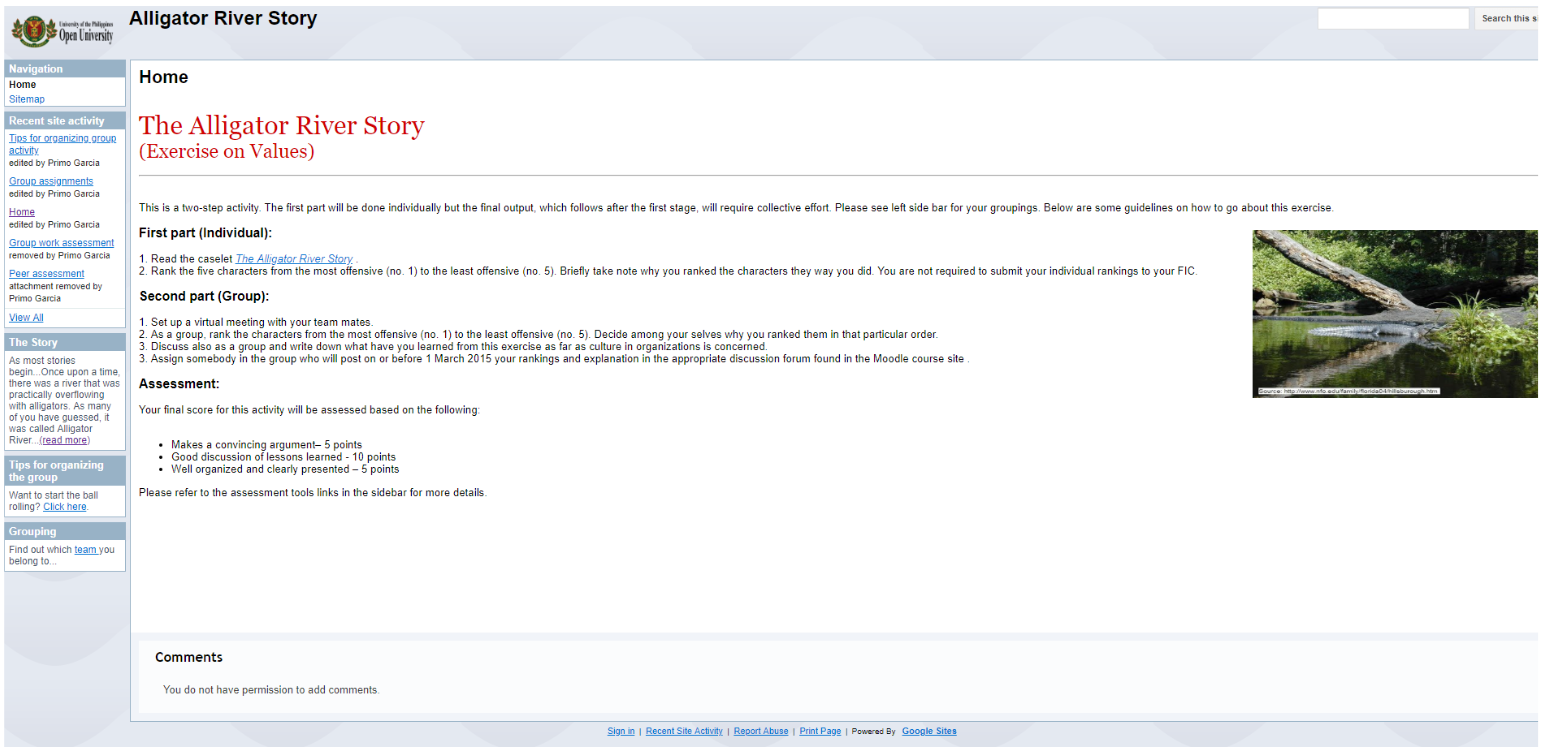
Fig. 1. Screenshot of the instructions of the Alligator River Story activity in the R&DM220 Google Site
Exercise on Values
The Alligator River Story
(Anonymous)
As most stories begin...Once upon a time, there was a river that was practically overflowing with alligators. As many of you have guessed, it was called Alligator River. A girl named Abigail lived on the west bank of the river. Her boyfriend, Greg lived on the opposite bank. Abigail and Greg were very much in love with each other. One slight complication: no boat, and an alligator-filled river stood between them.
Abigail decided to seek help so that she could see her boyfriend, Greg. She approached Rene, who owned a boat. Not this was very fortunate for Abigail, because Rene's boat was exactly what she needed to get across the river. She explained her situation to Rene and asked if she could borrow this boat. Rene thought for a moment and then replied: “Sure, you can borrow my boat, but only under one condition: The condition is that you sleep with me tonight”.
Now this startled Abigail, because she didn't want to sleep with Rene – she just wanted to borrow his boat so that she could see Greg.
After Abigail had told Rene “nothing doing,” she wandered down the road until she came upon Henry. Abigail explained her plight (her desire to see Greg, Rene's response) to Henry. After hearing all this, Henry told Abigail: “Don't bother me! That's not my concern. I've got other things to do. Leave me alone!” A despondent Abigail, her options exhausted, finally decided to go back to Rene. She slept with him that night. The next morning, Rene, true to his word, loaned his boat to Abigail.
Abigail sailed across the river and saw her beloved Greg. After spending a few delightful hours together, Abigail felt compelled to tell Greg what happened. After she had related her whole story, Greg blew up completely: “You what?” I can't believe you did that. I can't believe that you slept with him! That's it – it's all over – just forget the relationship – get out of my life!”
Distraught, Abigail wandered off. She came upon Larry, who was wandering around , too. Borrowing his shoulder to cry on, Abigail poured out her story to Larry. Larry then went looking for Greg (with Abigail close behind). Larry found Greg and proceeded to beat him up, with Abigail gleefully and laughingly applauding the bloody pommeling.
That's the end of the story.
Source: Readings in Human Behavior in Organizations (1990) by Rodriguez, R.A. et. al.
Footnotes
1 Data for this study consisted of the articles written by the first two authors which appeared in the Vol. 4, No. 1 issue of the open access ASEAN Journal of Open and Distance Learning: “Collaborative Learning Activities in Online Courses: Issues and Strategies” by Primo Garcia and “Learners’ Heterogeneity and Knowledge Sharing in Cooperative e-Learning” by Jaine C. Reyes
International Journal on Open and Distance e-Learning, Vol. 4 No. 1, June 2018 Issue