Special Report on Technology Application
Design and Development of an Online Repository System for Thesis and Special Problem Manuscripts
Armacheska R. Mesa
Instructor, University of the Philippines Mindanao, Philippines, [email protected]Abstract
It is vital to keep track of all the scholarly works undertaken by the students in research universities. As a premier research university,The University of the Philippines (UP) Mindanao has produced several scholarly works made by its students, such as thesis or special problem manuscripts. Similar to typical residential universities in the Philippines, UP Mindanao students submit both hardbound and digital copies of their thesis and special problem manuscripts to their respective departments. Problems such as duplication of work and missing manuscripts are rampant with the current method.This is because printed and electronic copies stored in optical discs can easily be misplaced and are difficult to track when borrowed. This paper describes the development of the UP Mindanao Manuscript e-library and Repository System (UPMERS), which is a web-based information system that provides administrators a tool to monitor and manage records of manuscripts by graduates of the University. This paper also describes the system’s user acceptance using the Technology Acceptance Model (TAM). Furthermore, the study also discusses the result of the System Usability Scale survey.
Keywords: Manuscript, Repository, TAM, e-Library, Theses, SUS
Introduction
Theses and special problems (SP) are the intellectual output of a research university. They reflect the research skills of students in the university and how they have applied the knowledge that they have learned in the institution. Levy (2012) cited that theses are intellectual assets that an academic institution should recognize and manage as such. As a premier research university in the country, the University of the Philippines (UP) Mindanao has produced several scholarly works undertaken by its students, such as theses or special problem manuscripts.
Similar to typical residential universities in the Philippines, UP Mindanao students submit both hardbound and digital copies of their theses and Special Problem manuscripts to their respective departments. Every department has its manual method of storing these documents. Printed copies of manuscripts are stored in libraries by different departments and colleges. These submitted manuscripts have remarkable roles in the reputation and credibility of the libraries (Khanipoor, 1999). Students and other stakeholders of the university access past researches through libraries to gather information for research-related endeavors.
However, when printed copies of the thesis or special problem manuscript are submitted, the research study often fades into obscurity or tends even to be forgotten by faculty members and students (Levy et al., 2012). Often, the hardbound copies of manuscripts are lost, misplaced or not returned by borrowers. Several problems on optical discs that pertain to reliability, longevity, and durability as storage media were also identified in past studies (Bradley, 2006; Finch and Webster, 2008). These issues are what UP Mindanao scholars have been struggling with. Therefore, it was suggested that a centralized storage for electronic formats of manuscripts be developed through the University’s repository system. A repository system can be a shop window for stakeholders of the university (Gutam et al., 2010). Its function is to store or catalog scholarly content such as research papers and journal articles. It can also be intended to collect and preserve the research output of universities in digital form (Eke, 2011) such as theses and special problems. Furthermore, Schopfel et al. (2012) observed that in a research university, there is a need for access to scholarly works since scientific communities require access to scientific information for research and teaching activities. A thesis repository system provides several opportunities for advanced learning because it can aid students in widening their interests in research.
Review of Related Literature
McCutcheon (2011) cited in his paper that one of the most effective steps for universities to increase the use of their scholarly works such as theses is to switch from print to electronic systems.
Several universities have already developed repository systems of their intellectual properties. Sheeja (2012) discussed the different theses repository systems in India. East Tennessee State University (ETSU) has also made their undergraduate theses available to the campus community and general public through an electronic repository system as described in the study by Levy et al. (2012). Several universities in Nigeria have switched to the digitization of their library materials such as theses and dissertations as reported in Alhaji’s (2007) paper. Ghosh (2009) examined nine thesis repositories in India and proposed on creating a national e-theses repository. University libraries in Korea have developed and utilized online bibliographic databases, which provides users access to electronic publications such as theses (Park et al., 2007).
Open Source Systems
As an attempt to address the problem without reinventing the wheel, several open source systems for journal management and document storage were reviewed. The following are the most commonly used systems:
Open Journal Systems (OJS) is a journal management and publishing software system, which provides a venue for submission to online publication and indexing. Thus, it supports a refereed publishing process. It offers not only the online presentation of journal articles but also an entire editorial management workflow, which involves submission, as well as multiple rounds of peer review. OJS also features various system roles such as the journal manager, editor, reviewer, author, reader, etc. (Da Fonseca, 2004).
Open Conference Systems (OCS) is another open source web publishing tool that creates a web presence for a scholarly conference. OCS has many features, such as creating a conference website, sending a call for papers, allowing paper and abstract submissions, posting conference proceedings, registering participants and integrating post-online discussions (Open Conference Systems, 2016).
Allen Track is another online manuscript submission and peer review system similar to OJS. It enables referees to access the articles online and submit reviews online. Through this system, users can enter the details of all participating authors, update addresses, upload the manuscript and figure files, add updated files, and view the electronic manuscript page proofs (Br J Gen Pract, 2006).
E-journal is a powerful production publishing system that allows users to create and control their own electronic or possibly printed journals in Drupal. Users can set up many journals, and it has functions for adding authors and editors. E-journal has modules, which allow users to manage basic user and access control, vocabularies and archives (Drupalorg, 2016).
Editorial Manager is another manuscript submission and tracking system that provides a suite of customizable manuscript tracking and reporting tools for authors, reviewers, editors, and journal office staff. This system also allows submission, peer review and production process (Ariessyscom, 2016).
Despite the existence of open source software for storing and managing theses, the special requirements of stakeholders in UP Mindanao called for the development of a bespoke system.
Objectives
This study aimed to develop a web-based information system that provides administrators a tool to monitor and manage records of manuscripts submitted by graduates of the University. The System, coined as UP Mindanao Manuscript e-library and Repository System (UPMERS), allows storage of digital copies in the database. It is an archiving web system that can be accessed by teachers, students, researchers, and all stakeholders of the University. Titles, abstracts, and even the whole theses or special problem manuscripts in various file formats can be retrieved using the system.The access to a certain manuscript is in compliance with its Intellectual Property Rights page, which specifies if the content of a manuscript can be made available to the general public or only to specific users.Moreover, this study measures user acceptance using the Technology Acceptance Model.
Research Design and Methods
Software Development Framework
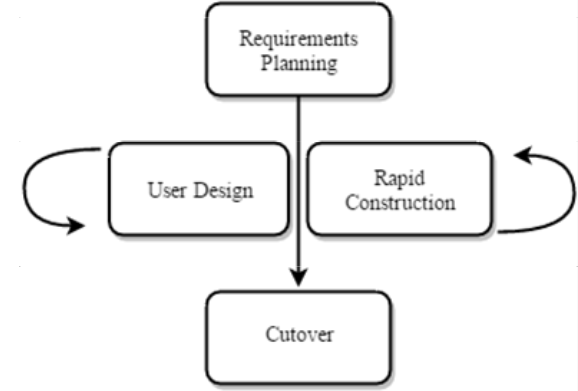
The framework used in developing UPMERS is the Rapid Application Development (RAD) structure in System Development Life Cycle. RAD was used for a faster development of the application, considering that project duration approximately took five months. RAD consists of four phases, namely: (1) Requirements Planning; (2) User Design; (3) Rapid Construction; and (4) Cutover. The phases followed in the traditional Software Development Life Cycle (SDLC) are also followed in RAD, but the phases are combined to produce a more streamlined development technique (Boehm, 1988). Figure 1 illustrates the sequential order of the model’s main phases.
Figure 1. Rapid Application Development Model (Watkins, 2009).
Requirements Planning Phase
This is the first stage in the development of the system. The objectives of this stage were: to establish a general understanding of the system, to become familiar with existing systems, and to identify the processes that will be supported by the system. On this phase, an outline of the system area and definition of the system scope were developed. The Requirements Planning stage began with series of meetings and interviews, between the developer and the primary user (administrative staff). These meetings initiated the development process by establishing a mutual understanding of the objectives of the development project in general and the system in particular. The developer was also part of the institution and a user of the system, so communication regarding the system was not difficult. This stage lasted only a short period because its goal was todetermine the initial requirement function, information, performance, and interface for the web-based system. This phase was divided into two parts: (1) user requirements; and (2) software requirements phase.
User Requirements
This web-based information system required input requirements such as manuscripts. Data encoded in the System was taken from manuscripts submitted by graduate students of the previous academic year. It was just a small portion of data encoded by one department. The data contains a list of manuscript titles submitted to the department during the Academic Year 2014-2015. These data were used for testing. The system needed to support five types of users of the System: system administrator, department chair, dean, faculty, and students, with specific functionalities for each.
Software Requirements
The key features of any DBMS application are data capture, query, and application development. For this project, some of the tools used were PHP, MySQL, HTML, CSS, and Javascript. Laravel 5.2 was used as the Model View Controller (MVC) framework of the system while Bootstrap was implemented as its front-end framework.
User Design Phase
In this phase, initial modeling and creation of prototypes were completed. Feedback from the main user, which is the administrative staff of the department,were gathered. The process was repeated as often as necessary during the duration of the development of the System.
Construction Phase
This is the phase for actual coding, testing, and integration of the modules of UPMERS. Similar to the User Design Phase, this phase was also repeated as often as necessary since there were several alterations needed to meet the demands of the user. This lasted for about three months.
Cutover Phase
In RAD, the cutover phase includes the installation of the system, user testing, and evaluation. The primary user utilized the system for detection analysis, correction of software faults, interface modifications, functional expansion, and performance improvement. This was needed to evaluate if the system will be ready for release and deployment to the intended end users. Upon the completion of the final prototype of this system, it was put through a series of black-box testing to ensure that each component of the system, as well as the complete system, performs according to user requirements.
Technology Acceptance Model
In order to describe how the stakeholders of the university use the system, the Technology Acceptance Model (TAM) was used in this study. TAM is one of the most widely used models for user acceptance of information systems. Proposed by Davis in 1986, it was used to evaluate the acceptance of a web-based repository of health education materials (Wynn et al., 2012). Park (2009) proved TAM to be a useful theoretical tool to examine learners’ acceptance of e-learning. Furthermore, TAM was used to measure the acceptance of domestic technologies (Calvin, 2008). According to Chen et al. (2013), the most important factors in the technology acceptance model are Perceived Ease of Use and Perceived Usefulness. This study focuses on these two factors.
Perceived Ease of Use
Perceived ease of use according to Davis et al. (1989) is the degree to which a prospective user expects a proposed system to be free of effort. An information system will most likely be used if prospective users find the system user-friendly and easy to learn. To assess the user’s perception of the system’s ease of use, a System Usability Scale (SUS) was used. The survey employed in this study is the most commonly used tool in testing usability.It is composed of ten statements with level of responses ranging from 1 (strongly disagree) to 5 (strongly agree). The responses from the survey are converted using a scoring scheme: the scores of the odd-numbered items are subtracted by 1 and the scores of the even-numbered items are subtracted by 5.The computation of the overall SUS score is the sum of the computed scores multiplied by 2.5 to convert the overall score from 0 to 100.
This survey was used to determine how the prospective users found the System; if the System was easy to learn; if it was clear and understandable; and if it was easy for the users to become skillful in using the system.
SUS 10-item survey questionnaire (Brooke, 1996):
- I think that I would like to use this system frequently.
- I found the system unnecessarily complex.
- I thought the system was easy to use.
- I think that I would need the support of a technical person to be able to use this system.
- I found the various functions in this system were well integrated.
- I thought there was too much inconsistency in this system.
- I would imagine that most people would learn to use this system very quickly.
- I found the system very cumbersome to use.
- I felt very confident using the system.
Perceived Usefulness.Perceived usefulness, according to Davis et al. (1989) affects the probability that using a specific application or system will increase the employee’s performance. A survey was formulated to determine the system’s benefits to the prospective users. The statements in the survey are significant benefits that the users may gain from using the System. They are based on a study by Davis (1989) but were customized for UPMERS. The statements also pertain to the productivity of the stakeholders in terms of research output and management of the manuscripts. There are five response options ranging from 1 (strongly disagree) to 5 (strongly agree). The average scores of every item were recorded. In order to test the reliability of the survey, the Cronbach alpha was computed using SPSS software.
Six-item survey used to measure user’s perception on UPMERS usefulness:
- UPMERS will help faculty monitor approved manuscripts (advised and paneled).
- UPMERS will help faculty administrators monitor students and faculty in terms of manuscript output.
- UPMERS will help students in acquiring titles to propose.
- UPMERS will solve problems of unreturned copies of manuscripts.
- UPMERS will help in proper storage of digital copies of manuscripts.
- UPMERS will
Deployment and Assessment
In this study, the target users of the system are stakeholders of the University, consist of the students, faculty members, research staff and alumni. After the system development phase, the system was uploaded on the university’s server last May 4, 2016. The system’s URL was then placed on the university’s website for easier access. The two surveys, survey for usability and usefulness, were then conducted after deployment to determine information system’s user acceptance. There were twenty (20) respondents for the two surveys. These were the department chair of DMPCS, (Dept. of Math, Physics, and Computer Science) administrative staff, faculty members, and fourth-year students from the College of Science and Mathematics. The users of the system were also interviewed regarding their impressions on UPMERS. They were also asked about how they thought the system could be beneficial in the monitoring of manuscripts and the quality of the students’ research output.
Results and Discussion
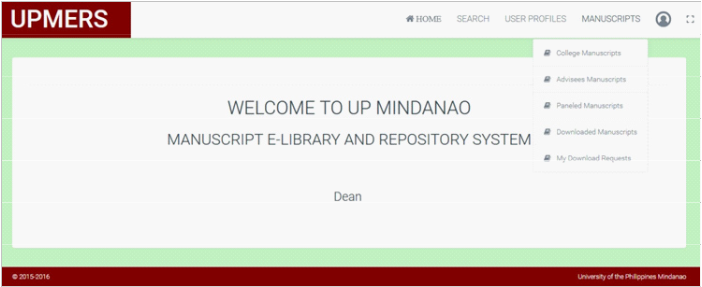
After following the methodology framework, the system was developed according to the needs of the intended users. A screenshot of the menu items exclusive to deans is shown in Figure 2.
Figure 2. Screenshot of the UPMERS Menu Items and Functionalities for Deans.
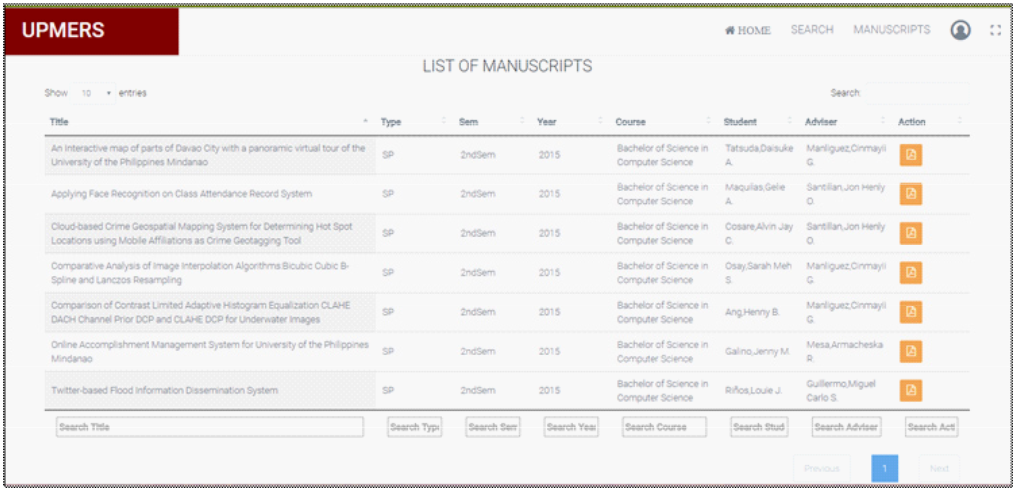
After testing the System, the results of the surveys and interviews conducted in the study showed that the retrieval of records became faster, and the storage of manuscript data was more secure and centralized. When the System was launched via the UP Mindanao website, the stakeholders were able to access the System anytime and anywhere, provided that their accounts were encoded. Users were able to search for and view manuscripts by specifying titles, keywords, and other metadata. Figure 3 shows a screenshot of the page where users can search for manuscripts uploaded to the system.
Figure 3. Search Functions for Student and Faculty Member Types of Users
Based on the interviews conducted, the administrative staff agreed that implementing the system would eliminate the problems spawned by borrowing hard copies of manuscripts. Faculty members who tested the System stated that monitoring manuscripts would be easier, storing them would be more secure, and accessing them would be faster once UPMERS is in full swing. Students who tested the system reiterated the benefits realized by the administrative staff.Furthermore, they also recognized the potential for the System to allow them to generate new ideas in their future research endeavors.
Results showed that the SUS score was 85.5, which means that the system’s usability is above average (Sauro, 2011). According to Thomas (2015), an SUS score of 80.3 and above is interpreted as the system being more than satisfactory and loved by the users. This means that the prospective users perceived the System as easy to use. For the perceived usefulness survey, all six statements on the average received a score greater than 4. This supports the interview results stating that users believed that UPMERS would aid faculty and administrators in monitoring research output of the students; UPMERS would be helpful to students in acquiring research titles; UPMERS would also be a centralized storage of digital copies of manuscripts; Duplication of research can be eliminated using UPMERS; and UPMERS will lessen, if not eliminate, the problem of unreturned copies of hardbound manuscripts.
As for reliability, the Cronbach alpha obtained was 0.78, higher than the 0.70 cutoff value for being acceptable (George and Mallery, 2003).
Conclusion and Recommendation
Based on the study, it can be concluded that UPMERS will be beneficial not only for administrators who can monitor and securely store digital copies of manuscripts but also for students and other stakeholders of the University. Using the System, users would be able to have knowledge or background on the research studies by UP Mindanao graduates. In general, results showed that UPMERSin its entirety is relevant, helpful and favorable to its users, and is adequately effective in carrying out its functions. The System was user-friendly, hence, learning all the features was not a problem. Furthermore, based on the survey and interviews, users were satisfied with the functionalities and performance of the web application.
However, the great challenge here is not on the use of the system, but on populating the database. The task of adding records of manuscripts on the System must be required for every department so that every manuscript will be stored in the database. As cited by Andrew (2003), various open-source packages are now in use that permits individual institutions to manage their digital research output. However, the problem is not about finding the appropriate software to use, but about gathering the content for these services. An impact study of the system is still yet to be conducted. Furthermore, a post-implementation survey on how the System has helped students in acquiring titles for their research and how the System has assisted the students in writing their theses and special problems can be undertaken as an extension of this study.
References
Alhaji, U.A. (2007). Digitization of past question papers, dissertations, and theses. The International Information & Library Review, 39 (3-4), 228–246.
Andrew, T. (2003). Trends in self-posting of research material online by academic staff. Ariadne: Web Magazine for Information Professionals. 37. Retrieved 20 May 2016 from http://www. ariadne.ac.uk/issue37/andrew/.
Aries systems. (2016). Editorial Manager. Retrieved 20 May 2016 from http://www.ariessys.com/ software/editorial-manager/
Boehm, B. (1988). A spiral model of software development. IEEE Computer.
Bradley, K. (2006). Risks associated with the use of recordable cds and dvds as reliable storage media in archival collections - strategies and alternatives. Paris: Memory of the World Programme.
Br J Gen Pract. (2006). Introducing Allen Track.Retrieved 20 May 2016 from http://www.ncbi.nlm. nih.gov/pmc/articles/PMC1839030/
Brooke, J. (1996). A quick and dirty usability scale. Usability Evaluation in Industry.189 (194), 4-7. Chen, Y., Lin, Y., Yeh, R., &Lou, S. (2013). Examining factors affecting college students’ intention to use web-based instruction systems: towards an integrated model. Turkish Online Journal of Educational Technology, 12(2). Retrieved 20 May 2016 from https://library3.hud.ac.uk/ summon/.
Colvin, H.M. (2008). The acceptance of domestic technology: TAM as applied to a proposed classification scheme. Retrospective Theses and Dissertations. Paper 15664.
Da Fonseca, R.M.S. (2004). Open Journal Systems. Paper presented at the ICCC 8th International Conference on Electronic Publishing. Brasilia.
Davis, F. D. (1986). A technology acceptance model for empirically testing new end-user information systems: Theory and results. Doctoral dissertation. Cambridge, MA, MIT Sloan School of Management.
Davis F.D. (1989). Perceived usefulness, perceived ease of use, and user acceptance of information technology. MIS Quartely,13(3),319–39.
Davis F.D., Bagozzi, R.P., & Warshaw, P.R. (1989). User acceptance of computer technology: a comparison of two theoretical models. Manage Science, 35(8), 982-1003.
Drupalorg. (2016). Drupalorg. Retrieved 20 May 2016 from https://www.drupal.org/project/ ejournal
Eke, H.N. (2011). Digitization of resources for University of Nigeria Repository: Process and challenges. Webology, 8(1).
Finch, L. &Webster, J. (2008). Caring for CDs and DVDs. London: The British Library.
George, D., &Mallery, P. (2003). SPSS for Windows step by step: A simple guide and reference. 11.0 update (4th ed.). Boston: Allyn & Bacon.
Ghosh, M. (2009). E-theses and Indian academia: A case study of nine ETD digital libraries and formulation of policies for a national service. The International Information & Library Review, 41(1), 21-33.
Gutam, S., Mishra, A.K., Pandey, P.S., Chandrasekharan, H., &Aneeja, G. (2010). Need of open access repositories for NARS in India. Commentary Current Science, 98(12).
Khanipoor, R. (1999). An introduction to manuscript cataloguing. Faslname-ye Ketab, 40, 37–48.
Levy F., Pyles R., Szarejko C.,& Wyatt L. (2012). Developing an electronic repository for undergraduate theses.Honors in Practice – Online Archive. Paper 160.
McCutcheon, S. (2011). Basic, fuller, fullest: Treatment options for electronic theses and dissertations. Library Collections, Acquisitions, & Technical Services, 35 (2-3), 64–68.
Park, E., Young-joon, N., &Sanghee, O. (2007). Integrated framework for electronic theses and dissertations in Korean contexts. The Journal of Academic Librarianship, 33(3), 338–346.
Park, S.Y. (2009). An analysis of the technology acceptance model in understanding university students’ behavioral intention to use e-learning. Educational Technology & Society, 12 (3), 150–162.
Public Knowledge Project. (n.d.). Open conference systems. Retrieved 20 May, 2016, from https:// pkp.sfu.ca/ocs/.
Sauro, J. (2011). Quantifying the user experience: Practical statistics for user research(2nd ed.). Morgan Kaufmann-Elsevier. Cambridge: United States.
Schopfel, J., &Soukouya, M. (2012). Providing access to electronic theses and dissertations: A case study from Togo. D-Lib Magazine: The Magazine of Digital Library Research, 19 (11/12).
Sheeja, N.K. (2011). The development of an Indian electronic theses and dissertations repository: An overview.
Thomas, N. (2015). How to use the system usability scale to evaluate the usability of your website. Retrieved 10 January 2017 from https://usabilitygeek.com/how-to-use-the-system-usability- scale-sus-to-evaluate-the-usability-of-your-website/.
Watkins, J. (2009). Agile development and testing. InAgile Testing: How to Succeed in an Extreme Testing Environment. Cambridge: Cambridge University Press, pp. 19–28.
Wynn, Z.N., Winn T.,& Syed-Mohamad S.M. (2012). Technology acceptance model for web-based repository of health education materials. Paper presented at the International Conference on Management and Education Innovation.Singapore.
International Journal on Open and Distance e-Learning, Vol. 3 No. 1, June 2017 Issue