Open and Distance eLearning: New Dimensions in Teaching, Learning, Research, and Extension for Higher Education Institutions
Grace Javier Alfonso¹, Primo G. Garcia²
¹Chancellor, UP Open University, Philippines, [email protected]²Professor, UP Open University, Philippines, [email protected]
Abstract
Open and Distance eLearning has helped evolve the idea of openness in education which expands to include the following (Alfonso, 2014):
Openness in admission policies; openness in credit recognition and accreditation; openness in delivery modes; openness in cost and affordability (some are free); openness in choosing educational track through multiple bridges and pathways, exits and entrances; openness in course design and evaluation; openness in strengthening digital literacies and e-pedagogies, emerging e-Research paradigms. The digitization of open and distance learning led to the Open Educational Resources (OER) movement and popularity of Massive Open Online Courses (MOOCs).
Based on UP Open University’s experience in Open and Distance eLearmig (ODeL), new dimensions of openness in instruction, research, and extension are explored, including the use of analytics in research, teaching and learning particularly in the areas of assessment and evaluation; openness in the shift from faculty-centered to learner-centered teaching; openness in flexible, distributed, blended, technology-enhanced and active learning; openness in the use of new digital technologies for course materials and for being in the core of teaching and learning process; openness in sharing resources and linking digital repositories; and openness in the use of Massive Open Online eLearning Systems as free and accessible to all.
Keywords: e-learning, open and distance learning, open and distance e-learning
Introduction
The 21st century has presented opportunities to educational environments in this ICT and digital age. Today’s media connectivity, interactivity, and ubiquity provides a powerful platform to all thereby also strengthening the concept of learning for all. More than ever, higher education institutions are called upon to be more open (Morgan and Carey 2003; Irvine et al, 2013; Knox, 2013; Stewart, 2013).
Open learning is a philosophy of learning that is based on flexibility of access for equity in education. It is learner-centered, where learners determine what they want to learn, how, when and where they want to learn, how to get their learning assessed and determine their career direction.
While openness in distance education is very much tied to flexibility of the educational system, it can occur in any of the following various forms:
- Openness in admission policies
- Openness in giving credits and degrees
- Openness in delivery modes
- Openness in cost and affordability
- Openness in choosing one’s educational track (open curriculum)
- Openness in course design and evaluation
These modes of openness have been applied in open learning institutions in varying degrees over the years. The idea of openness in education is not new. Even before the onset of digital media, people have always been hungry for open access to education. Peter and Deimann (2013) wrote a historical review on openness in education dating back to as early as the late Middle Ages. In the 14th century, public lectures were demanded to be held while affordable printed works were rampant in the 15th and 16th century. This was followed by the use of coffee houses as venues for research conversations and lectures in the 17th century, the founding of self-education societies in the 18th century, the establishment of miners’ libraries in the 19th century, and the offering of distance education in universities like the British Open University, University of South Africa, and Indira Gandhi National Open University in the 20th century.
Drivers of Openness in the Digital Age
The arrival of the digital era and recent developments in the global economy has offered vast opportunities and challenges to universities worldwide. The globalization of ideas has increased the movement not only of products, but also of people and ideas. Information and communication technologies have also given rise to knowledge-based industries and jobs that were nonexistent several years ago. Compared to our generation, graduates of today are expected to change careers several times in their work life. The rise of the so-called network society shall further increase the mobility of professionals and require people to regularly acquire knowledge and skills in dynamic environments (Lundmark, 2010). As people and organizations expand their exposure to international markets, more and more learners will require transnational education that goes beyond traditional modes of learning (Bannier, 2016).
As such, higher education institutions need to re-examine their approaches in the light of the demands of the global era and the digital age. Universities of today should produce graduates who have the ability to seek new information from different sources, translate this information into applicable knowledge, and communicate this knowledge in various forms and situations. They should be able to solve problems creatively and work in different cultural teams (Scott, 2015).
To cater to the needs of this new breed of learners, many educational institutions have considered alternative modes of educational delivery, including distance education and e-learning. The flexibility that distance education has opened up opportunities never before seen in the educational system. With its flexible and open philosophy, Open and Distance Learning (ODL) has made education accessible to people who are not reached by conventional universities (Morgan and Carey 2003; Irvine et al, 2013; Knox, 2013; Stewart, 2013).
From the early print-based models of delivery, advances in information and communications technology have transformed distance education. In the past most ODL institutions deliver a large part of their course content through print, radio, and television. The arrival of the Internet has enabled ODL institutions to get into what is called the “digitized” distance education (Wiley & Hilton, 2009).
In recent years, educational institutions have also felt the need to cater to the increasing demand for cross-border education. Institutions of open, distance and e-learning are well positioned to propel them to cross-border education given their experience in ICT-enhanced modes of delivery. In their efforts to control border education, governments may be forced to internationalize their accreditation systems.
Another trend in the higher education sector is the increasing demand for professional graduate and continuing education (UNESCO, 2005). There is a growing number of mature learners out there who do not see the university as central to their lives. These students will prefer to study part-time and acquire the skills necessary to advance themselves in their careers (Smith, 2008). e-Learning has proven to be a viable option in reaching out to this group of professionals. To cater to these learners, many conventional universities have gotten into blended learning, combining traditional classroom practice with e-learning solutions. However, many conventional universities have been unable to adapt online teaching methods fast enough to ensure increased access, quality, and sustainability through the use of teaching technology.
In addition to exploring more flexible teaching approaches and open system of admission, universities are also beginning to see the value of openly sharing their learning resources at no cost. The development of free and user-friendly ICT has brought down the cost of producing learning resources. This coupled with the principle that knowledge must be free has contributed to the propagation of Open Educational Resources (or OER). According to OECD, OERs are “digitized materials offered freely and openly for educators, students and self-learners to use and reuse for teaching, learning and research.” As Lane (2009) stated, OER promotes: 1) freedom from paying to access and use a content for specified purposes, 2) freedom to copy and make many more copies, 3) freedom to take away and re-use without asking prior permission, and 4) freedom to make derivative works (but not necessarily freedom to make profits from them). OER is especially applicable in the Philippines where the distribution of printed books is hampered by natural disasters and other logistical constraints (Arinto and Cantada, 2013). OER also fits with the open learning philosophy as they expand access to learning for everyone particularly the non- traditional groups of learners.
Related to the spread of OERs is the rice of Massive Open Online Courses (Alfonso, 2014). MOOCs are online courses that are openly accessible to large numbers of learners. It makes use of OER and is meant to make education more reachable to ordinary people.
While these outcomes have dominated the discourse on openness in distance learning, dramatic changes in information and communication technologies in recent years have been the major driver in the evolution of the openness dimensions. With the entry of digital media in the 21st century, the supersystem in which higher education is embedded in has become even more complicated and critical for the latter to recognize and understand (Wiley & Hilton, 2009). Wiley (2006) categorized how the human society is being transformed by technological innovations: 1) From Analog to Digital – MP3s, DVDs, digital broadcasts, and online newspapers have taken over VHS tapes, print newspapers, and analog broadcasts in the media industry; 2) From Tethered to Mobile – wireless devices and online platforms have enabled people to perform activities in such a way that they are not confined in a limited space; 3) From Isolated to Connected – hyperlinks in online journals, social networks, Voice Over Internet Protocol (VOIP) services, and mobile phones now provide real-time exchange of information among two or more parties; 4) From Generic to Personal – “mass customization” of goods and services have offered a more personal approach to consumers; 5) From Consumers to Creators – online platforms and mobile devices have empowered more people to write, record, and publish their own ideas and creations freely; and 6) From Closed to Open – the Internet has opened up possibilities of free sharing and access to information.
While numerous industries, particularly commercial ones, have adapted to these advancements in technology and used these to further their scale of consumers, higher education has been left ignoring these changes in its supersystem (Wiley & Hilton, 2009). This could be disadvantageous for higher education as the areas they once held monopoly on (i.e. structuring and providing access to content, tutoring and learning support services, curating and providing access to research materials, acting as a hub for social activities, and assessing learning and awarding degrees) could now also be offered through various media. “Mass participation, distributed expertise, valid and rewardable roles for all who pitch in” (Irvine et al, 2013) are now being pursued more than ever. Higher education must begin to innovate and see openness as a core organizational value to both remain relevant to the society and to contribute to the advancement of the field of higher education (Wiley & Hilton, 2009).
In this paper, we shall attempt to discuss the new dimensions opened up in teaching and learning, research and extension as framed by the world view of open and distance e-learning (ODeL) and within the context of the experiences of UP Open University as it has enacted this world view in the past years. The paper ends with some ideas on expanding the development of ODeL through institutional exchanges.
The ODeL Worldview
Open and Distance Learning (ODL) as a concept has been well entrenched with its rich literature and application. Institutions and associations have thickened the discourse on this and have exchanged best practices and have built this strong community through many years.
ODL is the merging of two concepts, that of Open Learning and Distance Education. This occurred when distance education institutions stated and agreed that distance education is a mode of learning in which students and teachers are physically separated from each other. Students undertake guided independent study of specially designed learning materials in various media, and two-way communication exists between the teacher and students commonly called continuing education, learner centered education, distance learning, flexible learning and distributed learning (Keegan 1980).
The ODL academic community has declared that distance education should always be together with the concept of Open Philosophy of Learning. As previously mentioned, open learning is a vision of an educational system accessible to every individual with minimal restrictions (Bates, 1995). Open and distance learning (ODL) is therefore a system which combines the methodology of DE with the concepts of open learning and flexible learning (Belawati 2008). So the community of ODL as we know it today can be traced to the establishment of the National Extension Institute in the United Kingdom in 1963 and later on the creation of the UK Open University in the late 1960s.
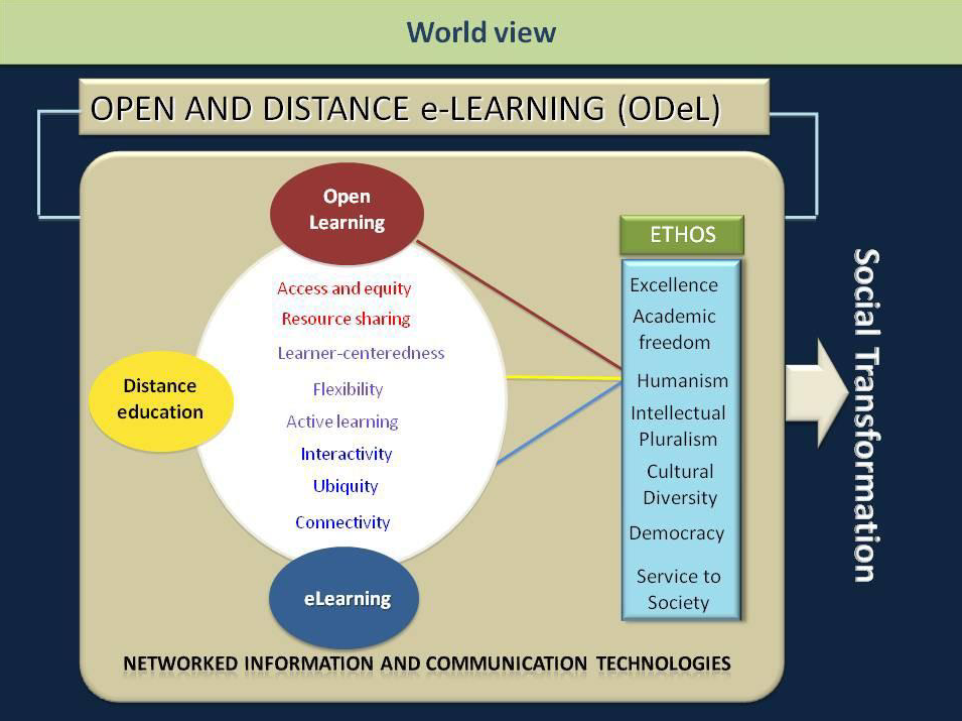
Given UP Open University’s unique position as an open university within a national university and its establishment at the dawn of the internet revolution, the university has developed a unique path towards openness. The first author has coined the term open and distance e-learning (ODeL) to capture the worldview within which the university has enacted openness, distance education, and online learning in its own context (Alfonso, 2014a). ODeL draws from the features and affordances provided by open learning, distance education, and e-learning -- access and equity, resource sharing, learner-centeredness, flexibility, active learning, interactivity, ubiquity, and connectivity (see Figure 1). Some of these features -- like access and equity -- are more in tune with open learning. Others -- like learner-centeredness, flexibility, active learning -- are shared by the three domains. Ubiquity, interactivity, and connectivity are more of e-learning’s contributions.
These affordances and features are infused with values that underpin the universitas -- excellence academic freedom, humanism, intellectual pluralism, democracy, and service to society. These ethos create the spirit of the university as we all recognize. Together, all these elements are embedded and facilitated by networked information and communication technologies and make up what is referred to as Open and Distance e-Learning (ODeL). The interweaving of these components can bring about social transformation. It must be noted that the first author wishes to state that she was not the first one to espouse these values. Many ODL institutions have actually practiced these values in one form or another. ODeL is not a normative framework but is more of an expression of values. As such, various educational institutions can draw upon ODeL depending on their own needs, priorities, target learners, and structures. The ODeL framework can open up new pathways for Higher Education Institutions and usher in new dimensions in teaching, learning, research and extension.
Figure 1
Open And Distance E-Learning Worldview
The UPOU Experience
Instruction
The UPOU was established in 1995 as the fifth constituent university of the University of the Philippines System. It aims to provide education opportunities to individuals aspiring for higher education and improved qualifications but who are unable to take advantage of traditional modes of education.
The creation of UPOU was a response to a felt need. Because of the limited resources of the residential colleges in other UP campuses, UP can only accommodate a certain group of applicants for admission. Through the distance education provided by the UPOU, the University is able to respond better to the demand for quality higher education especially in areas which do not have a UP campus.
When UPOU was established twenty years ago, the University taught primarily though stand- alone modules in print. With the growth of the internet at the turn of this century, the University shifted its gears and adopted online teaching and learning. At that time, there were concerns about the readiness of students to do their studies online. The university weighed the pros and cons of going online. We examined the technological and learning environments. We have noticed how academic texts in print are partially migrating into other forms of media. Harnessing the advantages of these technologies, the UPOU decided to look at e-learning as a means to enrich the learning experience of our students. In addition, e-learning also enabled UPOU to expand its reach abroad. In 2001, the UP Open University shifted to online learning to enhance the learning experiences of its students. Since then, UPOU is the only university in the country to deliver all its courses completely online. The hub of online learning at UPOU is Myportal, a virtual classroom powered by MOODLE. Teachers and students interact with each other at Myportal through asynchronous discussion boards, chats, wikis, and blogs. Students submit their assignments as well as take their quizzes and examinations in the said site. Through online technologies, UPOU is able to reach students from over 60 locations in over 40 countries. At present, offshore students come from over 60 countries and comprise 20% of the total student enrollment.
Open Educational Resources
When UPOU was established in the mid-1990s, the UPOU’s take on educational resources was solely anchored on copyright principles. The approach then was to teach primarily though copyrighted stand-alone modules in print. A few years later, UPOU had seen an explosion in the collective sharing and creation of knowledge as more people got more connected through social media. With the rise of web 2.0, internet users have been transformed from mere consumers to producers of knowledge. In this digital age, knowledge is not merely transmitted. It is constructed through the interaction of people across classes, disciplines, borders, and cultures. Instead of relying on the monologue offered by a teacher or a printed module or textbook, we can now take advantage of the wide array of resources available in the Internet. In the past, academics propagate ideas primarily through the print media. With the advent of web 2.0, we can now use a wide array of free online resources to facilitate learning. Compared to previous technologies, where the audiences of the learners are mere consumers of information, these technologies have given our teachers and learners the chance to share what they know, critique each other’s position, and discuss problems from different angles. In this way, knowledge creation becomes more relevant, participatory, and context specific.
All these developments have also changed the way we develop our educational materials. Instead of producing stand-alone course modules in print, we have decided to utilize various open educational resources in the web to deliver content. More than the accessibility and affordability, our reason for using OER is first and foremost pedagogical. We believe that learning goes beyond a simple transmission of knowledge from the educator to the student. Adopting a resource-based approach meant moving away from the traditional notion of the ‘talking teacher’ to the use of different media to communicate content and develop learning activities. We have used open educational resources as a material and tool for imparting concepts, developing thinking skills, and promoting creativity, self-discovery, and interactivity (Alfonso, 2014a).
OERs have been quite useful in offering our programs. However, we also recognize that a lot of these educational resources were created by foreign authors and for foreign audiences. For learning to be truly authentic, it has to be based on the realities of our learner’s context. Even scientific concepts that are largely universal can be explained more effectively and appreciated more if these are applied and grounded in the everyday conditions of our students. There is a need to design, construct, and produce our own information, stories, experiences, interpretations, and course materials and claim our voices and spaces in the vast limitless Web. More importantly all these OERs shall be grounded on Philippine experiences and realities showing the Filipino solutions and discourses on major concerns regarding our culture, health, environment, education, livelihood, labor, governance, and the like. We must create our own materials the way we want to create them and proliferate the web for the world to see (Alfonso, 2014b; Alfonso, 2014c).
As we source OERs from outside the country, it is also our responsibility to participate in the knowledge commons by producing and sharing educational resources with the members of this global community. In this way, we focus our moves towards a constructivist view -- creating quality and accessible educational resources, co-creating texts with teachers and learners in a global community, and making social networking go beyond generic entertainment to a repository of teaching and learning texts.
The UPOU has taken some efforts towards designing and creating OERs that are framed within the local perspective. In response to this challenge, we have recently created the UPOU Networks - an online web-based repository of open educational materials in rich media, delivering scholarly productions through the Web using a content management system programmed with various applications. The UPOU Networks produces research-based scholarly texts in various formats, from hypertext to rich media, for use in regular course offerings, special courses, and programs for the general public. The materials vary from open educational courseware (or freeware) to courseware designed for the exclusive use of specific client groups. The materials stored in the UPOU Networks are accessible on demand subject to curatorial and programming approval by the university.
Massive Open Online Courses
Corollary to the spread of OERs is the begging question about how OERs should configure in the actual process of learning. The OER movement has been made manifest in participation in the creation of OERs including open textbooks, participation in Creative Commons, and sharing of these resources through course management systems (CMS). At UPOU, our OERs are not only used in formal degree programs but more so in massive open online courses (MOOCs).
UPOU’s version of MOOCs is encapsulated in MODeL (massive open and distance elearning). MODeL courses draw upon the scalability offered by the existing MOOCs as well as the learner- centeredness of open and distance elearning. The assessment activities go beyond cognitivist- behaviorist approaches to include constructivist and connectivist activities (Bandalaria, 2014).
Learning materials developed for MODeL courses are often packaged in multimedia formats. Online learning activities like quizzes and discussion forums are usually incorporated. Individual learning is highlighted and one is virtually connected to the ideas of both experts and learners in the fields of studies. Peer evaluation may be used but in in tandem with tutor assessment. MODeL courses are usually in the format of rich media, like videos.
The UPOU launched the first MOOC in the Philippines in partnership with Smart Communications, Inc., through the development and delivery of MODeL courses on android apps development and technopreneurship. Learning materials developed for these were also designed as OERs. The University has also worked with the local Business Processing Outsourcing Industry for the development and delivery of MOOCs in service management to address the rapidly increasing demand for talent of our burgeoning BPO sector. Recently, the University has also offered MOOCs in child rights protection and promotion, inter-local cooperation, art in the ASEAN, and distance education readiness. We are aware of the issues surrounding around present-day MOOCs and are thinking of ways on how to stamp the UPOU approach on our own OOCs. The course materials for all these initiatives were also developed and shared as OER.
Opening Up New Dimensions in Teaching and Learning, Research, and Extension
Teaching and Learning
Our experiences have shown that ODeL has allowed us to take a closer look at new modalities of teaching and learning, e-pedagogies and methodologies for new knowledge, changing paradigms in research and specifically multimedia as research, engagement of communities of scholars communities of practice as co-creators of theorizing and practice of traditional and emerging fields and areas of study (Alfonso, 2013; Garcia, 2014).
In terms of teaching, ODeL has allowed the university to reach Filipino learners in over 60 locations across the world. Through its graduate programs, UPOU has allowed thousands of Filipinos to upgrade their competencies in their chosen professions.
At UPOU, learners study at their own pace and place using specially designed multimedia materials and interact with their teachers and co-learners in Myportal, a Moodle-powered learning management system or virtual classroom. Social media like Facebook and Twitter are also used in some subjects.
Just like their counterparts in the conventional classrooms, UPOU students are required to submit assignments, research reports, take examinations, and participation in online discussion forums. In all these assessments, we normally require our students to apply their theoretical lessons in their own personal and professional contexts and in solving realistic problems. In discussion forums, they are also encouraged to pose questions to each other and critique each other’s position.
The good thing about this mode of learning is that students’ outputs can easily be made open to the scrutiny not only of the teacher but also the classmates. When students are required to write down their reflections on their learning in the form of blogs, students can actually read and comment on each other’s ideas. When they post their responses to the teacher’s question in online discussions, they need to write down their ideas and post these on the discussion board for everybody to read, analyze, and evaluate. To be credible, they must ensure that their postings apply the concepts covered in the modules, provide evidence for their position, and even cite other literature if necessary. Not only does this format allow the other learners to scrutinize the ideas of their classmates in a much more detailed manner, it also enables them to respond to those questions and defend their stand on issues in more organized and transparent way. In addition, the online discussions also require a certain level of decorum, which fosters ethical behavior (Alfonso, 2014d).
In online learning, the teacher becomes more of a facilitator of learning (Alfonso, 2013; Garcia, 2014). The teacher is no longer the sole source of knowledge in class. In addition to video lectures and written modules, our students are also required to read scientific papers like journal articles which exposes them not only to the content of the subject matter but also the empirical process by which the content has been arrived at. In an environment where the students’ power relative to the teacher is increased, peer-to-peer learning and evaluation becomes more possible. This enables the learner to think for herself and not accept everything at face value. In this way, students are given the opportunity to imbibe the scientific cultural values of rationality, critical thinking, and openness to scrutiny, transparency and ethical behavior through the learning experiences they undergo.
While majority of e-learners are mature students who do not see themselves as part of the university life, ODeL promotes the instilling the universitas ethos in the electronic environment. In conventional universities, the ethoses of universitas were made manifest from the way classes are conducted to the way research is undertaken. The students’ socialization to these values occurred in cultural activities as well as sporting events held on campus. While efforts have been made to instill those ethos in terms of the content and design of the courses, there is still a need to study and explore how to best propagate these values in an online environment, particularly the use of social media as spaces for the creation of rituals for the performance of these ethoses.
Research and Extension
As part of its quality assurance, UPOU has conducted research to evaluate the impact of teaching innovation or address the operational problems associated with delivering courses at a distance. To date, the university has conducted several researches on ODeL learner profile, learning styles, learner performance, online teaching and learning, virtual learning environments, computer- mediated collaborative learning, gender and ODeL, pedagogical approaches in ODeL, OER, DE program evaluation, and management of ODeL. The fact that much of students’ behavior takes place in a virtual learning environment also allows open education institutions and teachers to use these online data to better understand learner profiles and behaviors through learner analytics. Many of these studies have been published in academic journals (many of which are open access).
Open Educational Resources has found its way into the options of technology enhanced teaching and learning but also in research and public service. Not only did OER enable the university developed its learning packages more efficiently, it also allowed developed our students’ capacity to “read and comprehend” a range of learning resources in various media. In addition, OERs have provided academics a space for scholars and academics from developing countries to claim their spaces and bring their narratives, solutions to problems, thickening of discourse and authentic contributions to various concerns and disciplines. This then adds to respect for diversity of cultures in approaching areas studies and discipline. New academic partnerships collaboration and networking are also opening possibilities in OER.
At the UPOU, we have considered OER as one of the pathways to making education more open to more people. The university tried to parlay these values as it designed and delivered its MOOCs or MODeL as the university defines its own version of such open courses. In the context of MOOCs, the usefulness of OERs has become more emphasized. Through MODeL, overseas Filipino workers, out-of-school youth, career shifters and other non-traditional learners were able to access relevant programs of the university (Bandalaria, 2014).
OER offers the higher education sector numerous possibilities. To maximize these opportunities, however, there is a need to catalyze the right environment for its long-term success and relevance of OER as it is tied up with the future of universities that support it. For OER to flourish and to be truly enriching, OER must be seen within the context of the “universitas”—the larger community of scholars. By going back to the concept of the universitas, there could be a better appreciate what education is—a social contract. At the core of the universities’ social contract is its role in social transformation. Universities have helped shape society not only by producing competent professionals but also by nurturing innovative ideas, facilitating discourse on important social issues, and developing technologies that people can use. Universities are able to do this as they encourage the free exchange of ideas, thereby allowing its community of scholars to think critically, creatively, and collegially (Alfonso, 2014b).
Institutional Exchanges for ODeL Development
The university is mandated to assist the educational system in the country, in general, by developing, testing and utilizing innovative instructional materials and technology, and sharing these with other colleges and universities through cooperative programs. UPOU’s role in this area is brought to the fore with the signing of the Republic Act 10650 of 2014 (Open and Distance Learning Act). The law has added to the need to actively practice and engage in technology enhanced teaching, learning, research and extension in this new environment in the 21st century. Academics are faced with this mandate of addressing the challenges that go with it. The UP Open University has been specifically tasked by the law to assist the Commission on Higher Education (CHED), the Technical Education and Skills Development Authority (TESDA) to promote ODL in the country. UPOU was mandated to assist HEIs and technical and vocational institutes in the design, delivery, and management of ODL programs and services. UPOU is presently crafting a program to address these concerns.
The law provides an opportunity for the expansion of the higher education mission and is pivotal in helping to create a culture of continuing education and lifelong learning and more importantly to participate in mainstream media through claiming spaces and filling it with the rigor and scholarship that we are familiar with in academe. The ODL law highlights the roles of traditional media (e.g., broadcast media and telecommunications networks) and new media (e.g., web-based applications) in increasing the capacity of HEIs and post-secondary schools offering ODL programs not only within the Philippines, but also outside the country. This scenario will certainly play a significant role in making teaching, learning, and research and extension part of the Filipino way of life.
In the end, the evolution of ODeL as practiced in different contexts lies on the strength of institutional partnerships among the stakeholders, the adoption of both “regulatory” and “developmental” approaches in dealing with HEIs interested in pursuing ODeL, and the openness of both academic leaders and academics in the adoption of more flexible approaches in instruction, research, and extension.
It is hoped that the model of collaboration, networking and partnerships that the university has gone into with more vibrancy, where MODeL/ MOOCs and OERs play a central role, can lead to the creation of an active knowledge hubs, expanding and engaging the communities of scholars and communities of practice in partnership with HEIs, industries, and media institutions. Academic spaces blend with the community, national and local government, industries and entrepreneurs. We design develop, produce teaching learning and research using ICT infrastructure and move processes, involving scientific and creative solutions to our education systems. Academic work becomes more challenging but ushers in countless possibilities as we mainstream ODeL culture and engage all through diverse media, a culture of evidence-based decision making, lifelong learning, innovation and creativity in our digital times.
References
Alfonso, G.J. (2013, September). Open and Distance eLearning at UP Open University: Higher education in an Open and Digitized World. Speech presented at Seoul Cyber University. Seoul, South Korea.
Alfonso, G.J. (2014a). Creating spaces and possibilities through open and distance e-learning (ODeL): A worldview. In Alfonso, G.J. & Garcia, P.G. (Eds.), Open and distance e-learning: Shaping the future of teaching and learning (pp. 3-14). Laguna: University of the Philippines Open University and Philippine Society for Distance Learning.
Alfonso, G. (2014b). Open Educational Resources and Higher Education: Putting Universitiesback in the Center of Knowledge Production. In Alfonso, G.J. & Garcia, P.G. (Eds.), Open and distance e- learning: Shaping the future of teaching and learning (pp. 87-98). Laguna: University of the Philippines Open University and Philippine Society for Distance Learning.
Alfonso, G.J. (2014c). Open educational resources and massive open online courses: Windows of openness in a digitized education landscape. In Alfonso, G.J. & Garcia, P.G. (Eds.), Open and distance e-learning: Shaping the future of teaching and learning (pp. 101-114). Laguna: University of the Philippines Open University and Philippine Society for Distance Learning.
Alfonso, G. (2014d). Openness, Communication, Collaboration, and Scalability: Some Thoughts on Mainstreaming Science and Technology in Higher Education. In Alfonso, G.J. & Garcia, P.G. (Eds.), Open and distance e-learning: Shaping the future of teaching and learning (pp. 136-143). Laguna: University of the Philippines Open University and Philippine Society for Distance Learning.
Arinto, P.B. & Cantada, R. (2013). OER in Philippine higher education: A preliminary study. In Dhanarajan, G. & Porter, D. (Eds.), Open educational resources: An asian perspective (pp. 143- 159). Vancouver: Commonwealth of Learning and OER Asia.
Bandalaria, M. (2014). MODeLing: A Search for an Ideal MOOC Framework. In Alfonso, G.J. & Garcia, P.G. (Eds.), Open and distance e-learning: Shaping the future of teaching and learning (pp. 111-124). Laguna: University of the Philippines Open University and Philippine Society for Distance Learning.
Bannier, B. (2016). Global Trends in Transnational Education. International Journal of Information and Education Technology, 6 (1). Retrieved from: http://www.ijiet.org/vol6/663-DL0006. pdf Bates, T. (1005). Technology, open learning and distance education. London and New York: Routledge.
Belawati, T. (2008). Conceptual origins of open and distance learning. PANdora Distance Education Guidebook (1st ed.). Retrieved from http://www.pandora-asia.org/downloads/guidebook/ PDEG-ed1.Pdf
Garcia, P. (2014). Becoming an ODeL Teacher at UP Open University: An Auto-Narrative. In Alfonso, G.J. & Garcia, P.G. (Eds.), Open and distance e-learning: Shaping the future of teaching and learning (pp. 47-64). Laguna: University of the Philippines Open University and Philippine Society for Distance Learning.
Irvine, V., Code, J., & Richards, L. (2013, June). Realigning higher rducation for the 21st-century learner through multi-access learning. MERLOT Journal of Online Learning and Teaching, 9(2).
Keegan, D. (1980a). On defining distance education. Distance Education, 1(2), 13-36.
Knox, J. (2013). The limitations of access alone: Moving towards open processes in education technology. Open Praxis, 5(1).
Lane, A. (2009, November). The impact of openness on bridging educational digital divides. International Review of Research in Open and Distance Learning, 10(5).
Lundmark. E. (2010). The Mobility of People, Ideas and Knowledge in the Entrepreneurial Society. (Unpublished thesis). Linköpings universitet.
Morgan, T. & Carey, S. (2009, November). From open content to open course models: Increasing access and enabling global participation in higher education. International Review of Research in Open and Distance Learning, 10(5).
Peter, S. & Deimann, M. (2013). On the role of openness in education: A historical reconstruction. Open Praxis, 5(1).
Scott, C. L. (2015). The futures of learning 3: What kind of pedagogies for the 21st century? Education and Research Foresight Working Papers. Retrieved from: http://unesdoc.unesco. org/images/0024/002431/243126e.pdf
Smith, J. (2008). Mature Learners. Retrieved from: https://www.heacademy.ac.uk/sites/default/ files/wp_mature_learners_synthesis_on_template_updated_090310.pdf
Stewart, B. (2013, June). Massiveness + openness = New literacies of participation? MERLOT Journal of Online Learning and Teaching, 9(2).
UNESCO (2005). Towards knowledge societies. Paris, France: UNESCO
Wiley, D. & Hilton, J. (2009, November). Openness, dynamic specialization, and the disaggregated future of higher education. International Review of Research in Open and Distance Learning, 10(5).
Acknowledgment
The authors wish to thank Ms. Mary Aizel Dolom for assisting us in the gathering of related literature.
International Journal on Open and Distance e-Learning, Vol. 1 No.1&2, December 2015 Issue