Social Presence among Distance Learners: Portrait of Online Communication at Universitas Terbuka*
Irsanti Widuri Asih
Universitas Terbuka, Indonesia, [email protected]Abstract
One of the main challenges faced by both distance education institutions and distance education students is how to maintain the spirit of students’ learning processes which is often felt solely. In providing services to students, Universitas Terbuka (UT) develops a variety of online services which are summarized in the facility of UT Online. Through this facility, students can communicate with UT and with other students, both for academic and non-academic purposes. Social presence, the ability to relatively feel proximity and intimacy in online interaction, becomes an important factor in disposing of the solitude sense of distance education students. This study explores various social presence indicators articulated by UT students in online interaction. By using the qualitative approach and implementing discourse analysis method, this study shows that social presence is quite minimum occurs in academic online interactive activities. As for the non-academic online interaction, social presence is more visible articulated. Social presence indicators emerging in online interactions are in the form of sharing stories and personal experiences, using informal hail, using emoticons, putting pictures as personnel identity, using informal everyday language, and motivating each other. One finding that should be highlighted is that distance learners are extending their online communication through social media.
Keywords: social presence, distance learners, online communication, social media
Introduction
In Indonesia, distance education system employing a new self-learning concept has been recognized since the establishment of Universitas Terbuka (UT) in 1984. Introducing a self-learning culture applied in UT is incredibly challenging. Puspitasari and Islam (2003) found that self-learning readiness of high school studentsin the final yearwas average yet tended to be low.
Although Darmayanti (1994) revealed that UT students possessed the average readiness of self-learning, on the other hand, Kadarko’s research (2000) reported the data that most of UT students have not been able to implement self-directed learning that underlies the application of self-learning concept in distance learning. This indicates that many students at the beginning of their enrollment at UT do not have an adequate understanding of the concept of self-learning which is the basic principle for distance learners.
Indonesians are known as a socialized or communal community. Indonesians prefer to do many activities together rather than individually. Indonesians recognize many concepts of gathering for the purpose of socializing.
In Indonesia, with the characteristic of socialized community, the development of information technology today increasingly enlivened by the presence of a variety of social media. The utilization of social media in Indonesia grows significantly. The ability of various social media as if it were still able to meet the needs of the Indonesian people to socialize, interact, chat, “huddle” despite it is virtual evidenced by the high number of users of various social media. In January 2015, out of a total of 255.5 million the population of Indonesia, 72.7 million of them are active internet users. 72 million of the active Internet users possess active social media accounts. Among those who possess accounts with active social media, 62 million of them access social media via their mobile phones. Of the 72.7 million active internet users, 14% are actively utilizing social media, such as Facebook, WhatsApp, Twitter, Google+, LinkedIn, and Instagram (id.techinasia.com).
Distance learners often feel that they are alone, since all along the process of learning, they only interact with the learning materials. However, as social creatures, distance learners also have to conduct social relations with others, such as lecturers and other students to efface the feeling of isolation, since indeed social interactions, relationships, and communicate with other learners affect the learning process in distance learning (Duffy and Kirkley, 2004: 186).
Moore and Kearsley (2012: 132) distinguishes three types of interactions that occur in distance learning, namely the interaction between students and teaching materials (learner-content interaction), the interaction between students and lecturers or tutors (learner-instructor interaction), and the interaction among students (learner-learner interaction). In UT, the interaction between students and teaching materials occurs when students learn the subject matter from the printed learning materials. The interaction between students and lecturers occur on tutorial activities, either face-to-face or online. Interaction among students can occur in face- to-face tutorial activities as well as on Internet-based communication media which are provided by UT.
Moore and Kearsley (2012: 133) identify interactions among students (learner-learner interaction) in two types. First is the interaction occurs within groups and between groups that can be found in for instance teleconference where students are in one or some different places at the same time. The second type is the interaction between students in the form of online communication, where they do not meet face-to-face. In this type of interaction, they form a virtual group.
As a distance learning institution, UT makes the most of the Internet-based information technology as a medium of learning in the form of various learning support services such as ITV, self-contained exercise, dry laboratory, web supplements, digital library, virtual reading room, and online tutorials.
In addition to the facilities in the form of learning support services, UT also provides Community Forum; a facility that can be used by the students to interact with UT. Most topics discussed in this forum are related to the administrative, academic issues. Community Forum has the second and third kind of interaction character as stated by Moore and Kearsley, namely the online interaction between students and lecturers, as well as the interaction among students where students do not meet physically in the form of face-to-face, but in the virtual world.
Sediyaningsih, Asih, and Limbong (2013) identified that from several types of learning support services provided by UT, online tutorial becomes the favorite one for most students. This is due to the contribution of 30% of activity online tutorial for students’ final grades. However, students also complained about the low rate of feedback given by their tutors. The low level of feedback given by tutors is very possible due to the big capacity of online tutorial class that must be managed by one tutor. One class consists of three hundred students and one tutor must manage four classes in one semester. Ideally, an experienced tutor only handles 20—25 students in online learning activities (Palloff and Pratt in Simonson, Smaldino, Albright, and Zvacek 2012: 179). It means that the tutors of UT handle 12 times of the ideal number of students. The low level of this interaction ultimately could also be correlated with the trend of declining levels of active participation of students in the activities of online tutorials every semester. The decreased level of active participation of students was indicated by the tendency of decreasing of students who submitted assignments in online tutorials.
Meanwhile, many studies have revealed the high correlation between the quality of online learning with students’ satisfaction (Richardson and Swan, 2003; Leong, 2011; Cui, Lockee, and Meng, 2012; Nazari, Nazari, and Motlagh, 2013; Sorensen, 2014; MacKenzie and Ballard, 2015). Specifically, Zimmerman and Nimon (2017) found that instructors/tutors play a very important role in building students’ engagement in the online learning by encouraging them to be actively participating in the learning process while they also have to interact actively in the discussions. As seen from the content, online interaction in the learning process at UT, can be categorized into two types: academic and non-academic. The academic online interactions occur in online tutorials. The non-academic online interactions occur in the Community Forum facility or through social media which are officially provided by UT; Facebook fan page and twitter.
Social presence is a condition in which the communication process has media (non-face-to-face). For instance, in internet-based communication, the parties involved in the communication process are still able to feel the presence and intimacy among them even though they do not exist in the face-to-face context. Social presence certainly has significance in distance learning, particularly for Indonesians with a very tight socializing character.
Objectives of the Study
Because of the importance of social presence for distance learning, this study explores how social presence is articulated in online interaction for both academic and non-academic contents. For academic online interactions, this study takes a look at the interaction of online tutorial activity. As for the non-academic interactions, this study examines the interaction among students that occur in the Community Forum.
Related Studies
Social Presence
The theory of social presence emphasizes the ability of mediated communication to continue giving a sense of the presence of parties physically or psychologically involved in communication activities (Short, Williams, and Christie 1976 in Moore and Kearsley 2012: 90). Each medium has different capabilities in delivering information about the various expressions that are common in face-to-face communication, such as facial expression, posture, gaze, clothes, and other various nonverbal expressions. However, Moore and Kearsley stressed that these capabilities do not entirely lie in technology to accommodate the types of the nonverbal expressions, but they lie in the quality of instructional design (2012: 91).
In further studies regarding the social presence, Gunawerdana and Zittle (in Aragon, 2003) proposed two important concepts emerge in social presence, namely the intimacy and immediacy. Intimacy relies on nonverbal factors, such as physical distance, eye contact, and smile. The immediacy is interpreted as the measure of psychological distance that a communicator puts between himself or herself and the object of his/her communication. Gunawerdana and Zittle believe that immediacy can be accommodated nonverbally, such as through physical closeness, how to dress, and facial expression likewise expressed verbally.
Sung and Mayer (2012) defined social presence as the degree to which a learner feels personally connected with the instructor and also with other students in an online learning environment. Meanwhile, Tu and McIsaac (2002) found that three dimensions of social presence; social context, online communication, and interactivity, were the prominent facets in building a sense of community among distance learners.
Aragon (2003) argued that social presence created in various types of the learning process, whether online or face to face, will provide a sense of comfort and ease among students or between students and tutors. Aragon offered a strategy that can be developed to create a climate of social presence in online learning for the three parties involved, namely the course designers, lecturers or tutors, and students. For lecturers (tutors) and students, to create the climate of social presence in the conducive online interaction, they can perform the following strategies.
- They should be actively involved in the discussions that occur in online learning that will build social relationships with all participants, both tutors and students. However, Rovai (in Aragon) stressed that the instructors (tutors) did not have to respond all students who submitted the post, though students should feel confident that their posts were read by the tutors.
- Tutors must be able to ensure and allow all participants (other students) to be able to respond immediately to the posting of other students.
- Chattering about little things that they commonly discussed when theyare in the context of face to face situation, such as about weather, residence, family, and other little things that serve to better know each other and break the ice.
- Sharing stories and personal experiences. Based on the experience of Aragon, to share stories4. and personal experiences were significantly able to accommodate social presence on online activities.
- The next strategy is to tuck humor on the sidelines of online interaction by utilizing emoticons to express nonverbal cues that will help participants interpret each message more accurately.
- Lecturers/tutors are strongly advised to call students by name informally to create closeness psychologically.
- Lecturers/tutors should also give students the freedom to call as they want as long as still along with the ethical corridor.
Learning in Distance Education
Learning is essentially a process of formation of oneself, both in knowledge and/or skills and values, attitudes, and/or emotional reactions. The process of learning the knowledge and skills is much more easily transformed than the attitudes, values, and emotions of a person. Learning can be seen in three parts (Ormord, 2012). The first is learning as a process of long term change, for example, how we inform the house or telephone number so that someone will remember it in the long term. The second is learning that includes mental representation, namely how someone puts knowledge or anything else obtained in their thought processes. The third is the result of learning from experience; this can be seen from many things past experiences or the experiences of others. Most people will learn from what is of interest to them, and with the reward will make people more active in the learning process.
At the beginning of learning theory, we know the perspective of structuralism of Wilhelm Wundt and functionalism of John Dewey. The emphasis is more on the learning process rather than looking within one self or introspection, seen as a weakness by the school of behavior or behaviorism. Behaviorism sees the learning process occurs due to seeing the environment or they are the response of the environment in which the learning process takes place. Hence, this perspective contributes how we understand the learning process. However, there is still another theory that gives more understanding of the learning process to us, i.e. the broader social learning theory looks at the learning process does not only imitate the actions or behavior of others but also observe what happens around us. In its development, learning is not merely an observation, but it is necessary to the process of cognition as the human thought process, so it gives birth to social cognitive theory (Ormord, 2012).
Social Cognitive Theory of Bandura (1977) gives priority to the process of viewing and interaction in learning. Here are some basic ideas of social learning theory.
- People will learn from seeing and observing others and accept the consequences. At this level people will experience trial and error process, from seeing, observing, and then havingcourage to try or imitate consciously against the consequences.
- The process of learning can occur without a change in behavior.This is caused by the process of seeing and observing making people can accept a learning process without changing his/ her principle or behavior.
- Cognition plays an important role in learning.Everyone possesses the ability to think so that there is consciousness or awareness and expectations accompanied with attention and retention in seeing or experiencing a learning process. Therefore, the learning process will occur when there is awareness and expectations growing attention so that it can easily be remembered and understood.
- People possess control in every action and environment.It is shown that people do not necessarily accept or respond reactively to what he/she sees, but in social cognition theory emphasizes that there is a process to create something for receiving or responding to the environment, and for Bandura (2006), it is called the personal agency.
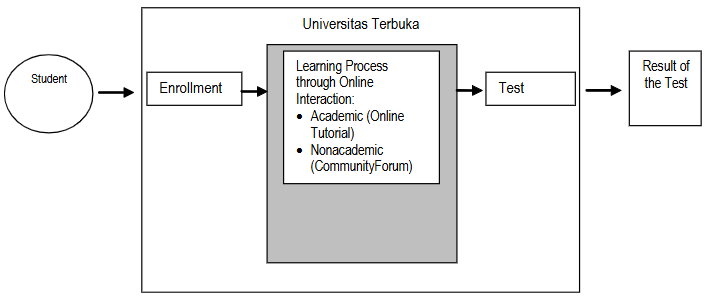
From some concepts of social presence and theories about learning process, this paper examinesthe articulation of social presence in UT’s online interactionswith the frame of work as follows.
Figure 1. Frameworkof Social Presence in UT’s Online Interactions
Methodology
This study identifies and describesindicators of social presence articulated by UT’s students andtutors in online tutorial activities and in Community Forum discussions. This study naturally seesthe social presence indicators. Therefore,it usesconstructivism paradigm with qualitative approach.
Discourse analysis is employed to analyze the online interactions. In analyzing social presence articulated in online tutorials activities and in Community Forum discussions, the early indicators of social presence proposed by Aragon (2013) as described in the literature review, are used. Those indicators can be seen in Table 1. However, modifications weremade since new indicators appeared in the process of data collecting.
Table 1. Indicators of Social Presence
| No | Indicators |
|---|---|
| 1. | The involvement of all parties actively |
| 2. | Chattering about small things |
| 3. | Tucking in humors along the conversations |
| 4. | Sharing stories and personal experiences |
| 5. | Informal calling or addressing |
This study elaborates indicators of social presence into two types of online interactions in the learning process at UT. For the interactions of academic content, the object of study is the interactions that occurred in online tutorial activities in the second semester of 2015. This study elaborates online tutorial classes with several different characteristics; tutors come from inside and outside UT (insource or outsource tutors), tutors with different gender (male or female), classes with a different number of students (small, medium and large). For that purpose, this study elaborates online interactions in classes of Livestock Product Process, Library Psychology, Semantics, Organizational Communication, Public Speaking, and Techniques in Finding and Writing News (Table 2).
Table 2. Lists of Analyzed Classes
| No | Class/Subject | Insource/Outsource Tutor | Gender of Tutor | Number of Students |
|---|---|---|---|---|
| 1 | Livestock Product Process | Insource | Male | 3 |
| 2 | Library Psychology | Insource | Female | 47 |
| 3 | Semantics | Outsource | Male | 101 |
| 5 | Organizational Communication | Outsource | Male | 190 |
| 6 | Public Speaking | Outsource | Female | 141 |
| 7 | Techniques in Finding and Writing News | Insource | Female | 80 |
For non-academic interactions in the Community Forum, this study analyzes the interactions in Community Forum discussions occurred in May to October 2015. The objective is to reveal the trend topics that become students’ interest to be discussed in one semester, starting from registration process to the announcement of the final exams results.
Data processed in this study were collected in two phases. First, is by documenting interactions occurring in online tutorials and Community Forum which become the object of research. Second, the data were inserted into a coding sheet, which corresponds the predetermined indicators of social presence. As supporting data, researchers conducted a Focus Group Discussion (FGD) conducted in two UT’s Regional Offices in Surakarta (Central Java) and Pekanbaru (Sumatra). The selection of two regional offices is based on interviews with coordinators of UT Learning Support Services in the two Regional Offices. To that end, researchers explore the causes of the low rate of student participation in online tutorial activities in both Regional Offices.
Social Presence in Online Interactions at Universitas Terbuka
In accordance with the preliminary design, the classes taken as the objects of research were Livestock Product Process, Library Psychology, Semantics, Organizational Communication, Public Speaking, and Techniques in Finding and Writing News.
From observations of the interactions that took place on the subjects of this study, the results can be seen in Table 3.
Table 3. Social Presence in Online Tutorials
| No | Indicators | Results |
|---|---|---|
| 1 | The involvement of all parties actively | Overall, we can say the activeness of tutors is still relatively low. This happens in both large classes and small classes. In the class of Livestock Product Process with three students, the tutor did respond to all comments/posts from students. However, the interaction that occurred in quantity is not high. In average of every week, both participants and tutors only sent one to two posts. The response rate of tutor was high because the tutor responded each student’s post. However, the quantity of interaction is low. |
| 2 | Chattering about small things | Indicators of social presence "chattering about small things", did not occur in all interactions that were analyzed. In general, when both tutors and students postedtheir responses, they always wrote directly to the issues. |
| 3 | Inserting humors along the conversations | Both tutors and students, almost never inserted humor to interactions. Except in the class of Semantics, some students inserted humor in the interaction. |
| 4 | Sharing stories and personal experiences | Sharing stories and personal experiences, almost never occurred in online tutorial discussions. If any student told his/her personal experience, it wascorrelated to the issues discussed. For instance, in Public Speaking class, students who had experiences in doing public speaking activities, sharedhis/her experiences in the discussion. In Organizational Communication class, when they were discussing about the materials relating to the organization, studentswho had experiencesrelated to conflict in the place where they works, sharedtheir experiences on it. |
| 5 | Informal calling or addressing | For indicator of informal call or form of address, this did not happen in online tutorial discussions. Communication that occurred in the online tutorial activities tended to be formal. Most tutors called students in a formal way, such as Saudaraor Saudara Mahasiswa. In the middle of a conversation, tutors called students with Anda which literally and politely means ‘you’. Even amongst fellow students also eventually used the same call with a tutor to greet other students;Saudara and Anda(both are the formal way for YOU since in Indonesia, we recognize several types in representing YOU). However, there were tutors who called students with informal calls and forms of address, like teman-teman literally meaning ‘friends’, teman-teman mahasiswa ‘student friends’, as well as calls and forms of address of Mbak literally meaning ‘elder sister’ and Mas literally meaning ‘elder brother’. Interestingly, the informal calls and forms of address were used by female tutors. The male tutors called students more formally. |
In addition to indicators of social presence as revealed by Aragon (2003) which wereused to analyze interactionsin online tutorials, this study also found other indicators of social presence that emerged in online interactionsas summarized in Table 4.
Table 4. New Social Presence Indicators in Online Tutorials
| No. | Indicators | Results |
|---|---|---|
| 1 | Using emoticons | The use of emoticons seems to have become part of the text-
based interactions. Although it occurs in interactions at online
tutorial as an academic forum, it turns out a lot of emoticons
appear along the discussion, especially used by students. They
aremostly used emoticons for smile and laugh. These emoticonswere used both by male and female students. However, tutorsdid not use emoticons when they deliveredthe learning materials. Students usually wroteemoticons when they responded to postings from other students. |
| 2 | Inviting participants/ students to furthertheir relationship outside online tutorial forum via other social media | As one of the countries with enormous social media users in the world, social media also penetrates in interaction in the online tutorial activities. In the discussion forum, there are students who invite other students to make friends in facebook by mentioning their facebook accounts. |
| 3 | Attaching profile pictures | For all tutors, they have to set their profile pictures as stated in the guidelines of online tutorials. The goal is to allow students to get to know their tutors and it was expected to increase students’ involvement in online tutorial activities. Compared to a few years ago, in the current online tutorial activitiesthe number of students who set their profile pictures increased significantly. |
| 4 | Using informal language | Although online tutorial isan academic forum, in the interactions there is the use of informal language. The informal languages tended to be used by female tutors. Male tutors tended to use formal language and speak directly to the point without using salutation, such as Hi... The use of informal language by students wasvery slightly, especially when the students commented postings from other students. |
| 5 | Motivations fromtutors | Tutors often motivated students by stating some expressions like "be success..." and "be enthusiastic…" |
For nonacademic category of online interaction, the indicators of social presence that can be analyzed are in Table 5 as follows.
Table 5. Social Presence in Community Forum
| No | Indicators | Results |
|---|---|---|
| 1 | The involvement of all parties actively | In Community Forum which was divided based on faculties and study programs, the response for the students’ posts was very minimum. The authorities from UT; the Third Vice Dean, The Head of Study Program, as well as the Academic Supervisor, they were very slightly responded the posts from students, even for the academic ones. |
| 2 | Chattering about small things | For small things relating to personal matters, it was not revealed in the discussions of the Community Forum. Things discussed always concerned with the study at UT. | 3 | Inserting humors along the conversations | Sometimes humor was given among students. |
| 4 | Sharing stories and personal experiences | Sharing stories and personal experiences occurred only in the related issues. This Community Forum actually serves as a medium for sharing experiences of students related to their studies at UT, such as pleasant, pathetic, annoying, frustrating, or amusing experience, i.e. successful in getting a good grade or successful completion of the studies with a high GPA. |
| 5 | Infomal calling or addressing | They tended to use informal addressing, such as mas, mbak, bro, gan ‘bos’ (all are representing the informal calls in Bahasa Indonesia which mean brother, sister, and boss). |
Besides indicators based on Aragon’s (2003) employed to measure the social presence, the study also finds some other indicators which can be categorized as indicators of social presence emerging from the discussions in the Community Forums used by the studentsto interact with UT and other students. The indicators are summarized in Table 6 below.
Table 6. New Social Presence Indicators in Community Forum
| No | Indicators | Results |
|---|---|---|
| 1 | Using emoticons | Most emoticons that emerge are smile and laugh. These emoticons are used both by male and female students. |
| 2 | Inviting participants/ students to further their relationship outside online tutorial forum via other social media | Students invite other students to make friends outside the Community Forum through social media such as Whatsapp group, the exchange of Black Berry Messenger (BBM) Personal Identification Number (PIN), BBM Group, and facebook. |
| 3 | Attaching profile pictures | More students set their profile pictures. |
| 4 | Using informal language | The use of language in Community Forum tended to be informal and more relaxed. They use many short sentences, spoken language, and a lot of punctuation, such as dots (....), abbreviated texts, and emoticons. For laughing, it was expressed with laugh emoticons and texts, such as "hahaha" or "hehehe". |
| 5 | Motivations amongst students | Many expressions are used to motivate each other amongst
students. Those phrases included “Be successful, be
enthusiastic, thanks, good luck, keep fighting, keep the spirit
high, OK guys, keep ur spirit, hope it can help and useful,
good luck for the final exams, I hope the results of the tests
will be great, success for the final projects, it was only one
step away !!! :) :) Regards for success.... Go ahead and be successful... Hopefully successful and get the best grade amin... OK, guys, those who began preparations, please keep on studying and studying, hopefully you’ll get great grades… |
For the topics discussed in Community Forum, this study sees the emerged issues as topics of discussion starting from May to October 2015. Six months is a cycle of academic activities for students from their registration to the announcement of final examinations. The top issues arising for six months are the results of the test, checking the grade of final examinations, re- enrollment, final projects, getting friends, asking about tutorials, accreditation of study program, sharing experiences, online tutorial, online examination system, online book store, and composing academic writing.
Of all topics emerged for six months of interaction in the Community Forum starting from May to October 2015, the trending topics were related to the results of the final examination, online tutorials, and academic writings. Some of the topics were indeed in line with academic activities that took place at UT, starting from the completion of the final test in which many students inquire about the test results, the topic of registration emerging in the period of registration, the topic of online tutorials appeared at the beginning period of online tutorials, and the topic about composing academic writing arose when the period of uploading academic writing came. Some other topics emerged unrelated with academic activities were looking for friends (being the trending topic most expressed almost all the time), inquiring the accreditation of study program, online bookstore, and sharing experiences.
Social Presence from Students’ Perspective
Besides analyzing the interactions occurring in the online tutorial activities and the Community Forum, to enrich the results of the study, researchers also conducted Focus Group Discussion (FGD). The purpose of this focus group is to explore the aspects of social presence of students. This FGD was undertaken in two Regional Offices (ROs), namely Surakarta and Pekanbaru.
Here are the results of FGD in UPBJJ-UT Surakarta. Eight students of Surakarta Regional Office joined the FGD, six students were from Communication Studies, and two students were from Management Studies. They all were the grantees of the Ministry of Research, Technology and Higher Education scholarship who enroll in UT with a particular scheme which was designed with face-to-face tutorials and equipped with training for special skills which are expected to enhance their academic ability. Scholarship recipients do have the necessity to obtain a GPA with certain standards. These factors may contribute to high average GPA of students receiving scholarships. In terms of age, scholarship recipients are still relatively young, at their early 20s. The designed scheme with face-to-face tutorials seemed to give a very significant contribution to their achievements. They were more highly motivated in reaching high grades.
For these students, since they met other students more intensively in face-to-face tutorials, they also created a group-based social media, such as Whatsapp (WA) group. The intensity of meeting face-to-face with this group of students occurred not only in the face-to-face tutorial forum but they also occasionally meet up outside face-to-face tutorial forum for discussing assignments of tutorials. Based on FGD results, the students do not take part in UT Online Communication intensively, both in online tutorials and the non-academic, discussions such as the Community Forum. For online tutorial activities, the very low feedback from tutors often demotivates students to persistently join the online tutorials. For the Community Forum, they considered sharing stories of other students was useful in enriching their information about the study at UT. It also motivates them to continue and improve their academic achievement.
Meanwhile, the results of the FGD held in Pekanbaru Regional Office are as follows. In Pekanbaru Regional Office, there were five students who participated in the FGD; 3 students of Communication Studies, one student of Biology Education, and one student of Governmental Studies. In terms of student characteristics, they are regular students who in the learning process did not rely purely on any mode of tutorials, whether online nor face-to-face. They also did not join any study groups. In other words, they were independent students. These five students have worked, and they admitted the difficulty in setting learning time. As they were the working students, then it was very hard for them to obtain good grades.
They also very rarely access the UT Online Communication both for the online tutorial and Community Forum. The reasons because of the very low response from the tutor and the UT authorities. For those who ever accessed Community Forum, they admitted that this forum was able to give them information related to the learning process in the UT and motivate them.
In the end, they felt alone because they did not know other friends who were at the same study program. They learned blindly because they were also busy with their work. For them, online communication at the UT did not give a contribution to their learning process.
Social Presence from Tutors’ Perspective
Some information was obtained from interviews of three online tutors. They primarily recognized the importance of social presence for UT students as distance learners. They sought to empathize with students. In the process of online tutorials that they managed, they made every effort to elicit social presence for students among others by giving motivation to the students to keep their spirit and their persistence in joining the online tutorials. However, they admitted that the bustling with other activities remain as an obstacle for them to be able to maximize their interaction with the students in the activities of online tutorials.
Conclusion and Recommendations
Conclusion
- Social presence is quite low in online tutorials as an academic-based activity at UT due to the formal sense of the interactions. Both tutors and students rarely use indicators that show the social presence.
- Social presence is more articulated in Community Forum which is non-academic interaction. Conversations tend to be more relaxed, more informal, students are free to express their feelings. Unfortunately, the response from UT in Community Forum is still minimum. In solving the various problems faced by the students expressed through this forum, they often get the solutions from other students. Interestingly, there are students who can act as role models, such as students who are successful in the study the and volunteered to be a resource for other students in solving their problems.
- In addition to the five indicators of social presence, other indicators that emerged from the results of this study are: using emoticons, inviting participants/students to further their relationship outside online tutorial forum via other social media, attaching profile pictures, using informal language, giving motivations from tutors to students and amongst students.
- Social media plays an important role for distant learners in bringing out social presence.
Recommendations
- Maximizing the role of tutors in online tutorials by articulating social presence more intensively.1. The ability of tutors in articulating social presence in online communication should be included in the guidance of online tutorials for tutors.
- Maximizing the function of Community Forum as the medium for communicating between2. students to UT. Each study program should make a regular schedule for every lecturer as academic advisors for students. The Vice Dean for Student Affairs in each faculty should supervise this Community Forum.
References
Aragon, S.R. (2003). Creating social presence in online environments. New Directions for Adult and Continuing Education, N100, 57-68. Wiley Periodicals.
Bandura,A. (1977). Social Learning Theory. Englewood Cliffs: Prentice Hall.
Bandura, A. (2006). Toward a psychology of human agency.Perspective on Psychological Science,1(2), 164-180.
Cui, G., Lockee, B., & Meng, C. (2012). Building modern online social presence: A review of social presence theory and its instructional design implications for future trends.Education and Information Technologies, 18(4), 661-685.
Darmayanti, T. (1994). Readiness for self-directed learning and achievement of the students of Universitas Terbuka (The Indonesian Open Learning University). Victoria, BC: Unpublished Postgradute Thesis for University of Victoria.
Duffy, T.M.,&Kirkley, J.R.(Eds). (2004). Learner-Centered Theory and Practice in Distance Education. New Jersey: Lawrence Erlbaum Associates.
Kadarko, W. (2000). Kemampuan belajar mandiri dan faktor-faktor psikososial yang mempengaruhinya: Kasus Universitas Terbuka. Jurnal Pendidikan Terbuka Jarak Jauh, 1(1).
Leong, P. (2011). Role of social presence and cognitive absorption in online learning environments. Distance Education, 32(1), 5-28. Routledge Taylor & Francis Group.
MacKenzie, L., & Ballard, K. (2015). Can using individual online interactive activities enhance exam results?MERLOT Journal of Online Learning and Teaching, 11(2). Retrieved from http://jolt. merlot.org/Vol11no2/Ballard_0615.pdf.
Moore, M.G. &Kearsley, G. (2012). Distance education: A systems view of online learning. MERLOT Journal of Online Learning and Teaching.
Nazari, H., Nazari, S., & Motlagh, F.S. (2013). Proposing a model for evaluation of effective electronic learning strategies on students’ achievement: A case study in virtual universities. European Online Journal of Natural and Social Sciences, 2(4), 631-637.
Ormord, J.E. (2012). Human Learning.6th Ed. London: Pearson.
Puspitasari, K.A.& Samsul, I. (2003).Kesiapan belajar mandiri mahasiswa dan calon potensial mahasiswa pada pendidikan jarak jauh di Indonesia. Jurnal Pendidikan Terbuka Jarak Jauh, 1(2).
Richardson, J.C., & Swan, K. (2003). Examining social presence in online courses in relation to students’ perceived learning and satisfaction.Journal of Asynchronous Learning Networks, 7(1).
Sedyaningsih, S., Asih, I.W., & Limbong, A. (2013). Analisis Difusi-Inovasi Model Komunikasi“Transactional Distance”dalam Layanan Bantuan Belajar Online.Unpublished Research.Universitas Terbuka.
Simonson, M., Smaldino,S., Albright, M., & Zvacek, S. (2012). Teaching and Learning at a Distance: Foundations of Distance Education (5th Edition). Foundation of Distance Education, Pearson Education, Inc.Boston MA 02116
Sorensen, C.(2014). Classrooms without walls: A comparison of instructor performance in online courses differing in class size.MERLOT Journal of Online Learning and Teaching, 10(4). Retrieved from http://jolt.merlot.org/vol10no4/Sorensen_1214.pdf
Sung, E., & Mayer, R.E. (2012). Five facets of social presence in online distance education. Computers in Human Behavior, 28 (5), 1738-1747.
Tu, C.H., & McIsaac, M. (2002). The relationship of social presence and interaction in online classes. The American Journal of Distance Education, 16(3), 131-150. Lawrence Erlbaum Associates, Inc.
Zimmerman, T., & Nimon, K. (2017). The online student connectedness survey: Evidence of initial construct validity.International Review of Research in Open and Distributed Learning, 18(3). Retrieved from http://www.irrodl.org/index.php/irrodl/article/view/2484/4139
Footnotes
* ^ The original version of this paper was presented at the 30th Annual Conference of the Asian Association of Open
Universities held at Crowne Plaza Manila Galleria, Manila, Philippines on 26 October 2016.
International Journal on Open and Distance e-Learning, Vol. 3 No. 1, June 2017 Issue