Indispensable Innovations in an English Listening and Speaking Class at an E-Learning Training System at Ho Chi Minh Open University (HOU)
Tuyen Nguyen Chau Bich
Lecturer, Ho Chi Minh Open University, Vietnam, [email protected]Abstract
The core value of the e–learning training system at Ho Chi Minh Open University (HOU) is being open to all learners who are interested in developing their knowledge, sharpening their practical skills under flexible learning conditions, and following quality training procedures. In some learning environments, e-learning courses using web-based learning, online exercises, media broadcast lectures, and the like are applied to encourage learners to access knowledge and promote improved learning performances. However, in English listening and speaking classes, learners with strong preferences, interests, determination, and personalization mechanisms can attain great achievements, but the rest do not perform at a high level. Hence, to improve the quality of this training model and meet the preferences and requirements of the learners, a survey questionnaire was administered to 120 sophomores in two listening and speaking classes at HOU. The results show that most learners expect some indispensable innovations, including increasing the class time to help learners gain more confidence and sociolinguistic competence in speaking in the target language; providing supplementary online exercises to support learner autonomy and improvement of listening skill; and maintaining the teacher-learner relationship to provide learners with opportunities for consultation and assessment.
Keywords: e-learning, indispensable innovations, sociolinguistic competence, consultation and assessment
Introduction
Chiefly recognized in various models of the modern university training system is the terminology “e-learning.” Wu Bing (2008) described the model of e-learning as the way of investigating the online interaction of learners. Suratinah (2009) strongly proposed that e-learning is an education system which encourages the demands of qualified high education in distance. Gervacio (2011) expressed that e-learning is the way of exploring the working effectiveness of online tutor and learners in various online learning activities. In 2013, in the paper of Subramaniam, e-learning was defined as “web-based learning” including four models of interaction as “student-student”, “student-instructor”, “student-content”, and “student–interface”. Moreover, Yanhui (2015) viewed e–learning as the form of online teaching and learning which is mostly based on massive records. In general, e-learning perspectives seem to be completely different in the eyes of educators and experts in diverse training contexts.
In the setting of Ho Chi Minh Open University (HOU), e-learning is known as distance learning, Internet-based learning, and “open learning” which mean learning opportunities are open to all people who are interested in accessing and improving knowledge, developing the profession, and changing social status. Due to this e-learning concept containing the meaning of distance learning and opened chances for learning at HOU, plenty of people interested in making improvement have signed up to numerous programs in this training system. Hence, the faculties, departments, and training centres in HOU have to think of ways to develop this e-learning training system. Designing or setting this up depends on the unique professional characteristics, and the various electronic appliances (i.e., including online exercises, web-based learning, teaching videos, social network and more).These learning sources chiefly support learners in their autonomy knowledge accessing.
In the environment of an English listening and speaking class at an E-learning System (Distance Training System) at HOU, the model of applying technology is completely ineffective. This is due to three factors: 1) individual characteristics in listening and speaking skills of English majors (e.g., communicative requirements, confident expression and language competence); 2) significant limitations of technology (e.g., inexperienced and newborn online system, a shortage of program designers); and 3) cultural influences (e.g., unwillingness of using technology in teaching and learning activities and the habits of face to face English classes, etc.). Evidently, the development of listening and speaking skills in the large international communicative environment (i.e., native and non-native speakers, learners and instructors, and peers and peers in particular fields) was admitted by numerous scholars. Boonkit (2010) however stated that lacking confidence and language competence are the greatest barriers of non-native English speakers. A series of solutions were suggested to help them improve, such as taking part in various classroom activities, seeking opportunities to expose ideas in a real situation, and carefully getting comments from other peers and instructors. Moreover, most Vietnamese learners have been deeply influenced by traditional culture as seen in the Vietnam proverb, “Nothing can succeed without the help of the teacher.” Most cannot expect to succeed in an online environment where learner’s autonomy is necessary, hence a consideration for face-to-face listening and speaking class.
The online training model in HOU has series of problematic issues that need to be solved, such as designing more professional and engaging online classroom activities, raising learners’ awareness in online autonomy, teaching learners the technique of applying technology in an online system, setting up the appropriate online assessment strategy, etc. A long-term and efficient e-learning training systems in HOU are required to solve these serious problems. Therefore, to ensure the high quality of HOU’s e-learning training system, to meet the requirements of the learners, and to satisfy the current condition of HOU’s e–learning system, indispensable innovations are needed. These include increasing more hours of class attendance, providing supplementary online exercises, and maintaining the close relationship between the teacher and learners should be taken into account in an English listening and speaking class at an e-training system in HOU. Thus, this research was necessary to be undertaken.
This research was carried out to understand the perspectives, attitude, perceptions, and expectations of English major learners in HOU e-learning system through some suggested essential innovations that benefit the learners in particular and HOU in general.
The research questions mainly focus on the following problems:
- Which training model would learners with major in English in HOU rather take part in an English speaking and listening class online learning model or face-to-face model?
- What benefits in language skills and social communicative skills can learners with major in English in HOU get when participating in a face-to-face English listening and speaking class?
- What innovative expectations would learners with major in English in HOU like to get from the e-learning training system at HOU?
Objectives
This research aimed to gather personal information such as age, gender, living area, and learning motivations from the distance learning participants to draw out the general picture supportive of planning training strategies for the E-learning training system at HOU. Furthermore, the research was set to understand learners’ perceptions in the process of learning to evaluate the qualified training criteria in this training system and to propose some positive adjustments. In addition, the research aimed to collect learners’ attitudes, perspectives, and expectations to project some appropriate improvements and indispensable innovations for HOU’s e-learning training system.
Literature Review
Previous studies strongly supported the benefits of applying technology in e-learning training system. According to Thurmond & Wambach (2004), “a new form of interaction” mostly “depends on the increased processing power of computers”. Yanhui (2015) viewed e-learning as “a form of online teaching and learning,” wherein activities are “mainly based on massive records.” This training model has been widely used in numerous HOU majors such as Economics, Finance and Banking, and Economics and Laws. However, in an English Listening and Speaking class at the E-learning training system, the “recording teaching and learning model” is not yet applied due to the complexity and difficulties of the Listening and Speaking skills. Shumin (1997) acknowledged that the effectiveness of speaking skill involved other elements like listening skill, social cultural factors, linguistics and social linguistics, and competence (i.e., grammatical, discourse sociolinguistic, and strategic competence). Boonkit (2010) recognized “confidence, creativity of topics, and speaking competence” as “the key aspects of improvement when speaking to the audience.” He also suggested “an action study in a regular course employing a task-based approach.”
Access, content, and technology are the three core values of e-learning, but HOU experienced limitations on these due to the complicated characteristics of listening and speaking skills, and their new experience with distance training. The English-speaking classes at HOU E-learning training system are maintaining traditional training through a face-to-face class. This model was shown to be extremely effective after Walker, Davies, & Hewer (2012) clarified the weaknesses of using technology with Skype to interact with partners. Although Skype provided opportunities for development of listening and speaking skills for learners who have few opportunities to practice their oral skills, and benefit from practice with peers from other countries (Blake, 2008), its inconveniences include time zone differences, and problems with computer equipment or internet connection. Similarly, Patil (2008) asserted that to eliminate the learners’ fear of making errors, it is important for the teacher to consider making the learners feel comfortable in language usage. A “face to face class” is integral to encourage them to overcome their fears and get more confidence in their speaking skill.
The speedy development of technology has great influence on various training systems. A great number of scholars and educators take advantage of this advanced technology by applying it in a variety of teaching methods and learning models. The student-student, student-instructor, student-content, and student-interface are the four modes of interactions that can be easily carried out and developed in a web-based learning environment (Thurmond & Wambach, 2004). Wu Bing (2008) was grateful that learning and communicating are perfectly convenient for learners through the online mode. Similarly, Blake (2008) highly recommended applying technology with Skype to provide excellent opportunities for development of L2 listening and speaking. This is because L2 learners have a few opportunities to practice oral skills, and even fewer opportunities to practice with peers from other countries. As an example,common handicaps are easily solved by the implementation of socio-constructivist activities through Skype (Blake, 2008). Noon-ura (2008) stated that to enhance the speaking ability of participants especially in out–of-class conditions, applying technology to some activities which use various English materials (i.e. listening to music, watching movies, listening to the radio, watching television programs, and accessing multimedia websites) is encouraged.
Gervacio (2011) supports the working effectiveness of online tutor and learners in online learning activities. This online tutor–learner activity is evaluated on global managing and tutoring communities, describing the strategy and positive practices as planning, implementation, monitoring and assessment, etc. A new form of interaction which is student interface interaction mostly depends on the increased processing power of computers and the advancement made in the field of artificial intelligence (Thurmond & Wambach, 2004). In general, technological interference seems to be greatly supportive to all training systems and it has more significant influence on e-learning training system in the world. Although this e–learning training system contributes positively to learners when it comes to accessing knowledge, attaining confidence, improving autonomy, developing critical thinking, improving social cultural background, widening social relationships, achieving social linguistics, etc., it still has some problems in definite training conditions such as problems of school facilities, special characteristics of various professions or typical subjects, and issues on technological appliances not being applied in an effective manner.
The negative examples of technology in training system, as Walker, Davies, & Hewer (2012) investigated the limitations of using technology with Skype in partner interaction, are time difference, computer equipment, or internet connection. In the context of the e-learning training system at HOU, some limitations in the three core values of e-learning training (i.e. access, content, and technology) existed (AAOU, 2016). Thus, manyof the subjects related to business, finance professions and others which encourage the autonomy of learners seem to have a perfect design and establishmentof applying technical appliances with plentiful online exercises, web- based learning, teaching videos, and social network media etc. In contrast, with listening and speaking classes, the preference of face-to-face learning model is taken into consideration due to special variables of confidence, sociocultural background, sociolinguistic competence, social relationship, and numerous sharpened skills of self-studying, assessment and correction. These concepts and perspectives are utilized by experts such as Patil (2008) who asserted that to build up the confidence of learners and eliminate the fear of making errors, the teacher should prioritize making learners feel comfortable in using the language. This point of view gives strong admission that language learners need to have direct face-to-face interaction with the instructors, so that learners have more opportunities to express feelings through eye contact and facial expression to solicit practical appreciation and encouragement from the teacher.
Similarly, learners get benefits through immersing in the host country. They also get the chance to develop their confidence through practicing the target language at all times (Iglesias, 2016). This also leads to the confidence of learners brought about by direct experience. Plus, Bailey (2005) & Songsiri (2007) said that learners could obtain confidence and competence in speaking skill if the appropriate syllabus design, teaching methods, sufficient tasks and materials are fully provided and developed. In the paper of Iglesias (2016), “a student-teacher ratio of one-to-one does not often yield the same results as those deriving from a more crowded class.” This perspective emphasized that the class size greatly affects the quality of interaction and learning. Evidence shows that a great number of UK language schools currently employ mini-group classes of two to four students to assure enhanced interaction. In reality, larger groups also allow for fruitful outcomes, except the class size alone does not give efficiency in language competence. This implied that having direct communicative environment among members is the best solution in language learning. Generally, speaking skill is a productive skill in output process; it has key criteria which are appropriate in face-to-face class. As Shumin (1997) pointed out, the effectiveness of speaking skill could not be excluded from some elements such as listening skill, social cultural factors, linguistics and social linguistics competences including grammatical, discourse, sociolinguistic, and strategic competence. These significant criteria strongly support the interaction function and training objectives in English listening and speaking class in an e-learning system at HOU. The questionable issue taken into consideration is the interactivity of face-to-face or online class. Indeed, to satisfy responses and to attain the appropriate and innovative English training model, survey questionnaire were administered to second year learners who have attended English speaking and listening classes.
Methodology
This research is descriptive and qualitative. The research variables are the perspectives, attitude, perceptions, and expectations of learners with major in English at the e-learning training system of HOU. The perspectives of learners were mostly analyzed in the form of general information and point of view of taking part in the e-learning English training course. The attitude and perception of learners in terms of their feelings and thinking during the learning process were evaluated through questionnaire responses. Learner expectation, based on the learners’ contributive spirit, is checked to make valuable future changes with the aim of enriching the learning program and giving more benefits to the learners of this e-learning system. The population of this research is urban and rural second year students, males and females, who have attended listening and speaking classes. The respondents of this research are 104 students from the 120 sophomore students majoring in English in HOU in 2014. Interviews and survey questionnaires were used in data gathering. The collected data were applied in the research and the data analysis was based on descriptive simple analyses.
Results and Discussions
Understanding personal information of learners as age, gender, and living area helps to recognize the practical motivations, great learning attitude, real perceptions, and expectation of learners. The following tables show the results from the answers of the respondents.
Figure 1. Personal Information of Learners
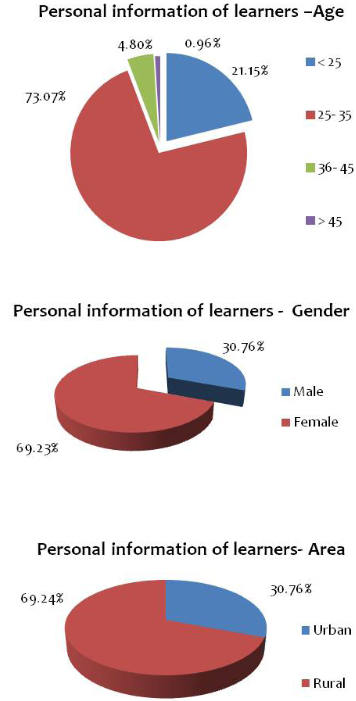
In Figure 1, it is shown that 73.07 % of the respondents are of ages 25-35 years old, 21.15 % of the respondents are under 25, 4.8% of the respondents are between the ages 36- 45 years old, while .96% of the respondents are over 45 years old. This number shows that the respondents who are of the working age are more mature in terms of selecting their profession, are more responsible for their learning, and are more dedicated in obtaining more progress and achievements.
In addition, the, number of female learners is as twice as much as male learners. This demonstrates that more females are interested to pursue a degree in English at HOU e-learning system. Through short and informal interviews, female learners who participated in this training revealed their motivations, such as teaching their children English, improving their performance in the workplace, or getting to communicate more effectively. . On the other hand, data showed that 30.76% of the respondents reside in the provinces while 69.23% live in Ho Chi Minh.This clearly states the demand of learning andusing English in the city is higher than in the provinces. This makes attending face- to-face classes in city more convenient
These data show that the respondents do not hesitate to reveal their own perspectives, express attitudes and perceptions, give positive or negative feedbacks, or even show their privilege to expect better condition or training quality. Hence, some essential innovations of HOU’s e-learning training model need to be taken into account.
Table 1. Perspectives of the Learners
| 1. Enjoy English speaking and listening skill | % |
| Yes | 99.03% |
| No | 0.98% |
| 2. Reasons of taking part in e –learning training system | % |
| Less time in class attendance | 21.15% |
| Taking in knowledge to support major | 63.46% |
| Getting degree | 15.38% |
Table 2 shows that majority of the learners commute to work on weekdays. Thus, the available distance training courses offered to learners on weekends are completely appropriate. In such a strict learning condition, learners must have strong determination and motivation to take part in these courses. In fact, 63.46% of the learners express their desire to access knowledge to support their major, while 21.15% of the learners claim to attend this training course because it requires less of their time. 15.38% of the learners enjoy this learning model to get their needed degree. Besides, one more question is carried out to check the passion of learners in listening and speaking skills, and 99.03% of them expressed strong interest in these skills.
In summary, according to the data presented in Figure 1 and Table 1, the learners with the major in English language in HOU’s e-learning training system are mostly females aged between25 to 35 years old who lives in HCMC. This means that HOU’s e-learning model is perfectly designed to offer active working people who enjoy taking more opportunities and spending time to improve themselves, particularly their English skills.
Table 2. The attitude of learners
| Attending in English L & S class | Fully attend (61.53%) | Regularly attend (34.61%) | Sometimes attend (3.84%) | Not regularly attend (0 %) | |
| Learning methods in distance training system\ | Mainly learn through internet (online, websites.) (9.61%) | Autonomy in Reading & Writing skills (67.30%) | Face to face” in Listening & Speaking Class (76.92%) | Set up various online listening exercises (66.34%) | |
| Getting more benefits in a “face to face” speaking class | Fully agree (71.15%) | Quite agree (11.53%) | Agree (13.46%) | Disagree (0%) | Fully disagree (0%) |
The result shows that 61.53% of the respondents fully attend the class, 34.61 % of them regularly attend the class, and 3.84%. of the learners sometimes participate in class=This shows that the learners are more attentive and interested in learning English. Furthermore, 76.92 % respondents believe that the e-learning training system should have face–to-face English speaking class, while 66.34% of the respondents indicated that HOU should set up more online listening exercises to improve listening skill. Besides, the attitude of learners are also clearly expressed, as 71.15% of them have agreed to getting more benefits when learning from a face-to-face speaking class. Take an observation of Table 2, it is no doubt to give conclusion that learners seem to have good attitude in attending an English listening and speaking class though they have to put more investment in this training model.
Table 3. Perceptions of learners
Getting English language skills & Social communicative ability in a “face to face” speaking class
| Improving English pronunciation (69.23%) | Getting confidence in public (72.11%) |
| Improving fluent expression ability (65.38%) | Creating good relationship between teachers & learners (62.5%) |
| Improving listening ability (various accents) (61.53 %) | Having self-correction (65.38% ) |
| Learning from various peers’ expression styles (48.07%) | Developing team work ability (48.07%) |
One of the most practical factors that make e learners feel more interested in learning English from a face-to-face listening and speaking class is their perceptions of the courses. Data show that 71.15 % of the learners fully agree that they can obtain language skills and social communicative ability when learning English in face-to-face listening and speaking classes. Specifically, the learner claimed that they improved in the following: English pronunciation (69.23%), English fluency (65.38%), and listening skill (61.53 %). They also claimed to: get more confident in public (72.11%), establish good relationship between teachers and learners (62.5%), and correct their language (65.38%).
In summary, the data show that it is essential to take these benefits into consideration in order to have innovation in HOU’s e-learning training system
Table 4. Expectations of learners
| Question: Do you have any suggestions to innovate in our teaching and learning activities of e –learning training system? (please clearly write down your proposals) | |||
|---|---|---|---|
| 1. | Increasing the periods of learning face to face in English Listening and Speaking classes | 67.30 % | |
| 2. | Setting up various online listening exercises from simple to complicated | 65.38 % | |
| 3. | Maintain teachers and learners relationship | 61.53 | |
| 4. | Keep balance between English and Vietnamese | 28.84% | |
| 5. | Give more time for final test preparation | 38.46 | |
Table 4 shows the data obtained through an open-ended question regarding the learners’ expectations. Data show that the top three suggested criteria include: increasing face-to-face learning hours in English listening and speaking class, designing more online exercises from lower level to higher level listening skills, and keeping contact between teacher and learners. The percentages of this result in Table 4 support the basic requirement of the research.
Conclusions and Recommendations
The e-learning training system at HOU has special characteristics, especially the English listening and speaking class. Listening skill is required in all levels, from beginning to advanced, to help learners practice their listening skill in an effective way. However, with the English speaking skill, almost all learners expressed their wish to take part in a face-to-face English speaking class. They believed that learning face-to-face in class help them to have strong social linguistic competence in terms of pronunciation, fluent expression, and listening skill. Besides, learners can develop their social communicative ability in a face-to-face class. Also, more listening exercises in various levels should be designed and set up online to encourage learners’ online autonomy and to improve their own listening skill. Together with e-learning condition, maintaining the relationship between the teacher and learners is a good suggestion because learners do not have enough time to attend class. Moreover, from the point of view of teachers, they get to more efficiently support.
It can’t be denied that advanced technology can be applied in the e-learning training system. However, it depends on the condition, context, and the special major or subjects. Other models such as a face-to-face English listening and speaking class is recommended in order to have essential innovations. The study is conducted to understand the information, perspectives, attitude, perception, and expectation of learners in HOU’s e-learning training system. The findings also showed the innovative expectations of learners. Hence, it is recommended that the results of this study be taken into consideration in order to benefit learners and the e-learning training system to increase income and strengthen the reputation of HOU.
References
Bailey, K.M. (2005). Practical English language teaching: Speaking. New York: McGraw-Hill
Boonkit, K. (2010). Enhancing the development of speaking skills for non-native speakers of English. Procedia - Social and behavioral sciences, 2(2): p. 1305-1309.
Gervacio, J.L.(2011). Tutors and learners without borders:In a relationship but it’s complicated. Asian association of open universities journal, 2011. Vol. 6, No. 1,: p. 24-31.
Iglesias, M. (2016). Language travel supply: the language learning programme. Procedia - Social and behavioral sciences, 232: p. 242-249.
Noon-ura, S. (2008). Teaching listening speaking skills to Thai students with low English proficiency. Asian EFL journal, 10(4). 173-192. Retrieved from http://www.asian-efl-journal. com/December_08_sna.php
Suratinah, S.D.A. (2009). Managing perfect distance services to meet the distance students complains. Asian association of open universities journal, 4 (2), 77-85.
Subramaniam, N.K. (2013). Web-based learning through mixed-initiative interactions: Design and implementation. Asian association of open universities journal, 8 (2), 19 - 31.
Patil, Z.N. (2008). Rethinking the objectives of teaching English in Asia. Asian EFL journal, 10 (4), 227-240. Retrieved from http://www.asianefl-journal.com/December_08_zn.php
Taillefer, L. and R. Munoz-Luna, (2014). Developing oral skills through skype: a language project analysis. Procedia - social and behavioral sciences. 260-264.
Thurmond, V., & Wambach, K. (2004). Understanding interactions in distance education: A review of the literature. International journal of instructional technology and distance learning, 1(1), 19 – 23.
Shumin, K. (1997). Factors to consider: Developing adult EFL students’ speaking abilities. English teaching forum. 35 (3),8. Retrieved from http://eca.state.gov/forum/vols/vol35/no3/ p8.htm
Yanhui Han & Shunping Wei Shaogang Zhang. (2015). Analysis of online learning behaviour from a tutor perspective: Reflections on interactive teaching and learning in the big data era. Asian association of open universities journal, 10 (1) 29 -48.
Walker, R., Davies, G., & Hewer S. (2012). Introduction to the Internet: Module 1.5 in Davies, G. (ed). Information and communications technology for language teachers (ICT4LT), Slough, Thames Valley University.
Wu Bing (2008.), T.A.P., A comparative analysis of learners interaction in the online learning management systems: Does national culture matter. Asian association of open universities journal, 3 (1) 2008.
International Journal on Open and Distance e-Learning, Vol. 2 No. 2, December 2016 Issue