New Media Usage and Its Perceived Effects on Classroom Communication and Learning Behavior
Patricia Ann E. Vera
Professor, Assumption College, Philippines, [email protected]Abstract
The study delves on how new media tools have impacted classroom communication and learning behavior. Conducted at the Assumption College among college students and professors, the study showed that there is no relationship between new media tools usage with learning behaviors of self-efficacy and motivation. However, it was found that there’s a strong relation between technological competence and motivation and self- efficacy. Further, it was also shown that the ubiquity of technology has not been fully utilized in classroom communication.
Keywords: New media tools usage, learning behaviors, classroom communication
Introduction
Learning is not a spectator sport. Students do not learn much just by sitting in class listening to teachers, memorizing pre-packaged assignments, and spitting out answers. They must talk about what they are learning, write about it, relate it to past experiences, and apply it to their daily lives. They must make what they learned as part of themselves (Chickering and Gamson, 1987, p. 3).
Education is probably the biggest single factor that influences the quality of life of an individual. Traditionally, an average student spends at least 12 years of his or her youth in school. The classroom is a significant setting for a student to develop reasoning and judgment skills, make friends, and more significantly, form character. That is, if what is passed on in the classroom is perceived to be relevant to them. For this reason, it is essential to keep on analyzing what makes this significant segment of one’s life more interesting and productive and pertinent to their future endeavors.
With the rise in technology, however, a new challenge in the classroom has arisen. Observing the youth of today and their obsession with technological gadgets, a teacher is inclined to rethink his or her mode of instruction to adapt to the changing dispositions of the students and to provide an equally fascinating presence. The use of new media (e.g. blogs, mash-ups, websites, online collaboration tools, podcasts, social networking sites, mobile, photo and video sharing, QR codes, RSS feeds, webcasts, webinars, social bookmarking) which the youth has so willingly embraced can be viewed both as a friend or a foe. New media has provided easy and fast access to information, giving an up-to-the-second update to the tech savvy. In this aspect, it is an invaluable companion. However, its fangs appear when it starts to control the students’ lives by serving as a replacement for face-to-face interaction and learning, hence replacing positive influence from teachers and mentors.
Objectives
Although there have been worldwide research directly relating technology use with improvement in students’ academic performance, it is still unclear if these studies are indeed relevant in the Philippine setting. Does technology use further accentuate the digital divide between the developed countries and the developing countries? If the student is tech savvy, does this translate to their self-efficacy making them more confident and willing to actively engage in learning? Can classroom communication be updated to accommodate these technological trends? Are professors ready to adopt these technological updates and develop new modalities to be more effective in delivering their subject matters and stay relevant in the 21st century? Are they equipped to use new media and adjust to the changing learning environments with confidence? Is there a gap between student readiness, technological influx and teacher competence in the classroom communication?
Changes in society happen through a long process of adoption that involves educating different participants to break down barriers or resistance. The process is expedited if the target adopters are cooperative and are willing to embrace the change. Couple this with societal pressures and glaring benefits and the change becomes permanent.
In classroom communication, technology has changed the landscape. Those born to new media or those who we call the digital natives have embraced it and adopted it as their way of life. These digital natives, born in the mid-nineties to late 2000’s, are those that we now call as Generation Z. On the other end of the room are the professors who have to learn and accept these technological changes. They were taught the traditional way and are thus passing on knowledge and conducting classroom communication in practically the same manner.
This paper intends to address these issues on classroom communication. The researcher would like to find out the usage level of new media tools among students to what extent they have brought this to the classroom, and if such classroom instruction has any relation to improving learning behavior of the students and the classroom communication between students and professors. Specifically, it aims to answer the following questions:
- What is the usage level of new media tools of students?
- What do students perceive about professors’ use of new media tools?
- What is the relation between students’ new media usage and their learning behavior?
- What is the usage level of new media tools of professors?
- What do professors perceive about the students’ use of new media tools?
- What is the relation between the students’ and professors’ new media tools usage and classroom communication?
- What trainings are professors willing to undertake to enhance classroom communication?
Furthermore, it is to the interest of the researcher to discover if the professors and instructors have coped with these changes to bridge this seeming communication gap between them and their students. With meaningful learning as the ultimate goal of teacher- student interaction in the classroom, the study hopes to tackle also the effects of these technological adoptions to the learning behavior of the students.
Theoretical Framework
New Media Tools
With the ubiquity of technology, demands and requirements for effective communication have drastically changed. The effects of this technological burst have affected communications everywhere including the classroom. With the intention of creating meaningful learning and maximizing technological benefits, classroom communication needs to adapt to this change. PowerPoint presentations have been prevalent to deliver lessons to the students. Teaching- learning process in schools used ICT facilities which include “include radio, television, computers, overhead projectors, optical fibers, fax machines, CD-ROM, the Internet, electronic notice boards, slides, digital multimedia, and video/VCD machines” (British Educational Communications and Technology Agency, n.d.).
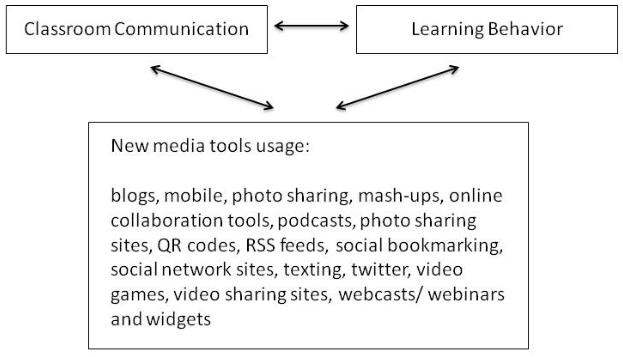
A listing of new media tools includes blogs, mobile, mash-ups, online collaboration tools, podcasts, photo and video sharing sites, QR codes, RSS feeds, social bookmarking, social network sites, video games, and webcasts/ webinars (Aids.gov, n.d.).
Blogs are websites usually initiated by individuals and consistently updated, who want to express their thoughts and comments about certain issues and trends or products. The main purpose is to engage their readers and encourage them to leave their footprint on the blog spot. Some of the more popular blogging platforms are Blogger, Word Press, and Tumblr.
Mobile is sending and receiving messages through the cell phone or other wireless devices. It includes mobile web, mobile applications, or texting. Messages may also vary from mere words (SMS or short service message) to pictures, video, or audio (MMS or multimedia messaging).
A mash-up is a combination of data from two sources or more for a single interface. An instructor can combine his or her source of lecture with a testing site for an immediate learning feedback. Online collaboration tools allow for people to work together via the internet (Aids.gov, n.d.). Wikipedia is one example where the reader can edit, modify, or contribute to the body of knowledge presented on the site. Popular wiki platforms are PBWorks and twiki. Cloud storage is another platform that allows individuals to back up their files on a server and not on a CD or a hard drive. It can be accessed by one person or be made accessible to multiple people. Email is an example of cloud storage. Dropbox, Box, SugarSync, and Microsoft SkyDrive are others.
Photo or Video Sharing Sites allow the uploading, storing, editing, organizing, and sharing photos and videos. One can comment or tag people in the pictures, too. Common sites include Youtube, Vimeo, Flickr, Shutterfly, Picasa, Photobucket, Twitter, or Facebook. Instagram is a mobile app that shares pictures as well.
Podcasts are audio or video files that can be accessed through the computer or any mobile device. They can be accessed through streaming or downloading. A directory of podcasts is listed in iTunes, Podbean or SoundCloud.
QR codes or quick response codes provide information through scanning of a barcode. It is meant to direct the scanner to a website that provides information, video file, or contact information. It is possible to track when, where, and how many people are using the QR code with Google analytics. Phil. Daily Inquirer has this normally in their cover stories to access more pictures or details of a certain news item. Advertisers also use this to provide more information to interested consumers.
RSS stands for “Real Simple Syndication”. You simply subscribe to a particular website and automatically receive updates via email or news reader (Aids.gov, n.d.). Newspapers and TV stations provide this to update their audience of the latest newsworthy events.
Social bookmarking is another new media tool that stores and organizes websites in an orderly manner for future use and sharing. Sharing may be done publicly or with specific networks. They are like folders which have name tags for orderly filing.
Social Network Sites are online communities that allow sharing of information, comments, pictures, or videos. Online communities are whoever you would like to share information with. Popular sites for this are Facebook, Google+, and LinkedIn.
Video and computer games are played on game devices like Nintendo, PlayStation or Xbox and computers. They can be played singly or in bigger numbers (MMO/ Multiplayer online games). When one participates in an online video game, there is more engagement among the players. Mostly, games are for entertainment purposes. But they can also have educational games.
Webcasts or webinars are conferences conducted on the net. It may be real time or pre-recorded; maybe interactive or one-way. Some of the vendors for webcast and webinar seminars are WebEx; Go to Webinar and Ready Talk. According to Bagui (1998) multimedia “may have unique capabilities to facilitate learning because of the parallels between multimedia and the natural way people learn,” that is, through visual information and imagery. Mayer’s Generative Theory of Multimedia Learning combines both images and speeches to boost up students’ learning process. It is because delivering of information and elaboration has been separated into verbal and visuals that enable students to understand by listening and envisage by images (Macaulay, 2000).
Current Classroom Communication Practices
Traditional classroom communication involves a teacher with a lesson plan delivered to a group of students who are taking notes and are occasionally participating in the discussion. Understanding the prevalent learning disposition of college students helps the professors and instructors to adapt a teaching style that will enhance classroom communication and improve student-teacher interaction, resulting in a better classroom environment conducive to better comprehension, a deeper sense of self-fulfillment, and heightened confidence to discuss and relate concepts to the real world.
The Felder study (Felder-Silverman model 1996) as cited by Katsioloudis (2012) classified students under one of the four learning style dimensions:
- Sensing learners (concrete, practical, oriented towards facts and procedures) or intuitive learners (conceptual, innovative, oriented towards theories and meanings);
- Visual learners (prefer visual representations of presented material—pictures, diagrams, flow charts) or verbal learners (prefer written and spoken explanations);
- Active learners (learn by trying things out, working with others) or reflective learners (learn by thinking things through, working alone);
- Sequential learners (linear, orderly, learn in small incremental steps) or global learners (holistic, systems thinkers, learn in large leaps) (Felder,1996).
The same study mentioned that most people, college age and older, are visual learners (Katsioloudis, 2012), while most of the college teaching is verbal. This discrepancy can lead to an uninteresting, unstimulated classroom communication. While the study was done almost 25 years ago, it can be observed that very minimal changes have occurred in the teaching method in the Philippines. Professors tend to explain concepts verbally aided with the Powerpoint presentations. According to Katsioloudis (2012), most professors will teach the way they were taught, even to the detriment of student learning. The professor’s failure to adapt to the changing educational landscape will not bring out the best in students, and this can be gleaned from their grades and attendance rates. Learners make the most out of information when they can select information and organize it into representations that make sense to Jonassen (1991).
Meaningful learning occurs when the students are allowed to construct knowledge for themselves. Use of technology in education has the potential to maximize meaningful learning when the student can make sense of learned concepts and apply and interpret them into unique understandings. In other words, the learning process is more efficient when it is built on previously acquired knowledge, and it will be more useful if the student is actively implicated in the learning process (Jonassen, 1991).
According to the constructivist theory, to promote student learning, it is necessary to create learning environments that directly expose the learner to the material being studied. It further elaborates that only by experiencing the world directly can the learner derive meaning from them. Since accessibility to information and subject matters can be had with online resources, then indeed, the student can make a more sensible connection between what she has actively pursued reinforced by the professor presentation or the other way around. As Nobel laureate Herbert Simon wisely stated, the meaning of “knowing” has shifted from being able to remember and repeat information to being able to find and use it (Simon,1996).
Schools can continue to employ traditional teaching methodologies and produce “satisfactory” (within the established assessment paradigm) learning outcomes as it has done so for many years. But in the light of technological development, an inconvenience arises when the different knowledge production and management skills that broader society demands are taken into account (Demetriadis, S. M. (2003).
Adoption of ICT in Classroom Communication
Information and communication technology (ICT) refers to technologies that provide access to information which includes new media tools. According to studies on ICT literature, such convergence has great potential to enhance student achievement and teacher learning. Technology can be a great tool in the classroom since they are interactive and can be used to create environments in which students can learn by doing, receiving feedback, continually refining their understanding, and building new knowledge. It was pointed out, however, that its mere presence does not simply enhance student learning and achievement. Unless properly utilized, resources spent on ICT are just going to be money and time wasted.
In the BECTA research, it is stated that ICT learning could prosper in schools when there is adequate resourcing, ICT leadership, ICT teaching, school leaderships, and general teaching. It further elaborates that progress will vary depending on curriculum place, class, and the various ways on how it is applied. Balanskat (2006) also found that limitations on ICT knowledge make teachers feel anxious about using ICT in their classrooms. In the research, it was mentioned that the use of ICT in education and training has been given priority in most European countries during the last decade, but progress had been uneven. There were considerable differences of ‘e-maturity’ within and between countries, and between schools within countries. A small percentage of schools in some countries have embedded ICT into the curriculum, and have demonstrated high levels of effective and appropriate ICT use to support and transform teaching and to learn across a wide range of subject areas. Most schools in most countries, however, are in the early phase of ICT adoption, characterized by the patchy un-coordinated provision and use, some enhancement of the learning process, some development of e-learning, but no profound improvements in learning and teaching.
It is noteworthy to say that progress can be achieved if infrastructure was in place. With infrastructure comes accompanying costs. All EU countries have invested in ICT in schools: equipment, connectivity, professional development, and digital learning content. Some recent studies have begun to provide evidence of the return on investment.This study, carried out in the framework of the European Commission’s ICT Cluster work, addresses the question of what have been the results or impact of ICT investment and integration in schools in two major areas, namely the learning outcomes and learners, and teaching methodologies and teachers.
In a survey of ICT and Education in Africa: A Summary Report (Farell, 2007), based on 53 Country Surveys over a 3-month period starting January 2007, states that the process of adoption and diffusion of ICT in education in Africa is in transition. Macro trends include multi-partnerships that involve private companies (usually ICT-based), one or more government ministries, educational institutions, donor and development agencies, and civil society organizations working together to garner resources and set priorities for ICT in education projects. The study is mostly based on projects and initiatives and good financing models which should be in place to make this necessity a reality for the progress of the nation.
Martins, de Carvalho, & Carrapatoso (2008) cited the use of Adaptive Hypermedia to adapt its contents, navigation, and interface to the user needs. Consisting of user model components and the Domain Model, the purpose of this system is to deliver courses over the web. Through the user model, they can identify the information, knowledge, and preference levels of the user to extract conclusions on the user characteristics so the system can be customized according to these characteristics. The Domain Model, on the other hand, represents individual topics and concepts. The first version of the framework was already implemented, tested, and evaluated in learning processes in higher education. According to the research, the collected evaluation data has shown a very high degree of interest and motivation from students and teachers alike, resulting from its use. It further stated that students also perceive this tool as very relevant for their learning, as a self-operating application to be integrated into a more global learning strategy that also includes tutoring (direct contact with the teacher) and peer learning.
Professors’ Level of Technology
“Teachers seem to have totally accepted the necessity of ICT use in teaching” (Demetriadis, 2003) Although such belief has been acknowledged, it is worth finding out if teachers’ acceptance is indeed backed up with a proficient working skill on the mediums. If teachers lack the confidence to carry out instruction that targets such skills, they will not be very likely to use such skills in their classrooms (Farah 2011).
In the including interviews, focus group discussions, and a document analysis, the two factors on how to increase teacher self-efficacy turned out to be 1) to utilize more targeted and specialized teacher training on instructional technology and 2) increased knowledge of and access to instructional technology tools and resources(13). This maintains that when teachers are asked to use technology to facilitate learning, some degree of change is required in (a) beliefs, attitudes, or pedagogical ideologies; (b) content knowledge; (c) pedagogical knowledge of instructional practices, strategies, methods, or approaches; and (d) novel or altered instructional resources. This further means that a support system has to be in place for ICT adoption to be smoothly implemented. Teacher acceptance of technology is also strongly influenced by perceived usability and self-efficacy (Holden & Rada, 2011). Unless technology is perceived to make a difference in the learning behavior and self-efficacy of students, the resistance to adoption is high. “Technical barriers impeded the smooth delivery of the lesson or the natural flow of classroom activity” (Sicilia, 2005,p. 43). These technical barriers may include lack of knowledge and working skills that professors need to be able to match students’ abilities and ease in using the mediums. Becta’s survey of practitioners (Fullan, n.d.) shed light on the fact that lack of confidence was the problem most participants identified. These teachers require extensive training and support systems to be able to acclimate themselves to the new technology. The study indicated that teachers do not have sufficient effective training opportunities in the use of ICT in the classroom environment.
Social Media and Digital Stats in the Philippines
Internet penetration in the Philippines increased from 44% in 2015 to 46% in 2016 despite the fact that Philippine internet connection speed remains to be low at an average of 2.8 mbps as compared to the global average of 5.1 (Castro, 2016).
Said research reveals that there are 3.42 billion internet users or 46% global penetration suggesting that the Philippines is at par with worldwide statistics. There are 2.31 billion social media users equaling 31% of global penetration. In terms of unique mobile users, there are 3.79 billion users suggesting that there is 51% global penetration. Mobile social users are registered at 1.97 billion or 27% global penetration. The Philippines registered as having the highest incidence of social media usage at an average of 3.7 hours per day. This is in comparison with other countries such as Japan which registered a usage of less than 30 minutes per day and Singapore which registered at 1.6 hours a day. Mobile internet users likewise have increased from 32% in 2015 to 35% in 2016. This can be attributed to the various promotional efforts of mobile phones offering mobile data bundle.
According to Bandura (1986), individuals develop a sense of self-perception that become instrumental to the achievement of the goals they want to pursue. It is like an internal reinforcement that makes one believe that they are capable of achieving because they believe they can. This concept of self-referent belief states that individuals are proactive and self-regulating more than reactive and products of environmental influences. In fact, according to Bandura, how people behave can often be better predicted by the beliefs they hold about their capabilities, which he called self-efficacy beliefs than by what they are actually capable of accomplishing. This is because self- perceptions help determine what individuals do with the knowledge and skills they have (Schunk, 2001).
This paper is anchored on this theoretical concept (see Figure 1). In this study, we tested the students’ and professors’ new media usage and competence in relation to classroom communication and learning behavior of the students. Classroom communication refers to the openness of both the students and the professors to engage in active discussions and idea exchanges. Learning behavior of the students is measured in 3 domains, namely technological competence, self- efficacy, and motivation.
Figure 1. Albert Bandura’s Social Cognitive Theory
Methodology
Sampling
A convenience sample of 97 students and 22 professors from the various academic departments of the college were the respondents for the study. All those having classes in school at the time the research was conducted were requested to participate, but only 97 consented. The students came from both the business and the liberal arts courses. Professors with varying levels of years teaching and number of preparations were also surveyed. The intention was to take all the full- time professors but only 22 were present in the faculty room at the time of the survey.
Design/ Research Tool/ Instrument
Two sets of structured quantitative questionnaires were developed and distributed to the respondents. For the student questionnaire, there were three sections. Section A measured their usage level where 13 new media tools were enumerated, and usage level indication ranged from 1 (representing 0 hours) to 5 (representing more than 40 hours).Section B of the questionnaire asked the respondents how they perceived their professors’ usage level of the 13 media tools. Section C is a 20-item self-constructed questionnaire which is based on learner empowerment scale version done by Weber, Martin, and Cayanus (2005). It used a 5-point Likert scale with headings from Strongly Disagree to Strongly Agree. It intended to measure the perceived effect of the use of these media tools in the students’ learning behavior in terms of efficacy, motivation, and technological competence. For technological competence, these were questions 1, 2, 4, 9, and 20. Reverse statements for technological competence are 13 and 15. Statements to measure self- efficacy were 3, 6, and 11,14,16,17 with 18 on the reverse. Motivation was measured in statements 5, 8, and 19, all on the reverse with 7, 10, and 13 positively stated. The questionnaires for teachers had the same format as that of the students’ questionnaires for Section A and B. Instead of Section C, however, they were administered a Section D which measured their openness to learn the new media tools which can help them in their classroom communication.
Data Gathering Procedure and Analysis
A five-point Likert scale was used for Sections A, C, and D to measure usage level, its perceived effect on student learning behavior and the openness of the professors in learning how to use new media tools. Frequency tests were ran to analyze the data on the usage level. Pearson’s r was used to determine the correlation between technological competence, motivation, and efficacy. A significant level of p is established at .05. The range for Section C and Section D is 1.-1.8 as strongly disagree, 1.81-2.6 Disagree, 2.61-3.4 neutral,3.4-4.2 agree, and 4.21-5 as strongly agree.
Results and Discussions
New Media Usage of Students
Table 1 shows that the frequently used new media tools among students are mobile, social networks and video sharing sites. QR codes and mashups are the least used. Mobile and Social network use is almost at par with an average rating of 3.59 which means that usage is between 4-5 hours a day.
Table 1. Mean Ratings of New Media Usage of Students
| Type of New Media | N | M | SD |
|---|---|---|---|
| Mobile (SMS, MMS) | 97 | 3.66 | 1.368 |
| Social Network (Facebook, Twitter) | 97 | 3.52 | 1.316 |
| Video Sharing Sites (You Tube) | 97 | 2.92 | 1.382 |
| Social Bookmarking | 97 | 2.08 | 1.152 |
| Online Collaboration Tool | 97 | 1.90 | 1.150 |
| Video Games | 97 | 1.89 | 1.266 |
| Blogs | 97 | 1.82 | 1.041 |
| Photo Sharing (Flickr) | 97 | 1.76 | 1.078 |
| RSS Feeds (Website subscription) | 97 | 1.76 | 1.058 |
| Webcasts/ Webinars | 97 | 1.57 | 0.923 |
| Podcast | 97 | 1.44 | 0.777 |
| Mashups | 97 | 1.40 | 0.731 |
| QR Codes | 97 | 1.27 | .638 |
Students’ and Professors’ Perceived Usage of New Media Tools
Table 2 shows that students perceive that their professors do not use new media tools as efficiently and as they should. On the other hand, professors perceive their students to be extremely active at the same level on mobile, social networking, blogs, and video sharing tools at .73.
However, for mobile and social networking sites, both professors and students perceive that they use these tools with the same regularity. Students further perceived that in addition to mobile and social networking sites, their professors use video sharing (YouTube) as frequently.
Table 2. Perceived Usage of New Media Tools
| Student M | Professor M | |
|---|---|---|
| Mobile (SMS, MMS) | 3.66 | 3.27 |
| Social Networking | 3.52 | 3.14 |
| Video Sharing Sites (You Tube) | 2.92 | 3.0 |
| Social Bookmarking | 2.08 | 1.77 |
| Online Collaboration Tool | 1.9 | 1.59 |
| Video Games | 1.89 | 1.36 |
| Blogs | 1.82 | 1.86 |
| Photo Sharing (Flickr) | 1.76 | 1.64 |
| RSS Feeds (Website | 1.76 | 1.91 |
| Webcasts/ Webinars | 1.57 | 1.77 |
| Podcast | 1.44 | 1.68 |
| Mashups | 1.40 | 1.23 |
| QR Codes | 1.27 | 1.18 |
Students’ Learning Behavior
Table 3 uses data extracted from the “agree and strongly agree” ranges. The highest of the learning domains with an average of 3.84 is technological competence followed by motivation. Students believe that they are technologically competent.
Table 3. Percentage Scores on Students’ Learning Behavior Domain
| % who agreed | M | SD | |
|---|---|---|---|
| Technological Competence (M= 3.84) | |||
| My exposure in social networks helps me to cope with the requirements of the class. | 76.3 | 3.99 | .98 |
| I have a choice in the methods I can use to perform my work. | 72.2 | 3.98 | .94 |
| I have the qualifications to succeed in this class. | 66.0 | 3.92 | 1.05 |
| Alternative approaches to learning are encouraged in this class. | 60.8 | 3.71 | 1.22 |
| I feel I can do more complex assignments because of technological advancements. | 57.7 | 3.69 | .88 |
| The work I do in this class is a waste of my time. (R) | 19.6 | 2.12 | 1.36 |
| I don’t think that I can do the work in this class. (R) | 18.5 | 2.29 | 1.22 |
| Self-Efficacy (M = 3.68) | |||
| I believe in my ability to do well in this class. | 74.2 | 3.97 | 1.03 |
| I have what it takes to do well in this class. | 70.1 | 3.91 | 1.04 |
| I feel confident that I can satisfactorily perform my duties. | 69.1 | 3.80 | .90 |
| I have faith in my ability to do well in this class. | 68.0 | 3.82 | 1.09 |
| I can influence what happens in this class. | 43.3 | 3.40 | .91 |
| I feel very competent in this class. | 38.2 | 3.27 | .94 |
| I don’t have the confidence in my ability to do well in this class. (R) | 20.7 | 2.42 | 1.19 |
| Motivation (M = 3.74) | |||
| This class will help me achieve my goals in life. | 65.9 | 3.77 | 1.04 |
| I have the power to create a supportive learning environment in this class. | 46.4 | 3.40 | .97 |
| The work I do for this class is valuable to me. | 19.6 | 3.99 | .94 |
| This class is not important to me. (R) | 19.6 | 2.11 | 1.38 |
| My participation in this class makes no difference. (R) | 15.4 | 2.56 | 1.11 |
| The tasks required in this course are a waste of time. (R) | 14.4 | 2.05 | 1.23 |
Relationship Between New Media Usage and the Dimensions of Learning
The relationship between new media usage and the dimensions of learning behavior was investigated using Pearson product-moment correlation coefficient. There was a strong positive correlation between technical competence and students’ efficacy (r = .712, n = 97, p = .000), with high technical competence associated with high level of self-efficacy. There was a moderate relation between motivation and self-efficacy (r=.558, n=97, p=.000). Although it is possible that the students have self-efficacy and motivation to start with as the research did not measure this, what is salient in this table is the relationship between motivation and efficacy which is closely linked with their technological competence. Table 4 further indicates that there is no relation between new media tools usage with the attendant dimensions of student behavior which are self- efficacy and motivation.
Table 4. Correlation between New Media Usage and Dimensions of Learning Behaviors
| New Media Usage | Technical Competence | Efficacy | Motivation | |
|---|---|---|---|---|
| New Media Usage | 1 | .045 | .059 | -.054 |
| Technical Competence | 1 | .712** | .403** | |
| Efficacy | 1 | .558** | ||
| Motivation | 1 |
Mean Differences in Professor’s Openness to Training
With regards to professors who have varying years on the job, with 6 years as the median, the study looked into their readiness to embrace the use of new media tools for classroom communication. As shown in Table 5, professors who have taught for more than six years ranked training in online collaboration as the highest at 3.86. The other media tools that they are also interested in are mobile, blogs, and video sharing at 3.79 level. Professors with less than six years on their job prefer training on webinars at 4.25 %. The other tools they are interested in training in are video sharing and online collaboration.
Table 5. Mean Differences in Professor’s Openness to Training According to Number of Years Teaching
| Years Teach | N | M | SD | |
|---|---|---|---|---|
| Blogs | >= 6 | 14 | 3.79 | 0.699 |
| < 6 | 8 | 3.13 | 1.642 | |
| Mashups | >= 6 | 14 | 2.71 | 0.825 |
| <6 | 8 | 2.88 | 1.356 | |
| Mobile (SMS, MMS) | >= 6 | 14 | 3.79 | 1.122 |
| <6 | 8 | 2.75 | 1.488 | |
| Online Collaboration Tool | >= 6 | 14 | 3.86 | 1.231 |
| <6 | 8 | 3.75 | 0.707 | |
| Photo Sharing (Flickr) | >= 6 | 14 | 3.36 | 1.277 |
| <6 | 8 | 3.38 | 1.302 | |
| Podcast | >= 6 | 14 | 3.21 | 0.893 |
| <6 | 8 | 3.75 | 0.886 | |
| QR Codes | >= 6 | 14 | 2.71 | 0.914 |
| <6 | 8 | 2.75 | 1.035 | |
| RSS Feeds (Website subscription) | >= 6 | 14 | 3.14 | 1.406 |
| <6 | 8 | 3.38 | 1.188 | |
| Social Bookmarking | >= 6 | 14 | 3.07 | 0.917 |
| <6 | 8 | 3.38 | 1.302 | |
| Social Network (Facebook, Twitter) | >= 6 | 14 | 3.64 | 1.151 |
| <6 | 8 | 2.75 | 1.389 | |
| Video Games | >= 6 | 14 | 2.07 | 0.730 |
| <6 | 8 | 2.25 | 1.282 | |
| Video Sharing Sites (YouTube) | >= 6 | 14 | 3.79 | 0.893 |
| <6 | 8 | 3.75 | 1.488 | |
| Webcasts/ Webinars | >= 6 | 14 | 3.29 | 0.914 |
| <6 | 8 | 4.25 | 0.707 |
Discussion and Implications
Involving students in a more meaningful learning requires more than just listening to the teacher and responding to his or her questions after. An ideal classroom communication is one wherein an environment is conducive for better comprehension, a deeper sense of self-fulfillment, and the confidence to discuss and relate concepts to the real world. Nothing is more real now than the presence of technology. Integrating technology in classroom communication will thus help achieve this purpose where instructional materials will be redesigned to adapt to the rapidly changing times. This study used a self-constructed questionnaire based on the study of Weber, Martin and Cayanus (2005) which measures self-efficacy and motivation in relation to learning behavior of students. Distributed to 97 college students and 22 professors of an exclusive college in Makati City, Metro Manila, the objective was to find out the usage level and effects of these technological innovations to the learning behavior of the students and classroom communication between student and teacher.
This study identified 13 new media tools, namely mobile, social networking sites, video sharing sites, social bookmarking, online collaboration tool, video games, blogs, photo sharing, RSS Feeds, Webcasts/Webinars, podcast, mashups, and QR codes which may be used to enhance classroom communication and understand its relation to students’ learning behavior.
Results revealed the three tools cited as highly used for academic requirements, which were mobile, social network, and video sharing sites. There were also some tools that were unfamiliar to both professors and students. The lowest usage was on QR codes and mashups which had an average usage of 1.3%. The results of the study were compatible with the study of Castro (2016) in terms of frequency of engaging in various Internet activities. With the ubiquity of technology, one would be inclined to think that this would pervade all facets of life, including one of the most important disciplines which is education. However, from the scenario painted in this study, it doesn’t appear as technology and education have truly fused for an engaging classroom communication. As shown in various research studies and experiential observations, many of the digital natives have only superficial experiences with technology. Many students lack a deeper understanding of how technology works or even extend such technological ability to academic requirements.
Technology has been closely linked with entertainment and socialization. Its application in the field of education is limited to the new media tools that are popularly used. To establish closer bonds among the student, teacher, and learning, a support system that pushes beyond comfort zones is required. It needs a new mindset that recognizes the need to adapt to the new modalities of thinking and doing for one to survive in this ever changing world. With this realization come more tangible provisions for hardware and software development. Hardware would include infrastructures to wire the country and software will include investments on redesigning skill sets for those who facilitate learning. The presence of technological gadgets is not a guarantee of better classroom communication. As the study showed, no relation was established between usage of new media tools to student learning behavior. It showed, however, that the higher the technological competence, the more self-efficacy, and motivation are shown. Adoption of technology is prevalently manifested in the acquisition of upgraded technological gadgets. Tech-savvy people are excited about the launch of upgraded phones and laptops. Such adoption behavior is too superficial. The opportunity to improve and raise the quality of lives is not maximized. Since the study showed that technological competence is directly linked with self-efficacy and motivation, one can imagine how much more can be achieved with a more appropriate adoption behavior.
The professors perceived that the students use new media tools much more frequently than they do. From the students’ point of, they sensed that their professors do not use these tools as much. Research further reveals that such perceptions are partly true since both students and professors use mobile and the social networking sites with almost the same regularity. The media tools which professors think the students are most adept with are blogs and photo sharing. On the other hand, there was not a single media tool which the students felt the professors used more than they do.
It is common practice to put people in boxes, labelling them with names, ascribing to them certain attributes which might not be correct at all. Such approach helps one determine the proper reaction. However, it can also be the beginning of miscommunication. With the perception that the student is more knowledgeable about technology, the professor may feel a sense of intimidation and inadequacy. Since they are major players in developing and enhancing students’ skills, it now becomes imperative for them to be equipped with the 21st century technological competence. An effort to erase that insecurity will help greatly in carrying out their tasks. There is a significant difference in the preferences of media tools that professors would like to be trained in. Professors with over six years of experience chose the new media tools that they felt are widely used by the students (i.e. mobile, blogs and video sharing). The professors with lesser number of years of experience, and consequently much younger, on the other hand, felt that they don’t need further training on the new media tools that they already use. Their choices included more sophisticated ones like webinars and online collaboration.
It is of utmost importance and interest to everyone, not only for those engaged in education, to maximize the new tools brought about by technology. It will define our willingness, readiness, and competence to join the global village.
It is to the interest of the educational system, a very basic service to humankind, to know what must be done to maximize meaningful learning in this era of new media. Specifically:
- Professors will benefit from this study because it will give them an insight on how to improve1. students’ academic performance. Hopefully, in the course of that discovery, it will also point out their strengths and weaknesses so that they too can be attuned to the changing needs of the students.
- Gone are the days when professors will be talking above the heads of their students. Use of new media instructional materials will engage students more and make learning as interesting as they want to make it. With the design of updated instructional materials, classroom communication will become more attuned to the 21st century challenges.
- The Society benefits from a productive, efficient, and effective population of students and3. teachers. Effective Professors develop achievers and inspired students who will eventually comprise the working class of society. Productive people make for a happy society.
Conclusions and Recommendations
One of the limitations of this study was that it was conducted only in an exclusive school in Makati. Such limitation might not be reflective of students’ new media tools usage from other public and private schools. For future studies, the researcher recommends that study be conducted more extensively to include other educational institutions in the country to measure how technology has impacted classroom communication. From such an extension, it is possible to establish educational quality and discrepancies between private and public schools and among various socio-economic classes. It can also measure the preparedness level of professors and others who are involved in passing on knowledge.
Depending on the results of a further study, necessary measures will have to be undertaken to fully adopt the implementation of K2-12. At the least, this study will crystallize an inventory of the “pedagogic” stocks, both hardware and software. For inadequacy in both infrastructure and training, financial and institutional support might have to be put in place.
Education is a privilege that should be accorded with every human being to realize their full potential. The integration of technology is a painstaking challenge but worth looking into as it might provide the answer. For today, its presence in education further accentuates the digital divide between the developed countries and the developing countries. As is prevalently practiced, resource materials, whether online or hard copy, are exclusive to those who can afford them. But with dynamism, ubiquity, and enthusiasm which accompanies technology, the future of education lies in its access. The adoption of the global village concept, where there is an “anywhere and anytime” access to information, learning and collaboration can break the barriers. A genuine desire to share, uplift, and liberate the information-hungry soul is a mindset and heart set that needs to be assumed as the great balancer.
Specifically, in the light of the ASEAN economic integration where there is a freer movement of goods, services, investment, skilled labor, and flow of capital, those who are better prepared will experience more success. One of the ways to achieve this preparation is a clear cut policy on technology and education. Adopting technology as the new culture for teaching not only in the private schools but also in the state ran public schools makes the Filipino more competent and ready for global survival.
References
Aids.gov. (n.d.). New media tools. Retrieved February 10, 2014, from aids.gov: http://aids.gov/ using-new-media/tools/
Bagui, S. (1998). Reasons for Increased learning using multimedia. Journal of educational multimedia and hypermedia.
Balanskat, A. B. (2006). The ICT impact report: A review of studies of ICT impact.
Bingimlas, K. (2009). Barriers to the successful integration of ict in teaching and learning environments: A review of literature. Eurasia journal of mathematics, science and technology education, 235-245.
Bransford, J. B. (2000). How people learn: Brain, mind, experience and school. Washington D.C.: National Academy Press.(n.d.). Retrieved from BECTA (British Educational Communications and Technology Agency): http://www.becta.org.uk
British Educational Communications and Technology Agency website (n.d.). Retrieved from http:// www.becta.org.uk
Castro, F. (2016, January 31). Social media and digital stats in the Philippines 2016. (We are Social Data). Retrieved from http://fleirecastro.com/guides/social-media-and- digital-stats-in-the- philippines-2016-wearesocial-data/.
Demetriadis, S. M. (2003). Cultures in negotiation: Teachers’ acceptance/ resistance attitudes considering the infusion of technology in schools. Computers and education 41, 19-37.
Farah, A. C. (2011). Factors influencing teachers’ technology self-efficacy: A case dissertation. Lynchburg, VA.
Farell, G. I. (2007). Survey of ICT and education in Africa: A summary report based on 53 country surveys. Washington D.C.: info dev/ World Bank.
Fullan, M. S. (n.d.). The new meaning of educational change. New York: Teachers College Press.
Jonassen, D. (1991). Evaluating constructivist learning. Educational technology, 28-33
Katsioloudis, P. F. (2012). A comparative analysis of preferred learning and teaching styles for Engineering, Industrial and Technology. Journal of technology education, 23 (2).
Macaulay M. (2000). Embedding computer based learning with learning Aids: A preliminary study. International journal of instructional media, 305-315.
Rubin, R. (2009). Learner empowerment. In R. R. Rubin, Communication research measures II (pp. 187-191). New York: Routledge.
Schunk, F. P. (2001). Perception. In R. R. Ragner(Eds), Perception (pp. 239-266).London: Ablex Publishing User Modeling in Adaptive Hypermedia Educational Systems.
International Journal on Open and Distance e-Learning, Vol. 2 No. 2, December 2016 Issue