Teacher Readiness for Online Teaching: A Critical Review*
Thanh Thi Ngoc Phan1 and Ly Thi Thao Dang2
1Vice Director, eLearning Center – HCMC Open University,Vietnam,[email protected]2Staff Executive, eLearning Center – HCMC Open University, Vietnam, [email protected]
Abstract
Online teaching is not only a trend but also a must at most of universities and colleges in many countries. The changes from conventional teaching to online teaching requires good preparation for faculty to adapt to the paradigm shift. Although online teaching has been popular in the world over the last two decades, it is new to faculty at universities in Vietnam, typically Ho Chi Minh City Open University (HCMCOU). Within the context of HCMCOU who is about to launch their online programs, it is essential to prepare the readiness for the faculty in online teaching (e-readiness). Conducting a research-based set of content and criteria is an initial step in this process. Hence, this literature review examines the prior empirical and case study research studies about teacher e-readiness including teacher attitudes, teacher training, and technical skills. The findings provide a foundation for HCMCOU in enhancing the preparation quality.
Keywords: Teacher e-readiness, elearning, Preparation
Introduction
The landscape of higher education has been changing rapidly in the past few decades, especially in terms of delivery format. The 21st century technology revolution, the changes in student demographics, higher cost of college education, and the competition among universities lead to the shift from conventional teaching to online teaching. The 21st century is the era of online education. The number of institutions including online education in their strategic plans and open more online courses has been increasing. In 2002, less than half of the institutions in the United States, approximately 48.8%, participating in their annual survey believed online education was critical to their long-term strategy (Allen & Seaman, 2013). In 2014, the number grew by 22%, and in the same report, it shows that 70.7% of all currently active degree granting institutions that are open to the public have some distance education offerings (Allen & Seaman,2015). The online student enrollment forpublic and non-profit postsecondary institutions has risen continually and reached an all-time high of 33.5% (approximately 7.1 million) students taking at least one of the online course in 2014 (Allen & Seaman, 2014).
In other countries, online learning has been increasing tremendously with a higher rate of learners enrolling in online programs. Leading the 1st position in the field of online learning throughout Asia, India has developed numerous world-class online programs which are expected to “bring in a whopping US$ 1 billion in revenue by the end of the decade” (“Edudemic”, 2012). In the same report, China, with a long history of distance education, was mentioned as “home to almost 70 online colleges” and is expecting the online learning industry will “grow by leaps and bounds over the next few years.” In the United Kingdom, the funding of 100 million pounds in online education was recommended with the hope that it could make public programs more successful and accessible to students. In Australia, online education had increased by approximately 20% in 2012. It is expected that within the next ten years, Australia will become one of the leading providers of online education.
While online learning is not a new notion in those countries, it has just started to develop in Vietnam in recent years and received more attention and investment from the Ministry of Education and Training of Vietnam (MOET) and universities and colleges. Vietnam has joined Asia eLearning Network - AEN with the participation of the MOET, the Ministry of Science and Technology, University of Polytechnic, etc. (Nguyen, 2014). However, according to Nguyen (2014) comparing to the development of online education in other countries, especially developed ones, Vietnam is now at an initial stage and has a lot of things to do to be able to catch up with them.
Since online education is relatively new in Vietnam, it is necessary to prepare the country’s education system to be mindful and well-prepared when implementing this learning delivery format. Lack of understandings about online learning may result in the failure of educational programs. The development of online education is the integration of technology, learning content and human resources including leaders, administrators, faculty members, staff, students and other stakeholders. Whereas a majority of academic leaders increasingly believe online education is critical to their long-term strategy. Only 28.0% of chief academic officers perceive that their faculty members accept the “value and legitimacy of online education.” This rate is substantially the same as it was in 2003, which is lower than the 30.2% reported for 2013, and even lower than the rate recorded in 2004 (Allen & Seaman, 2015). Allen and Seaman (2015) stated that with the apparent widening gap between faculty perception and institutional strategic objectives, many institutional leaders are searching for ways to harness the power of distance learning while maintaining the structural integrity of their institutions and promoting online teaching to a faculty who seem less than eager.
Within the scope of this study, the authors study how a higher education institution, Ho Chi Minh City Open University, prepare their faculty members to be adaptive to online teaching. Initially, the authors conducted a literature search on Google and Google Scholar in both English and Vietnamese language using the key words online teaching in Vietnam, and preparing teacher e-readiness in Vietnam ranging from 2002 to 2017; the authors found no scholarly papers on this topic issued in Vietnam as well as at HCMCOU. Obviously, there is a dearth of literature on this topic, while understanding and learning from experiences of institutions that have good preparation for their faculty e-readiness are very important to the success of their online programs. Therefore, the authors chose to conduct a critical literature review on faculty/teacher e-readiness preparation published all over the world to clarify what and how to prepare and learn from the best practices.
The findings of the literature based on Google Scholar search using the same key words and time range at the initial stage show that preparing faculty/teacher to be ready for teaching online should consider the following factors: attitudes, technology competency, pedagogy, training, and time constraint. The results are viewed, compared and discussed in this paper so that they can be implemented at HCMCOU.
Objectives of the Study
HCMCOU was established in 1990 and is dedicated to promoting an active learning society by offering the most flexible and obtainable learning methods to their students. The school offers both mainstream and non-mainstream or distance education to learners in Vietnam. In 2016 annual report, there are more than 30.000 students are taking courses at HCMCOU. Among those, there are about 20.000 distance students taking traditional distance education courses. In the last few years, HCMCOU has identified online learning/eLearning as one of the strategic development plans and started to prepare the technology infrastructure and course content. The process requires the involvement of many stakeholders including the school administrators, curriculum designers, information technology staff, financial planner, especially the participation of the subject matter experts (faculty members) and students. However, when it is about to begin their online distance programs and as they chose to apply instructor-led online learning model, there is raising demand for preparing their faculty members to be adaptive to teach in a new environment which is very different from their conventional classrooms. Teaching online is an art which requires the faculty’s expertise not only in learning content, technology skills but also online teaching methodology. According to Duong (2013), teachers who are the most successful and have the greatest influence on the growth of the students is not only the most knowledgeable teachers but also is rich in love and emotion. However, how can we convey the emotion and love through a machine – computer? This is indeed a huge challenge for online education, especially online teachers. The faculty/ teachers need to be well-prepared to get ready to adapt to this change.
The adoption of online learning resonates well with HCMCOU mission by removing barriers that may impede access to learning, the flexibility of learning provision and student centeredness (Ncube, Dube&Ngulube, 2014). In the implementing process, faculty/teachers play an important role in a successful online learning experience by influencing and motivating their students (Yiong, 2008). Due to their significant role, faculty/teachers need to be well-prepared to teach in a new environment, online classrooms, which are different from traditional ones. The notion of preparing faculty/teacher e-readiness is new in the context of Vietnam, especially at HCMCOU where academic research studies have not been conducted. Consequently, this study aims at:
- conducting a critical literature review on faculty/teacher e-readiness practices and models in other countries;
- building a conceptual framework showing factors that influence the e-readiness preparation for faculty/teachers;
- discuss which practices and models could be implemented and how the influencing factors should be used or avoided in HCMCOU.
Literature Review
Online Teaching: Benefits and Challenges
Benefits
The development of online education has both advantages and disadvantages for all stakeholders. For school leaders and administrators, it has offered a more cost-saving delivery format in terms of less investment in building classrooms, power, and travel. It provides the flexibility for faculty and learners and reduce travel cost.
Challenges
In the new era of online teaching, faculty members and students gradually switch from traditional classrooms to cyber-learning environment. The pressure is heavier on the shoulders of faculty members who are required not only to be content experts but also pedagogical and technological personnel. In an ethnographic case study about the role of online distance learning instructors, Easton (2010, p.103) concluded that the role of online instructors requires merging of multiple roles which are the communication skills and a paradigm shift. The communication skills are similar to those needed for effective classroom teaching, and the paradigm shift regarding instructional time and space, virtual management techniques, and the ability to engage students through virtual communication (Easton, 2010).
Teaching in cyberspace requires instructors to move beyond old models of pedagogy into new practices that are more facilitative (Palloff and Pratt, 2000). According to Palloff and Pratt (2000), in online distance education, attention needs to be paid to the development of a sense of community within the group of participants for the learning process to be successful. In order to achieve success in transition to cyberspace classroom, several key areas were suggested, which are: ensuring access to and familiarity with the technology in use; establishing guidelines and procedures, generated with significant input from participation and “buy-in” from participants; promoting collaborative learning; and creating a double or triple loop in the learning process to enable participants to reflect on their learning process. “Successful faculty in online learning environment can “think out of the box” and set aside the traditional teacher-centered instructional model” (Simonson et al., 2012).
Though roles can be defined and key techniques can mostly be applied, online instructors have to face challenges teaching and managing online courses. Facing and overcoming challenges is difficult for instructors to solve by themselves. They need the support from the school administrators. In a survey study, Roby, Ashe, Singh, and Clark (2012) showed that when university administration provided support instructors, it enhanced the student experience in online learning environments and affords online instructors with adequate support and assistance.
The reality of teaching online courses may get instructors most involved with the operation and use of the learning management system. Blackboard is a medium which has been predominant for instructors and students to access teaching and learning. In their qualitative research, West, Waddoups and Graham (2007) explored how instructors implemented Blackboard, by experimenting with its features. Facing both technical and integration challenges, they attempted to adapt Blackboard features to match their goals and practices. They pointed out challenges that instructors encountered when instructing online courses in two case studies. The researchers found that technical and integration challenges significantly influenced the success of instructors.
What is teacher e-readiness?
Technically, readiness is defined as being fully prepared for some experience or action (Webster’s New Collegiate Dictionary, Oxford Dictionary Online). Elearning readiness is referred as the mental and physical preparation of an organization for e-teaching experience or action (Borotis&Poulymenakou, 2004). Kaur and Abas (2004) suppose that implementing elearning readiness assessment helps a school to design e-teaching strategies and effectively achieve its Information Communication Technology goals. E-readiness is recognized as one of the most significant aspects for the success of implementing elearning programs in higher education (Rohayani.AH, Kurniabudi&Sharipuddin, 2015; Penna &Stara, 2008). According to Penna and Stara (2008), the e-readiness score can reveal “a learning institution’s strengths and weaknesses in technology acquisition and training to inform policy decisions, to position the institution technologically in the competitive global market, and to apply limited resources wisely across institutional boundaries” (p.126). One of the reasons that elearning often fails is that “teachers try to carry over predominant styles of the classroom to the new media, rather than developing new pedagogies that would maximize the use of new technology” (Bates &Poold, 2003, as cited in Ncube, Dube&Ngulube, 2014, p.359). Within the context of this study, teacher e-readiness refers to their willingness, their preparation for basic technical and communication skills and training new teaching methodology for elearning.
E-readiness Assessing Models
The e-readiness assessment was “used as a tool to determine a country’s starting point” for implementing elearning in colleges of education in India from the views of its heads/principals (Azimi, 2013). The readiness categories include “ICT infrastructure, Human Resources, Budget and Finance, Psychological and Content regarding the different types of colleges of education” (p.769). Azimi (2013) concluded that there was no significant difference among Colleges with respect to their types (Govt. Private-aided and Private-unaided) in readiness of elearning. In another empirical study, Darab and Montazer (2010) developed a new framework for assessing elearning readiness in the Iranian universities. The framework includes nine elements which are management, policy, network, equipment, security, culture, human resources, financial, regulations, content, and standards. This framework was applied for assessing the e-readiness at universities in Iran. It was found that “two out of nine indices enumerated under soft readiness, i.e. ‘laws and regulations’ and ‘management’ are the most important indices for the implementation of elearning systems.
The preparation for the readiness of faculty members plays such an important role in the process of transferring from conventional to cyber learning environment as they are the major driving force connecting the administrators and the students to help carry out the school mission. The faculty readiness including attitude, training, and behavior is described as one of the most influencing factors on student online learning experience (Adair, edited by Shattuck, 2014). Therefore, it is essential to encourage and engage faculty members to willingly participating the process to operationalize the school’s online education plans. However, it has been questioned that how administrators can promote faculty buy-in to teach online, what would motivate faculty to offer online courses if they would continue to integrate their teaching after faculty development programs digitally. These open-ended questions have fostered many scholars in the field to conduct different types of research to figure out methods and models for preparing the e-readiness for their faculty members.
In a critical literature review on the elearning readiness conducted in 2015, Rohayani.AH, Kurniabudi and Sharipuddin found that skills and attitudes as “the most critical factors influencing elearning readiness.” In this study, the authors discussed the theory of E-learning Readiness Factors and examined the readiness factors found in previous research studies. This meta-analysis paper, however, narrowed itself to the number of reviewed articles-- only seven articles were used. Although skills and attitudes accumulated as the highest score among other factors, the gap the scores was not huge. While skills and attitudes score 3, the other factors score 2 or 1.
Al-alak and Alnawas (2011) examined the relationship between Jordanian lecturers’ attitudes towards the adoption of elearning system. Studying at a larger scale, Alabdullaziz et al. (2010) investigated instructors’ and learners’ attitudes toward elearning. Both research studies found that the there existed positive relationship between the instructors/lecturers’ attitudes toward elearning Teacher attitudes was concluded to have positive impacts on the success of the implementation of elearning in the sector of higher education (Al-aka &Alnawas, 2011; Alabdullaziz, Alanazy, Alayahya& Gall, 2010). However, pressures from a university may be a de-motivation to the lecturers and made them feel resistant to change their work routines and failed to understand the benefits of elearning system fully (Al-alak&Alnawas, 2011).
According to Mukminin and Hidayat (2013), lecturers need to have some understanding of pedagogy as it relates to distance instruction in order to be successful as an online instructor. Some best pedagogical practices that are specific to distance learning are induction, the building of learning communities, construction of support 3 of 15 networks for students and lecturers and the development of adequate security practices. However, online instructors in Indonesia still do not know how to convert traditional lectures into interactive lessons that encourage students to be active participants; therefore, the worrying attitudes towards online learning remains. As a result, there need to be other best practices which include thorough planning, communication between lecturers and students, student-student interactions, respect of student diversity with regard to learning styles, collegial and individual activities that ensure high levels of time on task, the importance of prompt feedback, and the maintenance of high expectations. Induction refers to ensuring that the students entering an online learning environment have the technological proficiency to be successful. Examples of learning communities for students include discussion boards, avenues for peer review of assignments, and chat sessions.
Sadik (2007) found Higher education institutions (HEIs) in Africa face the challenge of responding to the expanding demand for tertiary education while maintaining or enhancing the quality of their course offerings. This demand has led to some HEIs introducing the use of interactive web technologies to support their distance teaching and learning practices. However, academic staff at these institutions may struggle to provide sufficient support to online learners in part due to inadequate staff capacity in terms of familiarity with and use of online communication tools and virtual learning environments. Moreover, adopting eLearning represents one of the major problems in lecturers development plans at Egyptian University. His report stated that lecturers considered themselves to have the limited competence and little experience in eLearning. Potential online instructors are also apprehensive about the adequacy of institutional support.
E-learning paradigm has grown significantly in the tertiary education sector in Palestine (Shraim, 2008). For Palestinian education, e-learning has become a necessity rather than a luxury to mitigate the negative effects of the ongoing Palestinian Israeli conflict on the access to quality education. Substantial investment has been made in developing the elearning approach since 2002. However, the use of elearning by higher education instructors is still underutilized, and considerable efforts should be made to enable them to take full advantage of the potential of e-learning. The preliminary findings of this study show that instructors have positive attitudes to embark on e-learning initiatives. This research also demonstrates that individual characteristics and technological factors have a significant influence on instructors to adopt elearning. However, organizational factors were found to be the most significant determinant for adopting e-learning. Political will and the capacity of the university to respond quickly and appropriately to the transition change is crucial to facilitate wider adoption. In practice, this requires decision makers to take an active interest in and provide visible support for the e-learning approach to ‘bridge the chasm’ between early adopters and the early majority and promote the rate of diffusion of the e-learning approach.
Methodology
As the objective of the study is to conduct a critical literature on teacher e-readiness to build a framework displaying factors influencing teacher e-readiness, articles relevant to the research topic were identified from Google Scholars search engine with the time range from 2002 to 2017 (the last 15 years). The search strategy used was to identify articles with “online teaching preparation,” “teacher e-readiness,” “willingness to teach online.” All references obtained were entered into a Reference Manager Software named Mendeley to check for duplication.
Our literature search identified 41 articles relevant to the topic; however, most of them focused on the readiness of educational institutions rather than teachers’. Only seven studies were selected for review (Table 1).
Results and Discussions
Factors Influencing Teacher e-Readiness
The results of the literature search show that there are plenty of research studies investigating the e-readiness of higher education institutions toward elearning. However, the number of studies focusing teacher e-readiness is limited. Table 1 below displays the findings of the empirical research studies related to factors impacting the preparation for teacher e-readiness in colleges and universities.
Table 1. Factors Influencing Teacher e-readiness
| Year of Publication | Authors | Title | Factors Influencing teacher e-readiness | Perceptions of Elearning |
|---|---|---|---|---|
| 2016 | Glenda H. E. Gay | An assessment of online instructor e-learning Readiness before, during, and after course delivery | Technical skills; Pedagogical skills; Lifestyle skills | Not mentioned in the article |
| 2014 | SiphamandlaNcube, LuyandaDube, Patrick Ngulube | E-Learning Readiness among Academic Staff in the Department of Information Science at the University of South Africa | Attitudes Technology Training | Appreciate the value of e-learning |
| 2011 | Krishnakumar R & Rajesh Kumar M | Attitudes of Teachers of Higher Education towards eLearning | Attitudes; ICT familiarity Training | Favorable |
| 2010 | TaherehEslaminejad, Mona Masood & Nor AzilahNgah | Assessment of instructors’ readiness for Implementing e-learning incontinuing medical Education in Iran | Attitudes; Technology competency; Teaching pedagogy; Continuous training | Positive |
| 2008 | Ah-Choo Koo | Factors affecting teachers’ perceived readiness for online collaborative learning: A case study in Malaysia | Attitudes New learning paradigm; Collaborative intention; Time constraint Technology Training | Positive |
| 2007 | Alaa Sadik | The Readiness of Faculty Members to Develop and Implement E-Learning: The Case of an Egyptian University | Competencies, Experience, Attitudes Training | Useful; having the potential to support teaching- related activities |
Attitude or lifestyle is an initial and important factor influencing the readiness of teachers/ intructors for elearning implementation. Except for the study of Gay (2016), other research studies displayed in Table 1 show that teachers have positive perceptions of elearning. Both Koo (2008) and Eslaminejad, Masood and Ngah (2010) stated that the teachers participating in their research expressed positive attitudes toward elearning. The intructors in Sadik’s (2007) found “elearning is useful and have the potential to support their teaching-related activities” (p.445). How teachers perceive the adoption of elearning in higher education institution is, therefore, have strong impacts on the success of the implementing process. “Attitudes” was mentioned as one of the main factors influencing the e-readiness of the teachers/instructors in all the selected research in Table 1. Although the word “attitudes” was not directly used in Gay’s (2016) study, “lifestyle readiness” was described as another way of “attitudes.” According to Gay (2016), lifestyle readiness refers to the instructor-related issues such as satisfaction, resistance to change, expertise, the organizational culture, administrative instructions, and rules in an online environment.
Technical skills also have strong impacts on the teacher e-readiness. The research findings revealed that the more familiar the teachers are with technology (computer, internet, and media tools), the readier they are for teaching in an online environment. Technical skills are the abilities of the teachers to “access the Internet and a dedicated network connection, their capabilities in using essential software tools and access to the online campus’ help desk” (Holsapple& Lee-Post, 2006, as cited in Gay, 2016). According to Ncube, Dube, and Ngulube (2014), the fast evolvement of technology might become issues for teachers as technology could be intimidating. In Koo’s quantitative research, the findings reveal that the factor of “insufficient access to technology” had a marginally significant effect (P<.1) in predicting teachers’ perceived readiness for online collaborative learning in their schools (p.274).
Furthermore, one of the utmost important factors influencing teacher e-readiness is online teaching pedagogy. When accessing the impact of this factor, Gay (2016) evaluate whether online instructors prefer a traditional classroom setting compared to an online environment for teaching, are self-motivated, independent learners of new technologies or software applications, proactive in completing tasks well in advance of deadlines, prefer to receive written feedback or verbal feedback, and are confident regarding communicating effectively and comfortably in writing (p.206). Online teaching requires the paradigm shift from traditional teaching methods to innovative ones (Ncube, Dube&Ngulube, 2014; Eslaminejad, Masood &Ngah, 2010). Eslaminejad, Masood and Ngah (2010) concluded that in the paradigm shift from traditional to the non- traditional education system, instructors need a set of online content and resources to facilitate learning process (p. e412). Hence, it is necessary to be aware of the change of teaching pedagogy when moving from conventional classrooms to a cyber learning environment.
Last but not least, training programs should be carried out to support teacher e-readiness. The training programs needed to be continuously and varied in different aspects of online teaching, including technical skills, online teaching methodology and pedagogy, online educational content, etc. (Eslaminejad, Masood &Ngah, 2010; Krishnakumar& Kumar, 2011; Ncube, Dube&Ngulube, 2014). Finally, time constraint was also an element influencing teacher readiness for elearning. However, it was not widely expressed in all selected articles, and its role comparing to other factors is less vital.
Conceptual Framework for Teacher E-readiness
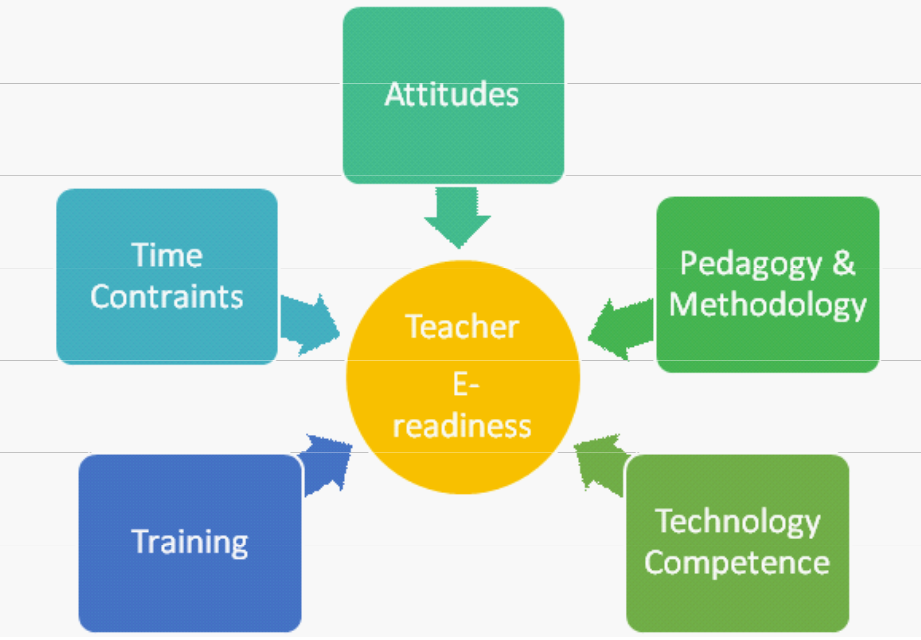
The conceptual framework for teacher e-readiness is derived from the findings of this critical literature review. The research studies show that the key factors influencing teacher readiness for elearning include attitude, technology competency, pedagogy, training, and time constraint (Figure 1).
Figure 1: Factors Influencing Teacher E-readiness
Envisioning the Context of Ho Chi Minh City Open University through the Framework of Factors Influencing Teacher E-readiness
Ho Chi Minh City Open University is going to launch their online programs after several years of preparation. The school has developed learning content and modern infrastructure; however, there has not much investment in preparing their lecturer’s readiness for teaching online. Hence, this critical literature review helps provide a general picture of what should be considered and done for the preparing process. The newly conducted framework based on the findings of this paper is, therefore, a good lens for the authors to re-envision the status of the school in getting ready before starting a new teaching format.
Currently, there are about 400 lecturers who graduated with master or doctoral degrees from national institutions or abroad. Although the school has used Moodle--an open source learning management system-- for more than ten years, its main function was to provide forums for students to post their questions. The number of lecturers and students using the system was very limited because there was no learning activities or learning programs operated in the system. Thus, teaching on Moodle appears to be a new concept to most of the lecturers at Ho Chi Minh City Open University. Since the administrators of the school began to prepare for online programs which will be mainly carried on a Learning Management System powered by Moodle, they predicted that there is a lot to do to prepare the lecturers to work in a new teaching delivery format. One of the most important factors to take into account is the attitudes of the lecturers who are going to teach online.
Attitudes
According to Ncube, Dube and Ngulube (2014), elearning can assist the university to advance its academic goals but it is important to note that these goals may be influenced by the lecturers’ attitudes toward elearning (p. 357). It was found that positive attitudes have strong impacts on the success of the adoption of elearning in higher education institutions (Table 1). Reflecting on the attitudes of the lecturers of HCMC Open University, it is subjective to affirm whether they are positive or negative about the implementation of elearning and teaching online programs because there have not had any research studies conducted on this topic at the school. Understanding lecturers’ attitudes will be useful for the school administrators to have strategic plans to support and motivate them to participate in the adoption of elearning with willingness. Within this paper, we would recommend that HCMCOU administrators should encourage more research on exploring the attitudes of lecturers before, during and after online course delivery.
Pedagogy and Methodology
“Readiness in terms of instructional strategies or pedagogy has to do with the knowledge, skills, attitudes, and habits of instructors to use the appropriate strategies acquired through normal face-to-face classroom interaction to accommodate the elearning “classroom” and learners” (Eslaminejad, Masood &Ngah, 2010, p.e406). The term “pedagogical knowledge” refers to the ability to design appropriate learning experiences and good at selecting instructional media and delivery methods, management of small/large group discussion, and internet interaction (Gagne et al., 2005, as cited in Eslaminejad, Masood &Ngah, 2010). Those learning activities must be designed for the web and available through the Internet. These could not be achieved unless the teachers forming good habits with discipline.
Issues of methodology were identified as a major challenge affecting the success or otherwise of elearning. Most researchers emphasized that design, delivery and pedagogy challenges are crucial and traditional approaches cannot be assumed to transfer to the elearning environment. As the original design idea in Ho Chi Minh City Open University is personal and essentially connected with individuals, design education focuses on strong collaboration between teacher and student as well as among peers. Therefore, in order to be like a traditional classroom based activities such as lectures that have been practiced in many other disciplines, online education has to call for a wide array of instructional methods such as problem-based learning, project-based learning, inquiry- based learning, scenario-based learning, etc. The teacher’s role has to shift from the lecturers to instructors or facilitators of the online classes and have to maximize the role of the learners. Learners need to be the center of the learning process and can express themselves in online learning. This educational philosophy fits into HCMC Open University’s academic goals as the leaders and the curriculum designers always have the learners as the locus of their teaching and training programs. The school aims at providing the learners with practical skills and profound knowledge based on the theory of learning by doing. The process of transferring these educational goals from face-to-face to online environment requires the lecturers of the school to be well prepared for the paradigm shift. Beyond the knowledge and skills vital for online teaching, online instructors should teach with care, love and passion.
Technology Competence
Ho Chi Minh City Open University (HCMCOU) acknowledges that for the instructors to be good facilitators for online learning, they must have the technological skills and competencies of basic computer operation and technical issues relating to internet usage, such as web searching and conferencing and managing a learning management system. Therefore, there has been early efforts to computerize the administration procedures and course management system at HCMCOU. So far, there have been certain positive outcomes such as network and programs have been deployed. However, most of these systems are underdeveloped. Moreover, many teachers who do not consider themselves to be well skilled in using Information and Communication Technology (ICT) feel that technologies are not helpful in their teaching and personal work. According to Le et al. (2014), the level of ICT skills and knowledge of the key participants differed significantly in a large institution line HCMCOU. Young scholars, having grown up with ICT, had an advantage but it could take time for the older generations to get used to the new ICT and LMS.
Apart from the advantages that the existing system brought to HCMCOU, there were many drawbacks that needed to be taken into account. Firstly, there was still insufficient understanding about eLearning and ICT among three important players: manager, lecturers, and students. This was mainly because the current course management system did not apply those in their activities. In 2016, HCMCOU has tried to change the culture by using the modern technology in daily activities. This change started with the training which includes training I basic skills in using technology – Google Apps as well as training in the integration of those technologies into interactive and effective teaching. However, the training still does not have an efficient result.
Training
One of the important mission of Ho Chi Minh City Open University is the support to instructors about applying innovative technology in their effective teaching. Therefore, the University has handled many ICT training courses. However, those trainings have not brought effective results as expected. The reason is that the content is not focusing on how to apply those skill in online class. Moreover, providing pedagogical training for teachers, rather than simply training them to use ICT tools, is an important issue. Nevertheless, the University lacks pedagogical training for instructors. This leads after instructors have attended professional development courses in ICT they still do not know how to use ICT in their class. They explained that this is because the course only focuses on instructors acquiring basic ICT skills and do not often teach instructors how to develop the pedagogical aspects of ICT. Therefore, when there are new tools ad approaches to teaching, instructor training is essential in both ICT and pedagogical skills if they are to integrate these into their teaching.
Time Constraint
Koo (2008) supposed that time constraint could be a major impediment to affect the teachers’ perceived readiness for online collaborative learning. Some teachers expressed that they were too busy with their classroom and school administrative works (Lim & Hwa, 2007; Koh, 2004, as cited in Koo, 2008). This could be problematic for HCMCOU lecturers when adopting online education. The lecturers have been used to teaching face-to-face classrooms for both mainstream and distance education. Besides a certain number of periods they are required to teach each year, the lecturers at HCMCOU are assigned other tasks such as designing and developing learning materials, doing research and other administrative work. The workload seems to be high and might make the lecturers feel overwhelming. Hence the school leaders issued a more flexible policy for the lectures in which they can choose whether to do research or designing learning materials or designing and teaching online
Conclusions
The results of the selected research papers in this critical review show that there are many factors influencing teacher readiness for elearning. A conceptual framework for preparing teachers for e-readiness was built based on the findings of these research studies. The key elements of the framework are factors discovered in the literature review, including attitudes, technology competence, pedagogy and methodology, training, and time constraint. Understanding these factors and having strategic implementation plans will help higher education institutions to succeed in adopting elearning “without having to spend the cost, effort, and time” more than necessary (Rohayani, Kurniabudi, &Sharipuddin, 2015).
Recommendations
As the purpose of this study is to find out what to do to prepare teachers for e-readiness so that we could suggest solutions regarding this aspect for Ho Chi Minh City Open University before launching their elearning programs. Research on the application of these factors as readiness assessment should be conducted at the school firstly for identifying the level of readiness of the teachers in particular and the school in general and then designing appropriate training courses for the lecturers. The training courses could be about online teaching pedagogy and methodology, technical skills, or seminars presenting online teaching experiences.
References
Abhijit B. V., &Duflo, E. (2014). (Dis)organization and success in an economics MOOC. American Economic Review, 104(5), 514-518.
Alabdullaziz, F., Alanazy, M. M., Alyahya, S., & Gall, J. E. (n.d.).Instructors’ and learners’ attitudes toward e-learning within a college of education.34th annual, 3.
Al-alak, B. A., &Alnawas, I. A. (2011). Measuring the acceptance and adoption of e-learning by academic staff. Knowledge Management & E-Learning: An International Journal (KM&EL), 3(2), 201-221.
Allen, I. E., & Seaman, J. (2013). Changing course: Ten years of tracking online education in the United States. Sloan Consortium. PO Box 1238, Newburyport, MA 01950.
Allen, I. E., & Seaman, J. (2015). Grade level: Tracking online education in the United States.Babson Park, MA: Babson Survey Research Group.
Azimi, H. M. (2013). Readiness for implementation of e-learning in colleges of education. Journal of Novel Applied Sciences, 2(12), 769-775.
Borotis, S. and Poulymenakou, A. (2004). e-Learning Readiness Components: Key Issues to Consider Before Adopting e-Learning Interventions. Retrieved from http://www.eltrun.gr/ papers/eLReadiness_ELEARN2004.pdf
Darab, B., &Montazer, G. A. (2011). An eclectic model for assessing e-learning readiness in the Iranian universities. Computers & Education,56(3), 900-910.
Duong, G.V. (2013). The biggest challenge in teaching is emotion. Retrieved from http://vietnamnet. vn/vn/giao-duc/138576/thach-thuc-lon-nhat-la-cam-xuc-trong-qua-trinh-day-va-hoc.html
Easton, S. S. (2003). Clarifying the instructor’s role in online distance learning. Communication Education, 52(2), 87-105.
Edudemic (2012). 8 countries leading the way in online education. Retrieved from http://monitor. icef.com/2012/06/8-countries-leading-the-way-in-online-education/
Eslaminejad, T., Masood, M., &Ngah, N. A. (2010). Assessment of instructors’ readiness for implementing e-learning in continuing medical education in Iran. Medical Teacher, 32(10), e407-e412.
Hung, N. M. (2014). Using ideas from connectivism for designing new learning models in Vietnam. International Journal of Information and Education Technology, 4(1).
ICT Center for Education MOET Vietnam. (2015). Vietnam higher education: Reform for the nation’s development. Retrieved from http://www.unescobkk.org/fileadmin/user_upload/apeid/ workshops/macao08/papers/3-p-7-4.pdf
Kaur, K. and Abas, Z. (2004). An assessment of e-learning readiness at the Open University Malaysia. Paper presented at the International Conference on Computers in Education (ICCE2004), Melbourne, Australia.
Koo, A. C. (2008). Factors affecting teachers’ perceived readiness for online collaborative learning: A case study in Malaysia. Educational Technology & Society, 11(1), 266-278.
Krause, S., & Lowe, C. (2014). Invasion of the MOOCs: The promise and perils of massive open online courses. Parlor Press: South Carolina. Retrieved from http://www.parlorpress.com/ pdf/invasion_of_the_moocs.pdf
Krishnakumar, R., & Rajesh, K. M. (2011). Attitude of teachers’ of higher education towards e-learning. Journal of Education and Practice, 2(4).
Le, H. K., Sriratanaviriyakul, N., Nkhoma, M., & Vo, H. X. (n.d.). Ho Chi Minh City Open University: IT governance in Vietnamese higher education.Journal of Information Technology Education: Discussion Case, 3(3).
Mukminin, A., &Hidayat, M. (2013). Teaching in a digital era: English lecturers’ readiness toward the internet use in teaching and learning at selected higher education institutions in Indonesia. Asia-Pacific Collaborative Education Journal, 9(2), 113-124.
Ncube, S., Dube, L., &Ngulube, P. (2014). E-learning readiness among academic staff in the Department of Information Science at the University of South Africa. Mediterranean Journal of Social Sciences, 5(16), 357.
Nguyen, H. (2014).Vietnam education and elearning trends. Retrieved from http://dantri.com.vn/ suc-manh-so/giao-duc-viet-nam-va-xu-huong-e-learning-1407947936.htm
Palloff, R. M., & Pratt, K. (2000). Making the transition: Helping teachers to teach online.Retrieved from http://www. educause. edu/asp/doclib/abstract. asp? ID= EDU0006.html
Penna, M. P., Stara, V., & De Rose, M. (2009). The failure of e-learning: why should we use a learner centred design. Journal of e-Learning and Knowledge Society, 3(2).
Roby, T., Ashe, S., Singh, N., & Clark, C. (2013). Shaping the online experience: How administrators can influence student and instructor perceptions through policy and practice. The Internet and Higher Education, 17, 29-37.
Rohayani, A. H. (2015). A literature review: Readiness factors to measuring e-learning readiness in higher education. Procedia Computer Science, 59, 230-234.
Sadik, A. (2007). The readiness of faculty members to develop and implement e-learning: The case of an Egyptian university. International Journal on ELearning, 6(3), 433.
Shattuck, K. (Ed.). (2014). Assuring quality in online education: practices and processes at the teaching, resource, and program levels. Stylus Publishing, LLC.
Shraim, K. (2012). Moving towards e-learning paradigm: Readiness of higher education instructors in Palestine. International Journal on E-Learning, 11(4), 441-463.
Simonson, M., Smaldino, S., &Zvacek, S. M. (Eds.). (2014). Teaching and learning at a distance: Foundations of distance education. IAP.
West, R. E., Waddoups, G., & Graham, C. R. (2007). Understanding the experiences of instructors as they adopt a course management system. Educational Technology Research and Development, 55(1), 1-26.
Yiong, B. L. C., Sam, H. K., &Wah, T. K. (2008). Acceptance of e-learning among distance learners: A Malaysian perspective. In Proceedings: Ascilite Conference.
Yuan, L., Powell, S., & CETIS, J. (2013). MOOCs and open education: Implications for higher education.
Footnotes
* ^ The original version of this paper was presented at the 30th Annual Conference of the Asian Association of Open
Universities held at Crowne Plaza Manila Galleria, Manila, Philippines on 27 October 2016.
International Journal on Open and Distance e-Learning, Vol. 3 No. 1, June 2017 Issue